The Elimination Project, Part 8. Looking back at the seven articles and the one practice that turns out to matter more than any single elimination.
If you haven’t read Part 1, start there. The whole series rests on knowing what your work is supposed to move.
You made it! Hopefully if you’re reading this, it means that you have read the other seven pieces. These seven conversations about routine work that’s been quietly burning your hours and how to actually get rid of it. We’ve talked about meetings and email, subscriptions and status reports, approval chains and the deeper question of ownership underneath all of them.
This is the last article and I want to end it the way every good series should end… not with a tidy summary, but with a look at what the project hopefully revealed, what I got wrong, the objections I expect to hear, and the one practice that turns out to matter more than any single elimination you made.
If you’ve been following along and doing the work, auditing your meetings, sorting your inbox, killing the dead reports, simplifying the approval chains, today, I’ll hopefully tie it all together. If you haven’t done any of the work yet, this might be the piece that finally gets you started
The Pattern That Surprised Me
When I started this series, I thought I was writing about productivity. Each piece was supposed to identify a category of low-value work and propose getting rid of it. It was meant to save hours, recover capacity, and free people up to do the real work.
By the time I got to Part 5 on status reports, the pattern had shifted on me. The status report problem turned out not to be a reporting problem. It was actually a goals problem. The reports were activity logs because nobody had said clearly what outcomes the team was trying to move. Cancelling the reports without fixing the goals would just produce a quieter team that was still uncertain what it was trying to do.
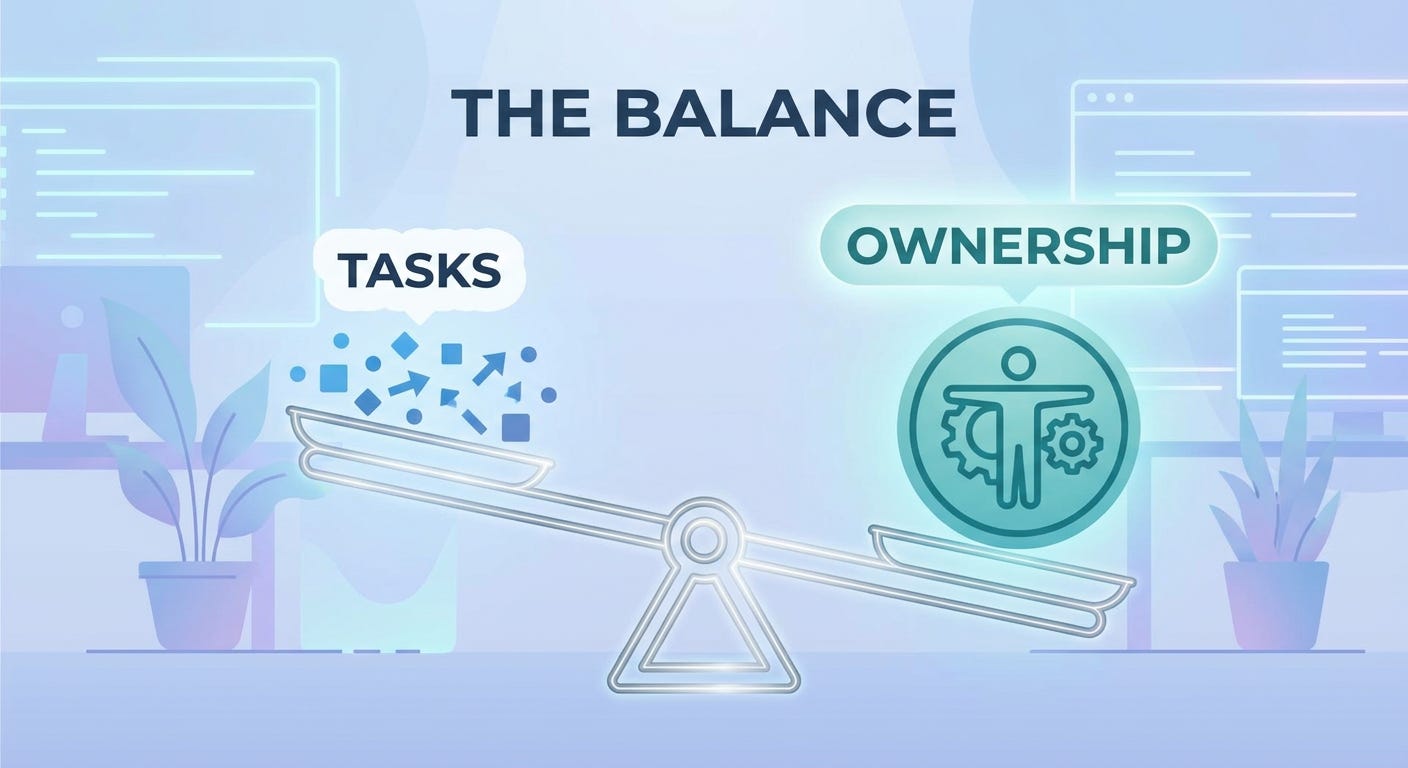
By Part 6 on approval chains, the same pattern showed up again. The approval problem wasn’t really an approval problem. It was an ownership problem. The chains existed because nobody had told the team what was theirs to decide. Streamlining the approval chain only creates a temporary relief, but the approval chain will eventually grow back.
Part 7 finally said the thing out loud. Every elimination in this series traces back to the same root. The team was never told clearly what was theirs.
I did flag this in Part 1, briefly, in the section on watching for the pattern. but the truth is, I didn’t fully see it then. I saw the shape of it, but I didn’t see how completely the entire series would converge on it. I expected each piece to be a separate elimination with separate logic. By the end, they were all the same elimination, applied to different surfaces.
The Elimination Project ended up being less about cutting work and more about exposing the unclarity that all the work was hiding. The meetings, the reports, the approvals were the visible artifacts of a question nobody had answered. What does this team actually own?
If you walk through your work with that question in mind, you’ll see it everywhere. Most of the routine work compensates for ambiguity. Make the ambiguity go away, and most of the work was never necessary. I knew the destination as I was writing. I didn’t know how completely it would dominate the territory.
What I Got Wrong
A few things I want to come back and correct.
I underestimated how hard this is.
In Part 6, I named that approval chains are tied to power, which is true. What I didn’t say clearly enough is that every elimination in this series threatens someone’s authority, identity, or comfort.
Status reports threaten the writer’s sense that they accomplished the week. Recurring meetings threaten the organizer’s relevance. Subscription emails threaten the senders. Email CCs threaten the people who use the CC field as a credential. Cutting work is never just a productivity decision. It’s a political decision. I may have been too optimistic about that in the early pieces.
I overestimated how much AI changes this.
I wrote, repeatedly, that AI lowers the cost of the alternative. AI is making elimination cheap. That’s true at the mechanics level. AI can summarize, automate, screen, and draft. What AI does not do is make the elimination politically easier. The decision to cut, to upset the routine, to challenge another leader who likes the recurring meeting… that’s still a human decision.
As much as I wish it would, AI doesn’t do that for me. The series sometimes implied that the AI era would naturally produce the eliminations. It won’t. AI just removes one of the barriers, but the other barriers are still in the human chair. If we don’t fix the core of the problem, AI can actually exacerbate the problem.
I implied this is faster than it is.
Most of the takeaways at the end of each piece said “do this in 30 minutes” or “act on this this week.” Some of the eliminations actually do work that fast. The subscription audit is 30 minutes. Killing one meeting can happen in a day. But the deeper work, writing the document, having the empowerment conversation, restructuring how a team operates… these may takes months.
I leaned too hard on the leader.
Many of the takeaways assume the reader has the authority to act unilaterally. Let’s face it… most of us don’t. You may sit in the middle of an organization. If so, you can audit your own work, but you can’t streamline the approval chain that flows through three peers and a senior leader. The article should have spent more time on what the middle-out version of this looks like, where you aren’t trying to fix the system but trying to operate inside it as cleanly as you can. More on that below.
These are the things I wish I’d said more clearly the first time. Let me try to clean those up in this final article.
“Don’t Copy Phil On That”
I want to expand on a story I touched on briefly in Part 6. It turned out to be one of the most important things I learned in my own work, long before this series existed.
When I first joined a regional leadership team many years ago, I was visiting with one of the guys who had been on the team for years. He was helping me learn the ropes. We were talking through a decision I was making, and I mentioned that I was going to copy our boss on the email when I sent it. His response stopped me cold.
“Don’t copy Phil on that. His email box is loaded as it is. You have been empowered to make the decision. You made the decision. Just mention it to Phil the next time you guys are talking. No reason to add him to yet another email chain that will create several more messages in his inbox.”
That advice has stuck with me ever since. It captures something the entire Elimination Project has been circling.
The mentor wasn’t just teaching me email etiquette. He was teaching me what empowerment actually feels like in practice. I had been told the decision was mine. The act of CCing the boss would have been a small reversal of that. I was quietly returning the decision back upward, hedging my own authority, asking for a kind of post-hoc permission I’d already been given.
Worse, it would have consumed Phil’s attention. Each unnecessary CC is a small hemorrhage of focus. Multiplied across the dozens of people who default CC their boss out of caution or habit, the senior leader’s inbox becomes unworkable. Phil can’t do the work only Phil can do, because Phil is sorting through emails about decisions that weren’t his to make.
The two-pizza rule from Part 2 was about meetings. The same rule applies to email. If you can’t name what every person on the CC line is going to do with the information, take them off. If they’re there to be informed, send them a summary later. If they’re there to feel included, that isn’t a reason. If they’re there because the sender doesn’t have the courage to own the decision alone, the cure isn’t the CC. The cure is the courage.
The same rule applies to reply-all. The “thanks” reply that goes to fifteen people. The acknowledgment that adds nothing but consumes everyone’s attention briefly. If the email was informational, file it or delete it. The thank-you reply isn’t gratitude. It’s reflex. Some of you feelers may argue with me, but it really doesn’t add anything other than one more email.
If you want a single rule that captures most of this series, it’s the two-pizza rule, generalized. Get the right people in the room.. and not one more. Whether the room is a physical meeting, a virtual meeting, an email thread, an approval chain, or a project team. The discipline is the same. Identify the people who are actually going to contribute. Exclude everyone else. Protect their attention as if it were the most expensive resource in the organization, because it is.
Phil’s attention was that resource. My mentor was protecting it on his behalf. That’s what good colleagues do. That’s what good leaders do. That’s what the Elimination Project, at its core, has been arguing for.

The Four Objections I Expect
Over the past week, some of you have reached out to me privately. Four objections or challenges have come up.
The biggest objection: “I can’t do this. The system above me won’t let me.”
This is real. If you aren’t at the top of the chain you want to cut, you don’t have the ability to cut it. What you can do is operate inside the chain as cleanly as possible. That means, never cc unnecessarily, never reply-all when private will do, decline meetings that fail your own private needle test, and write decision documents that pre-empt the meeting your team would have otherwise demanded. The middle-out version of this work is real. It’s slower than the top-down version, but it compounds. If enough people in the middle of an organization start operating this way, the eliminations spread upward.
The second objection: “I tried this and people pushed back hard.”
Also real. Cutting a meeting that someone else found valuable. Cancelling a report that someone else was expecting. Removing a CC that someone else interpreted as a slight. The pushback is part of the work. The series didn’t give enough attention to how to handle this pushback. The short answer is this. Don’t back down on the substance. It’s always good to soften the delivery and apologize for the awkwardness. but hold the line on the cut. If you reverse every elimination at the first sign of friction, you’ll end up exactly where you started.
The third objection: “I’ll do the audit and be horrified by what I find.”
Yep. That’s almost certainly going to be the case. It was for me. The audit step is the hardest part, not because the audit is hard to do, but because the results are so depressing.
Eighty percent of my email is junk. Sixty percent of my recurring meetings haven’t produced a decision in months (years). The status report I’ve been writing for two years is read by nobody.
That horror is the point. It’s the data that motivates the cuts. Sit with it. The discomfort is the doorway.
The fourth objection, “What if I’m wrong?”
What if the meetings are doing something I can’t see? What if the reports are valuable to people who don’t write back to say so? What if the approval chains are actually catching something? Fair questions, but the answer is that the cost of unnecessary work is invisible (we’ve absorbed it as background) while the cost of cutting work is loud (someone complains). This asymmetry is why organizations accumulate work and never shed it. The bias has to be intentionally reversed.
Cut, see what breaks, replace what genuinely needed to exist, leave the rest cut. The instances where I’ve been wrong about cutting something have been small and recoverable. The instances where I’ve been wrong about keeping something have been large and invisible. The number of times I have kept something that needed to be cut far exceeds the times I cut something that I shouldn’t have cut. I’ll take the recoverable mistake every time
.
The Practice That Matters Most
If you only do one of the things that I discuss in this series, do the audit.
The discipline of stopping, on a regular cadence, and looking honestly at the work. Where is your time actually going? What recurring artifacts are you producing? Who is actually reading them? What standing meetings have you been attending out of habit? What CCs are you adding reflexively? What approvals are you routing because you aren’t sure if they’re yours to make?
The audit doesn’t require an organizational mandate. It doesn’t require permission. It doesn’t require the political authority to cut anything yet. It simply requires the willingness to look.
Once you look, the cuts get easier. The audit makes the invisible visible. You can’t eliminate what you can’t see, and most of the routine work in your life has become invisible from sheer familiarity.
So if you do nothing else, set a recurring time on your calendar for the audit. On a quarterly basis, walk through your calendar, your inbox, and your recurring outputs. Apply the needle test. What is this for? Is it moving anything? If it disappeared, what would actually change?
Do that four times a year, and you’ll be cutting a quarter of the work you accumulate every cycle. That compounds into a fundamentally a different perspective on work

Where to Start
If you’re reading this and you haven’t done any of the work in the previous seven pieces, here’s the order to attack it. The series itself is in this order, but if you want to do the work efficiently, here’s the practical sequence:
Start with subscription decay. The Part 3 piece. Sort your deleted folder by sender. Spend 30 minutes unsubscribing. You’ll feel the win immediately. The momentum from this single elimination is what makes the harder ones possible.
Then audit your inbox. Part 4. Sort the last 30 days by category. The breakdown will tell you something about your work that you didn’t know.
Then audit your calendar. Part 2. Run one recurring meeting through the meeting test. Cut it if it fails. Just one.
Then run the harder audits. Status reports (Part 5). Approval chains (Part 6). The structural questions about ownership (Part 7).
The first three are individual practices. The last three are organizational practices. Build the muscle on the individual side before you take on the organizational side. You’ll be more credible when you do, because you’ll be able to point to your own changes as evidence rather than as theory.

One Take-away
Today, do exactly this one thing.
Pick one part of this series that you haven’t yet acted on. Not the easiest one. Pick the one that you’ve been quietly avoiding because you knew it would expose something. The recurring meeting you haven’t killed. The approval chain you haven’t questioned. The status report you haven’t paused. The conversation about ownership you haven’t had with your team. Do that one thing.
Tell me what happened. Tell me what got cut. Tell me what surprised you. Sharing with others will not only keep you accountable, but it will encourage others.
The Elimination Project doesn’t end with this piece. The series ends, but the practice doesn’t. The discipline is permanent.
We don’t need fewer approvals. We need clearer ownership.
We don’t need better tools. We need better questions.
We don’t need to add more. We need to remove what we should have removed years ago.
Justify everything you keep.
Eliminate everything else.
That’s the whole Elimination Project.
Thanks for reading AI, Innovation, and Faith! This concludes The Elimination Project. The full series: Part 1 (the manifesto), Part 2 (meetings), Part 3 (subscription decay), Part 4 (email), Part 5 (status reports), Part 6 (approval chains), Part 7 (we don’t need fewer approvals), and this final piece. The Meeting Test tool is free and lives at meetings.donbarger.com.