


The Elimination Project, Part 1. Before we cut anything, we have to answer the harder question. What is your work supposed to move? If you cannot answer that, eliminating the busy will not save you. It will just give you more time to be busy at nothing.
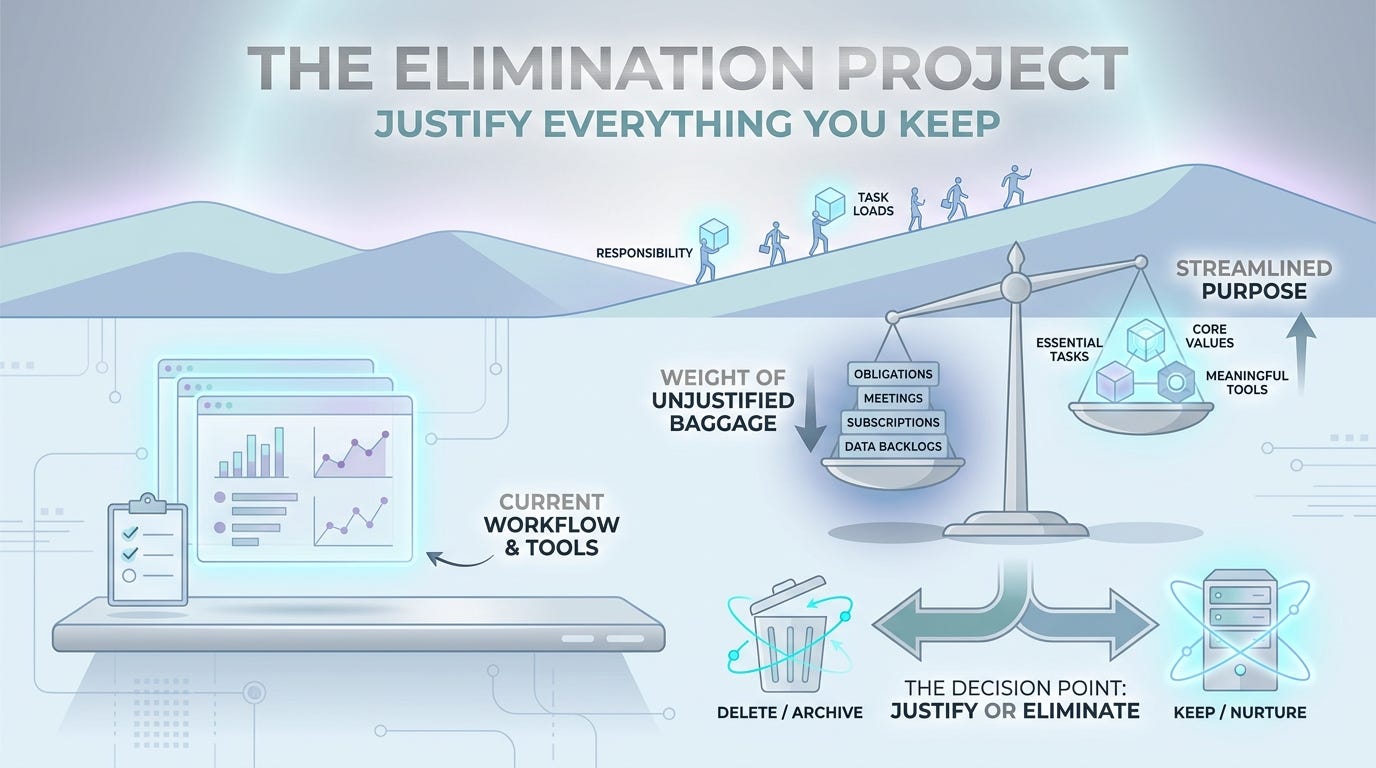
Today, I want to start a new project with you. Over the past few months, I’ve had a series of posts dealing with the AI Driven Organization and another on setting up Claude. Today, I begin a series on getting rid of your work clutter.
I am calling this series, “The Elimination Project” and it’s going to run for several posts. The premise is simple, but I already know that this one is going to make some of you uncomfortable.
Most of the productivity advice we get is about adding. Add this tool. Add this practice. Add this meeting. Add this dashboard. Add this AI assistant. Add this framework. Add this metric. Add… Add… Add…
The really smart ledaers aren’t focused on adding anything. They are focused on removing. Removing meetings. Removing email. Removing status reports nobody reads. Removing the small daily friction that consumes the day a quarter-hour at a time. Removing the assumption that every question requires another human to answer it. Did I mention removing meetings?
The Workload Elimination Audit is something I have been working on for a couple of years. The core principle is brutal.
Justify everything you keep.
Not “what should we cut?” That is the polite version of the question, and politeness is exactly why nothing gets cut. Flip the tables on the question. The better question is the inverse. Justify why every meeting on your calendar still belongs there. Justify why every recurring email is still being sent. Justify why every report is still being written. Justify why every approval chain is still seven people long. Justify why you are still the person who has to answer questions a tool could have answered.
If you cannot justify it, eliminate it. Oh, if life were just that simple!
In this series, I’m going to walk you through specific categories of work that are quietly burning your team’s hours, and how AI gives you the leverage to actually remove them. Not optimize them. Not streamline them. Not make them faster.
Remove them.
But before any of that works, we have to talk about something most productivity writing skips. If we do not get this right first, every elimination decision in the rest of the series will be arbitrary.
The Needle Question

Most leaders with cannot, on a moment’s notice, name what their work is supposed to move. What it is accomplishing. How what they are working on contributes to the overarching purpose or desired outcome of the organization.
I don’t say that to be harsh. I include myself in this indictment. There are weeks where I look at my calendar, my inbox, my open tabs, and I have a hard time answering the simplest question.
What are you actually trying to accomplish with all of this? Twelve hour work days and when you find an efficiency gain, you just do more, not less.
If the answer to what you’re trying to accomplish is hazy, the work that follows will be hazy. You will respond to emails. You will attend meetings. You will write reports. You will review documents. You will feel busy. At the end of the year, you will look back and wonder where the time went, because none of the activity was anchored to anything specific enough to add up.
This is the part of leadership that AI cannot fix and that no productivity tool will solve for you. The needle has to be set by a human. The KPI has to be chosen. The goal has to be specific. The measurement has to be real.
Before you eliminate anything, sit with three questions.
What is the one thing your team has to accomplish this quarter, that, if not accomplished, makes the rest of the work irrelevant?
How will you know you accomplished it? What is the actual measurement, not the activity proxy?
If a stranger looked at your last week of work, would they be able to identify what you were trying to move?
Those three questions are the prerequisite to elimination. Without them, you are just rearranging the busy. The Elimination Project does not work as a productivity hack. It only works as a clarifying tool. You decide what matters first. Then you cut everything that does not feed it.
If you cannot answer the questions above, do not worry about the eliminations yet. Spend an hour writing down the one or two needles your work is supposed to move this quarter. Until that exists, the rest of the elimination work is a dog and pony show.
I’m very serious about that. The single most common reason elimination programs fail in organizations is that the team has never actually agreed on what they are trying to accomplish. Without that, every cut feels arbitrary, every elimination feels like loss, change doesn’t feel productive, and the routine reasserts itself within a few months.
Activity Is Not Progress
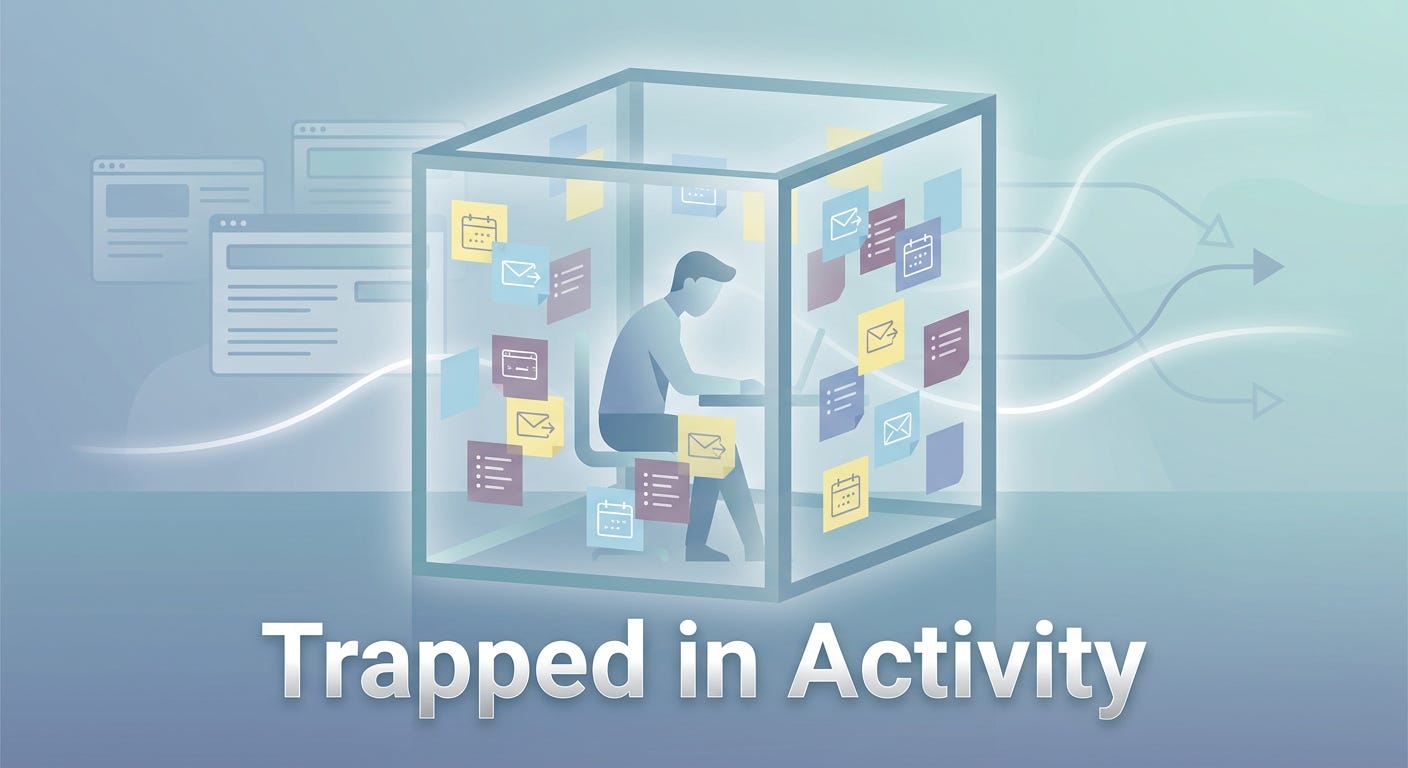
Here is the second thing worth sitting with before we go any further.
Most of us, most of the time, are measuring activity instead of outcomes. We track how many emails we sent, not whether the project moved. We track how many meetings we held, not whether the decisions improved. We track how many reports we produced, not whether anyone changed behavior because of them.
Activity is easy to measure. Outcome is hard to measure. So we drift. Over time, the activity becomes the goal. Sending the email becomes the win. Holding the meeting becomes the deliverable. Producing the report becomes the proof of work. Stop and ask yourself, “Why did I send the email? Why did we have the meeting?” What were you trying to accomplish
The good leadership move is to write down, in advance, what your KPIs actually are. Real measurements that connect to the needle, not activity proxies that make you feel productive.
If your needle is “expand reach to underserved populations,” your KPI is people reached or engagement quality, not emails sent or even dollars raised.
If your needle is “improve team capacity,” your KPI is output per person or time-to-deployment, not training sessions held. Then you need to have a way to measure output.
If your needle is “make better decisions,” your KPI is decision quality and speed over time, not meetings completed or decisions logged.
If you cannot find a real KPI behind an activity, the activity is probably not connected to anything. That is a candidate for elimination right there.
Activity that is not anchored to a measured outcome is, by default, on the chopping block.
That is the philosophical core of The Elimination Project. Everything else in the series is mechanics.
Watch for the Pattern

I want to flag something at the start of this series, because it is going to keep showing up and you will see it more clearly if I name it now.
Every elimination in the coming weeks is going to look, on the surface, like a tactical fix. Cancel the meeting. Cut the report. Streamline the approval. The advice will be practical, sometimes 30 minutes of work, sometimes a quarter of careful change management.
But underneath every one of those eliminations, the same root cause will keep surfacing. Did anyone ever clearly tell this team what was theirs to decide? What outcomes they were trying to move? What success looked like?
When the answer is no, the routine work multiplies. Meetings proliferate because nobody knows who can decide. Reports proliferate because nobody knows what to measure. Approvals proliferate because nobody knows what is theirs to authorize. The chains get longer and the calendars get fuller, not because the work got more complex, but because the unclarity got more expensive.
I didn’t know this was the through-line when I started planning this series. I thought I was writing about productivity. By the third or fourth elimination, the pattern became impossible to miss. The series ends up being less about cutting work and more about exposing the unclarity that all the work was hiding.
If you read each piece in the coming weeks with this question in mind, “What would have to be true for this category of work to be unnecessary?” You’ll see the pattern as it surfaces. Each piece is the visible artifact of an earlier failure to be specific about what the team owned.
We’ll keep coming back to this. Today’s work is the prerequisite. The needle, the KPIs, the outcome you can name. Without those, the rest of the series is theater.
Why This Is Hard
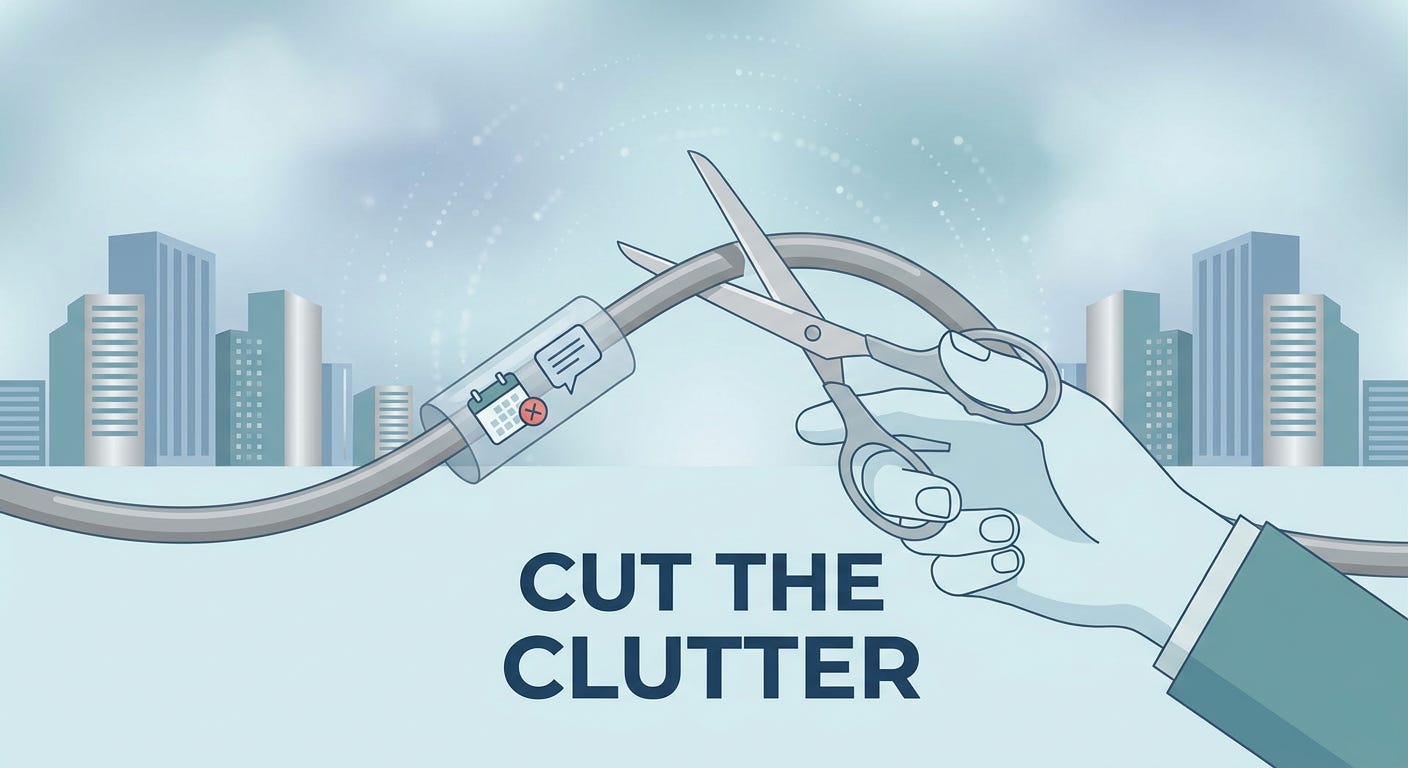
Eliminating work is much harder than adding work. Politically, organizationally, and psychologically. It’s hard. Organizations become bloated and that bloat… it begets more bloat. People do more, because they can do more. Never does anyone ask if we should be doing it.
Adding a meeting feels like progress. Removing one feels like you are not doing your job.
Adding a report makes leadership feel informed. Removing one makes them feel out of the loop, even if the new system gives them better information faster.
Adding an approval step feels responsible. Removing one feels like you are loosening controls.
Adding a new tool feels like investment. Removing one feels like loss… unless it’s Microsoft… then everyone’s for that.
This elimination bias is the entire reason organizations grow more bureaucratic over time. Leaders are incentivized to add. Almost no one is incentivized to remove. The work piles up, slowly, year after year, until the organization is spending most of its energy maintaining its own internal coordination cost rather than producing anything for the people it is supposed to serve.
Here’s some bad news. AI can’t fix this for you. AI just makes the cost of the elimination strategy much lower than it used to be. The summaries get written for free. The questions get answered for free. The synthesis gets done for free. The leader’s only remaining job is to choose to eliminate and that part is still a hard human choice.
This is the leadership work of the next two years. Not adopting AI. Using AI as the lever that finally lets you cut the work that should have been cut a decade ago.
What’s Coming in the Series
The rest of The Elimination Project is going to take this needle frame and apply it, one category at a time, to the routine work that consumes most leaders’ weeks.
Part 2: Meetings. The most expensive thing on your calendar. We will walk through a free tool I built (meetings.donbarger.com) that applies the needle test to any meeting before you send the invite.
Part 3: Subscription decay. The newsletters, automated reports, and notifications quietly consuming hours per week that you have never actually audited. Easiest win in the series.
Part 4: Email. Probably the largest unconsidered consumer of your attention. We will sort the inbox into five categories and attack them in order.
Part 5: Status reports. The work that exists because someone wanted visibility once and we have been writing them ever since.
Part 6: Approvals. The chains that pass through five people who all rubber-stamp the same thing.
Part 7: We don’t need fewer approvals. The structural critique underneath the entire series is the conversation most leaders never had with their teams.
Part 8: What the project actually taught. A big picture closing to the series. The pattern that surprised me, the things I got wrong, and the practice that turns out to matter most.
If you have a category of routine work in your organization that you suspect is wasting hours and not moving the needle, send it to me. I’ll try to write about it… or maybe I’ll eliminate it!
The Elimination Project isn’t a productivity hack. It is a discipline and the willingness to look at your calendar, your inbox, your routines, and ask the harder version of the question. Not “how do I do this faster?” but “should this exist at all?”
Not “how do I optimize this activity?” but “what needle is this activity supposed to move, and is it actually moving it?”
One Take-away
Before you read another piece in this series, do one thing.
Write down, in one sentence each, the two needles your work is supposed to move this quarter. Not the activity. The actual outcome. Then write down, in one sentence each, the KPI you are using to measure progress on each one.
If you cannot do this in two clear sentences each, that is your work for the week. Stop everything else until you have it.
This is not optional. This is the work that makes the rest of this series possible.
The Elimination Project is going to keep returning to this question. What needle is the work supposed to move? Every elimination decision in the coming weeks flows from that one. Without it, we are all just busy people, getting faster at being busy.
Justify everything you keep.
Eliminate everything else.
The needle is the only thing that decides which is which.
Thanks for reading AI, Innovation, and Faith! This piece launches The Elimination Project — an eight-part series on the routine work AI lets us finally cut. Part 2 (meetings) drops next.