


We need clearer ownership. The approval chain isn’t the disease. It’s the symptom of something many people ignore. Until that conversation happens, every approval you streamline will quietly grow back.
If you haven’t read Part 1, start there. The whole series rests on knowing what your work is supposed to move.
Yesterday’s piece (The TSA of your Organization) walked through the mechanics of approval chains. Three failure modes. The latency math and specific eliminations you can act on today. Yesterday was the operational half of the argument.
Today I want to deal with the other half… it’s the part that actually matters.
The operational fixes from my last post won’t last without fixing the root of the problem. You can streamline an approval chain on Tuesday and watch it grow back to its original length within a year. The reason is that you fixed the symptom, not the disease.
The Conversation We Avoid
Let me walk you through a conversation that should happen in every organization, every team, and in every reporting relationship. In most organizations, this is rarely discussed. A leader sits down with a team — a department, a function, a project group. The leader says something like this.
Here’s what I want this team to accomplish over the next year. Here are the outcomes that would make this work successful. Here’s how we’ll measure progress. Here’s what is yours to decide. Here’s what is mine. Here’s what is bigger than both of us, and goes back up the chain.
Then the leader says the harder part.
Within the scope I just described, you don’t need my approval. I don’t want you waiting on me. I don’t want you escalating decisions that fall inside what we just agreed. If you’re inside the scope, decide. If you’re outside the scope, come back to me. The line is here. Don’t blur it. You are empowered to do what needs to be done to reach the desired outcomes.
That conversation, written down and signed off by everyone above the team, would eliminate most of the approvals you’ve been routing through five-person chains. That conversation, in most organizations, never happens.
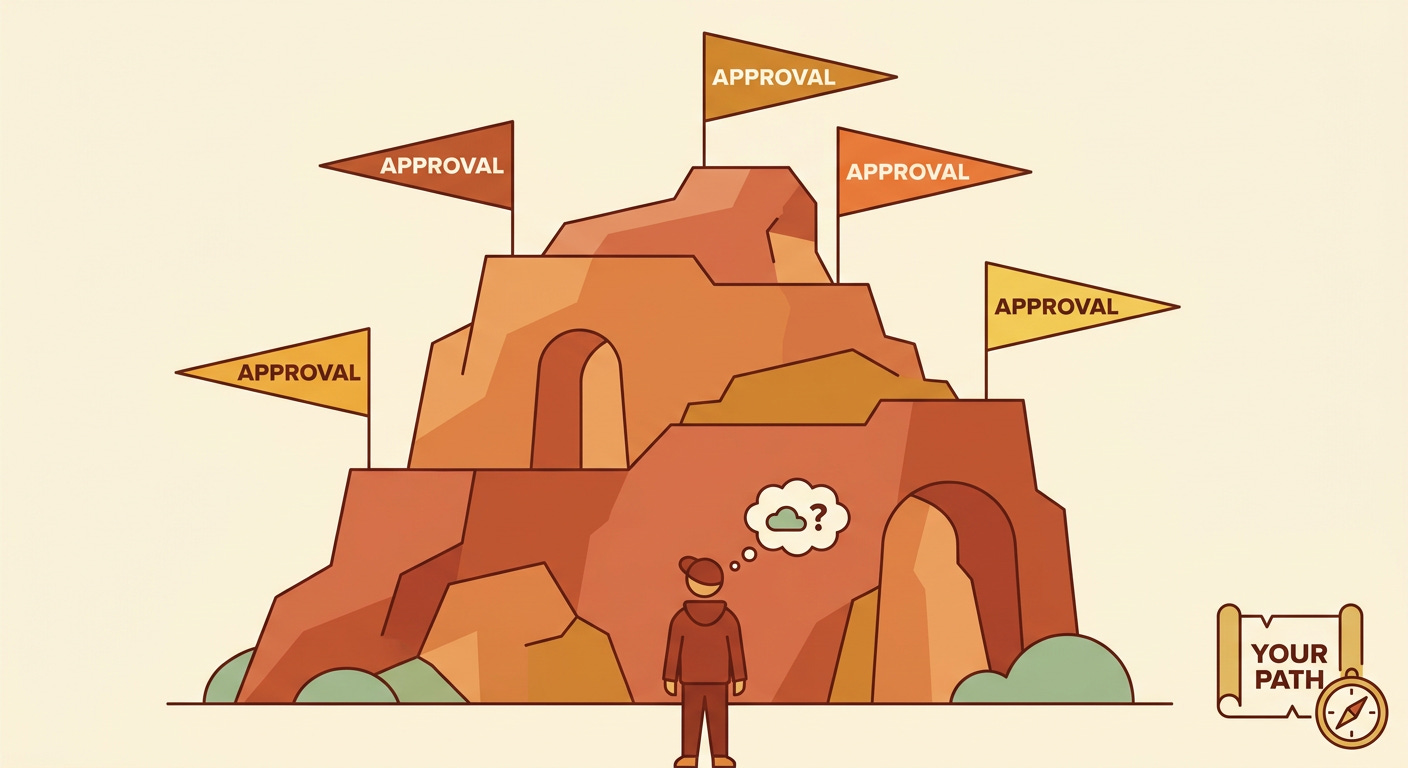
What happens instead is fragmented. The team is given a budget, a title, a reporting structure, and maybe even a project name. They’re implicitly told what’s expected of them, and implicitly trusted to figure it out, and implicitly expected to know when to escalate. None of it is written down. None of it is signed off. None of it is durable. At any point, someone outside of the team can step in and grind progress to a halt.
The result is predictable. The team is uncertain about what they own. They escalate things they should have decided. The leader, busy with their own work, sends those escalations back down without thinking carefully about the pattern. The team escalates the next one too. The leader sets up an approval to “make sure things are coordinated.” The approval chain is born.
Two years later, that approval has grown to five or ten people. Each one was added in response to a specific incident or anxiety. None of them remembers why the chain originally existed. Everyone is rubber-stamping. The team has forgotten that any of these decisions used to be theirs.
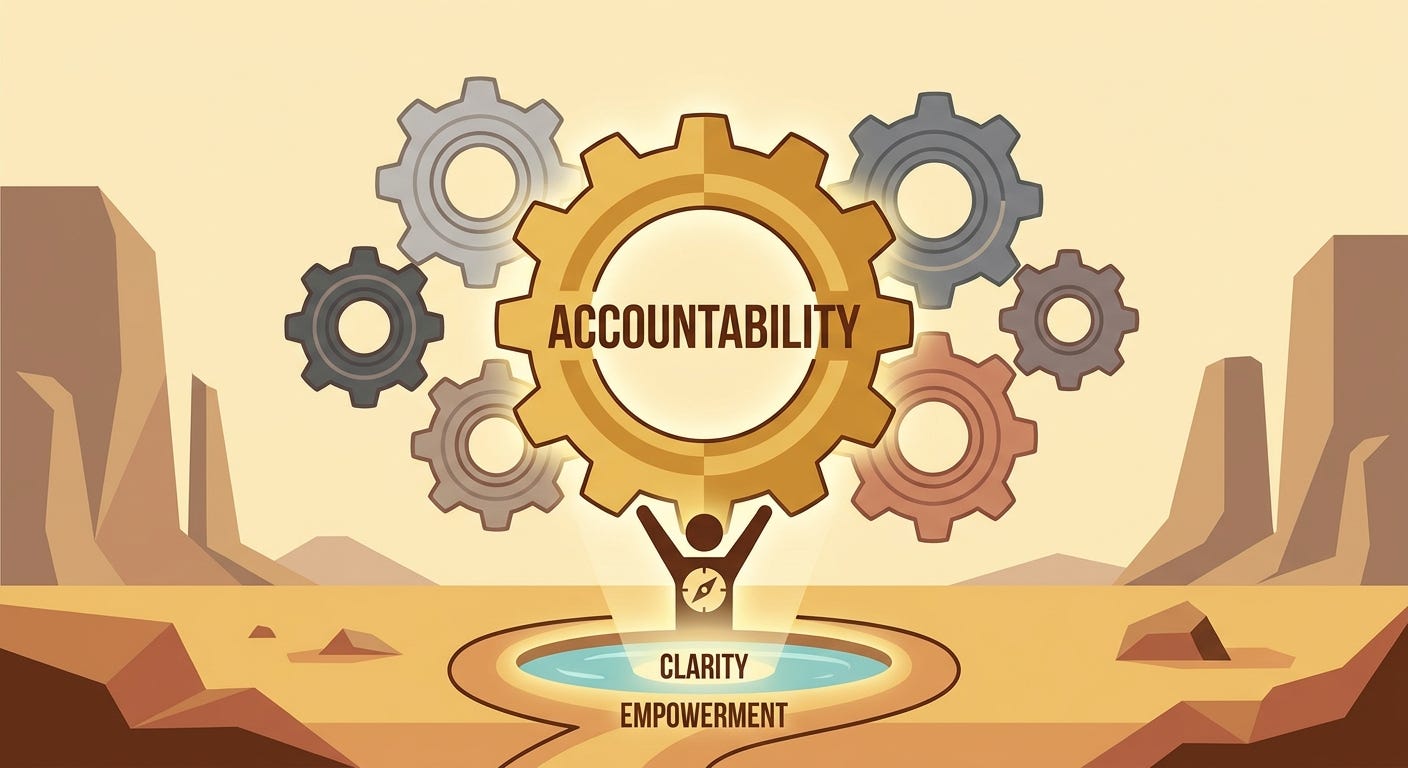
You didn’t need fewer approvals. You needed the original conversation. You needed empowerment.
The Symptom and the Disease
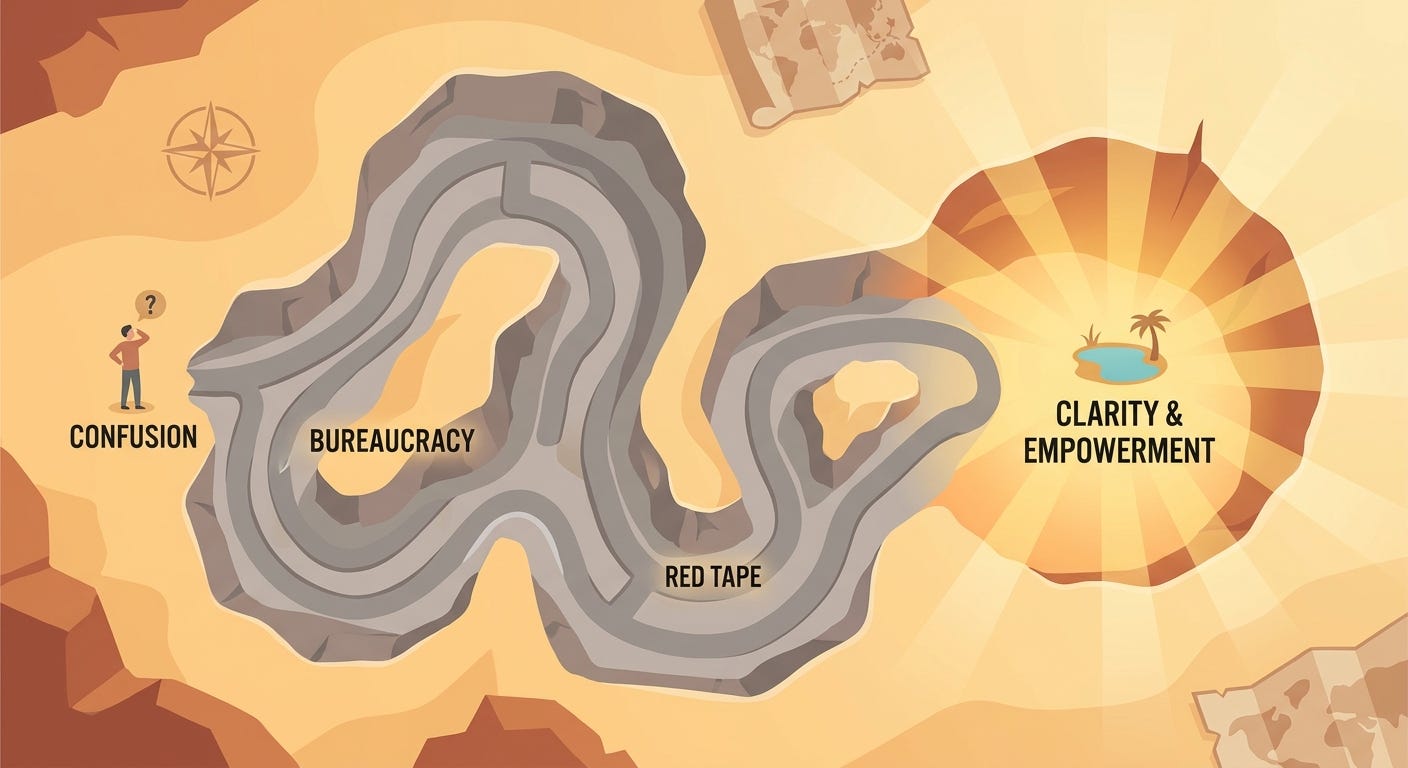
Approval chains are the visible symptom. They sit on top of the actual problem like a fever sits on top of an infection. You can take the fever down with aspirin, that’s what Part 6 was about. but if you don’t address the infection, the fever comes back.
The infection is the absence of clarity about what the team owns.
This pattern shows up in three predictable places. Watch for them.
The escalation reflex.
Team members, when uncertain, default to escalating. The first time it happens, a manager might think it’s a one-off. The third time, the manager realizes the team doesn’t know what’s theirs. By the tenth time, an approval chain has been informally established, even if nobody wrote it down. The team has trained itself to ask permission, because the original definition was never given.
The “let me check with my boss” answer.
A team member is asked a question they should be able to answer themselves. Instead, they say they need to check. The asker accepts this as normal, because they’ve heard the same answer from everyone on the team. The team has effectively delegated all authority back upward, because the original delegation downward was never made clear.
The post-mortem that adds an approval.
Something goes wrong. The team did something they shouldn’t have done, or failed to do something they should have done. The post-mortem concludes that more oversight is needed. A new approval is added. What’s missed is that the failure happened because the team was unclear about what they owned in the first place. Adding more oversight reinforces the unclarity. The next failure will trigger another approval, not a clarifying conversation.
In each of these patterns, the symptom is the approval chain. The disease is the absence of clarity. Treating the symptom without treating the disease just produces more elaborate forms of the same problem. Now enterprise systems like Microsoft or Workday make the approval chain even “easier” to perpetuate, which further complicates empowerment.

What Real Clarity Looks Like
Here’s what the alternative actually feels like. A team that has had the desired outcomes and empowerment conversation operates differently. You can see it from the outside.
They don’t escalate decisions that are theirs. Even when something is hard or politically risky, they own it. They might come ask for advice. They don’t ask for permission. That’s a very real difference and it impacts how the team operates.
They don’t start sentences with “I need to check.” When asked a question that falls in their scope, they answer it. The answer might be “I don’t know yet, let me look into it.” They never say, “let me see if I’m allowed.”
They distinguish, in real time, between what’s in their scope and what isn’t. When something is in scope, they decide. When something is out of scope, they escalate cleanly with a recommendation, relevant context, and a clear sense of why they’re bringing it up. Their escalations are rare and useful, not frequent and reflexive.
Empowered teams don’t chase approvals. Their work moves at the speed of their judgment, not at the speed of the approval queue.
When you watch a team like this work, you notice something else. The leader’s calendar is dramatically less full of approvals. They aren’t signing off on things all day. The team is signing off.
This is what good organizational leadership should feels like. It’s rare because the conversation that creates it is rare.
Why the Conversation Doesn’t Happen
There are three reasons most leaders skip this conversation.
It’s hard
Telling a team what they own in writing is one of the most difficult things a leader does. It requires you to have actually decided what you want them to accomplish, what success looks like, what authority you’re willing to delegate, and what you want to retain. Most leaders haven’t done that work, even in their own heads. It’s much easier to leave it ambiguous and resolve specific instances as they come up.
It feels like loss of control.
When you write down what the team owns, you are formally delegating authority. The leader who has informally retained that authority by default loses something visible. The team can now point to the document and say “this was ours.” Some leaders find that uncomfortable, even though the day-to-day reality of the leader’s work gets dramatically better.
It exposes the leader to risk.
If the team does the wrong thing inside their scope, the leader can’t easily say “well, they should have escalated that to me.” The decision was theirs, by agreement. The leader who hasn’t had this conversation always retains plausible deniability, which feels safer than the alternative.
These three reasons explain why approval chains keep growing in organizations even when the cost is obvious. The cost is borne by the team, the requesters, and the speed of the organization. This benefits leaders who prefer to avoid difficult conversations resulting in ambiguity.
Until a organization is willing to absorb the cost of having the conversation, the chains will continue. Let’s face it. Most organizations are slow to act. The larger the organization, typically, the slower decisions are made. Most of them are more FRagile than agile.
The Empowerment Document
Here’s what the document looks like when it exists.
It’s short. One to three pages, usually. Anything longer is performative.
It states, in plain language, what the team is responsible for, not what they do. What they accomplish. It states the desired output, not the activity.
It states what success looks like. Specific. Measurable. With a clear answer to “did we get there or not.”
It states what is theirs to decide. With examples. The examples matter, because abstract authority delegations always get reinterpreted later. Concrete examples create durable shared understanding.
It states what isn’t theirs to decide. Also with examples. The boundary needs to be visible from both sides.
It states how progress will be tracked. Not “weekly status reports” that was Part 5. These are the actual Key Progress Indicators. The actual measurements. Tied directly to the outcomes named earlier.
It’s signed by the leader, the team lead, and ideally one level above the leader. The signing matters. It makes the agreement durable. It survives the leader leaving. It survives the inevitable moment when someone tries to relitigate what the team can decide.
This document is the structural alternative to the approval chain. The chain exists because the document doesn’t. Write the document, and most of the chain becomes obviously unnecessary.
Need help getting started? I created this tool to help walk you through developing this document.
Reframing the Political Fight
Last week’s piece named that approval chains are the politically hardest elimination, because they’re tied to power. This week’s argument changes the politics significantly.
If you walk into a leadership conversation and say, “I want to remove your approval authority,” you’ll lose… every single time. Authority is too important to people, and the framing is adversarial.
If you walk into the same conversation and say “I want to clarify what this team has always been responsible for, in writing, so we can stop running every decision through five reviewers who aren’t actually catching anything,” you’ve changed the game.
Now you aren’t asking the leader to give up power. You’re asking them to be specific about what they intended to delegate. Most leaders, given the chance, will agree that the team should have been able to make these decisions all along. The clarification isn’t a loss. It’s a confirmation.
The approvals that fall away in this conversation aren’t approvals the leader was actively withholding. They’re approvals that defaulted into existence because nobody was clear. The leader isn’t losing anything by clarifying.
For the rare approvals that the leader genuinely wants to keep, the document acknowledges that explicitly. Decisions above this dollar threshold come back to me. Decisions about new personnel come back to me. Strategic shifts that change the outcomes we just agreed on come back to me. The leader retains the authority that actually matters, and gives up the rubber-stamp authority that was never serving anyone.
This is why I said in Part 6 that this piece would give you a much stronger way to win the political fight. The fight you can’t win is “remove this approval.” The fight you can usually win is “let’s get clear on what this team has been responsible for all along.”
Seeing a Pattern?
I’ve been writing about approval chains because that’s what Part 6 covered. The argument generalizes.
Status reports, the subject of Part 5, exist because nobody is clear what the team should be measuring. Get clear on the outcomes and the KPIs, and the status report writes itself in two paragraphs… Or the AI summary of the actual underlying work is the status report, because the real measurements are visible in the work.
Meetings, the subject of Part 2, proliferate because nobody is clear what decisions a team is empowered to make versus which need group conversation. Get clear on that, and most meetings collapse into office hours and async updates.
The approval chain is the most concentrated version of the same pattern. But every elimination in this series traces back to the same root. The team was never told clearly what was theirs.
Once you see this, you start seeing it everywhere.
The committee that exists because nobody knew who should make the decision. The dashboard that exists because nobody knew which numbers actually mattered. The recurring sync that exists because nobody knew how the two functions were supposed to coordinate. The vendor relationship that nobody owns and everybody comments on. The cross-functional initiative that has six leaders and no decision-maker. All of these are clarity failures wearing the costume of process.
The Elimination Project hasn’t really been about cutting work. It has been about exposing the unclarity that the work was hiding.

Do This Today
Pick one team you lead, or one team that reports to you, or one team you sit on.
Write the document.
It doesn’t have to be perfect. It doesn’t have to be exhaustive. Three pages, plain language, what the team is responsible for, what success looks like, what is theirs to decide, what isn’t, how progress will be measured.
Then sit down with the team and read it together. Get their reactions. Revise it where it’s wrong. Sign it. Put it somewhere durable.
That document, more than any approval chain you streamline this quarter, is the work that makes the eliminations stick.
If you can’t write it, you’ve just discovered why the approval chain exists. The work to clarify is the work that prevents the chains from growing back. There is no shortcut.
Tell me what you wrote down. Tell me what surprised you about the conversation. Tell me what the team said when they read it.
Takeaways for today
We don’t need fewer approvals.
We need clearer ownership.
Justify everything you keep.
Eliminate everything else.
Thanks for reading AI, Innovation, and Faith! This is Part 7 of The Elimination Project. Part 1 (the manifesto), Part 2 (meetings), Part 3 (subscription decay), Part 4 (email), Part 5 (status reports), and Part 6 (approval chains) build the foundation. Part 8 closes the series with a high level look-back on what the project actually taught, what I got wrong, and the practice that turns out to matter most.