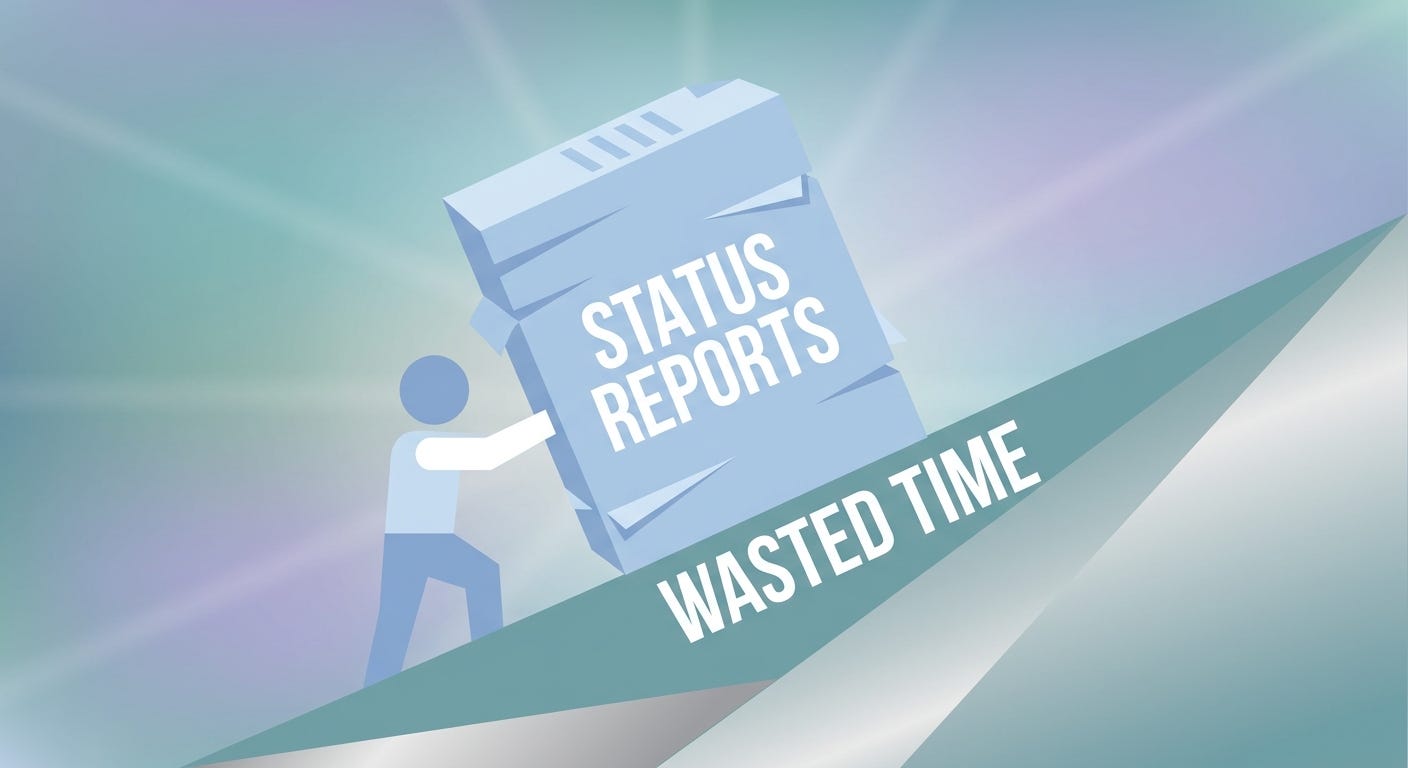
Status reports… The hours we spend writing them, multiplied by the seconds anyone spends reading them, makes status reports the most disproportionate work in any modern enterprise.

If you haven’t read Part 1, start there. The whole series rests on knowing what your work is supposed to move.
The first four parts of this series went after the obvious culprits. Meetings that should have been an email. Subscriptions that should have been cancelled three years ago. Email that should have been a document. Those are the easy eliminations.
Today we go after something harder. Something woven so deeply into how organizations operate that most leaders have never thought to question it. The work that exists because someone, at some point, wanted visibility, and we’ve been producing these reports like clock work ever since.
Status reports.
I’m going to make a stronger claim than I made in earlier parts of this series. Most status reports in your organization should not exist. Notice, I didn’t say they “should be shorter” or that they “should be AI-assisted.” They just shouldn’t exist.
If that sounds extreme, stay with me. By the end of this piece I think you’ll agree, and you’ll know how to start cutting

.
The Math Doesn’t Math
Walk through your organization’s recurring written reports, project status updates, weekly team summaries, monthly progress reports, quarterly reviews, executive dashboards, field reports, department updates, and annual reports. Do we really need all of these reports?
For each one of these (and other) reports, you should ask two questions.
How many person-hours go into producing it each cycle?
How many seconds does the average reader actually spend with it?
The arithmetic is brutal. A weekly status report that takes an hour to produce, distributed to ten people who skim it for thirty seconds, is paying sixty minutes of production time for five minutes of total reading attention. The producer gets one minute of attention back for every twelve they invested. Not a great dividend.
Now multiply that by every recurring report in your organization. Multiply by every team. Multiply by a year. Yikes. This is really bad stewardship of time.
The reason this persists isn’t that anyone has done the math and decided it’s worth it. The reason it persists is that nobody has done the math at all. The status report is just there. It has always been there and cancelling it feels risky. Producing it feels safe… so it continues. This is like so many of the things we do. We’ve just always done it and no one asks what the desired out come is.
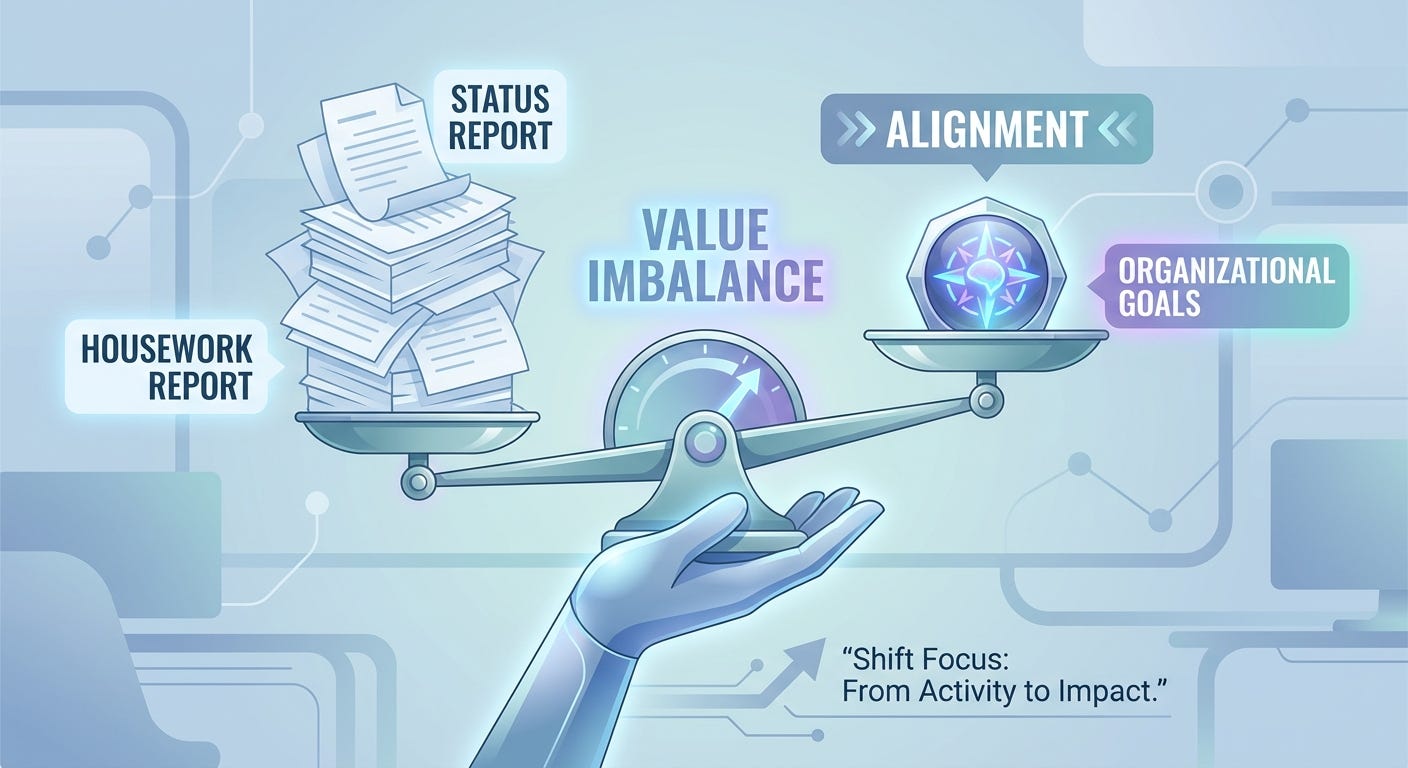
It’s time someone put status reports to the needle test. What does your organization exist to do? Does this status report move the needle on the important things that your organization does? If not… why are you doing it?
What a Status Report Is Actually For
To eliminate status reports intelligently, we have to be honest about what they were originally supposed to do.
The original purpose of a status report was simple. Leaders had no other way to know what was happening across their organization. The work was distributed, the people were distributed, and the only way to maintain visibility was to ask everyone to write down what they did and send it up the chain.
This made sense in 1985. It made sense in 2005, mostly. By 2015, it was already starting to creak.
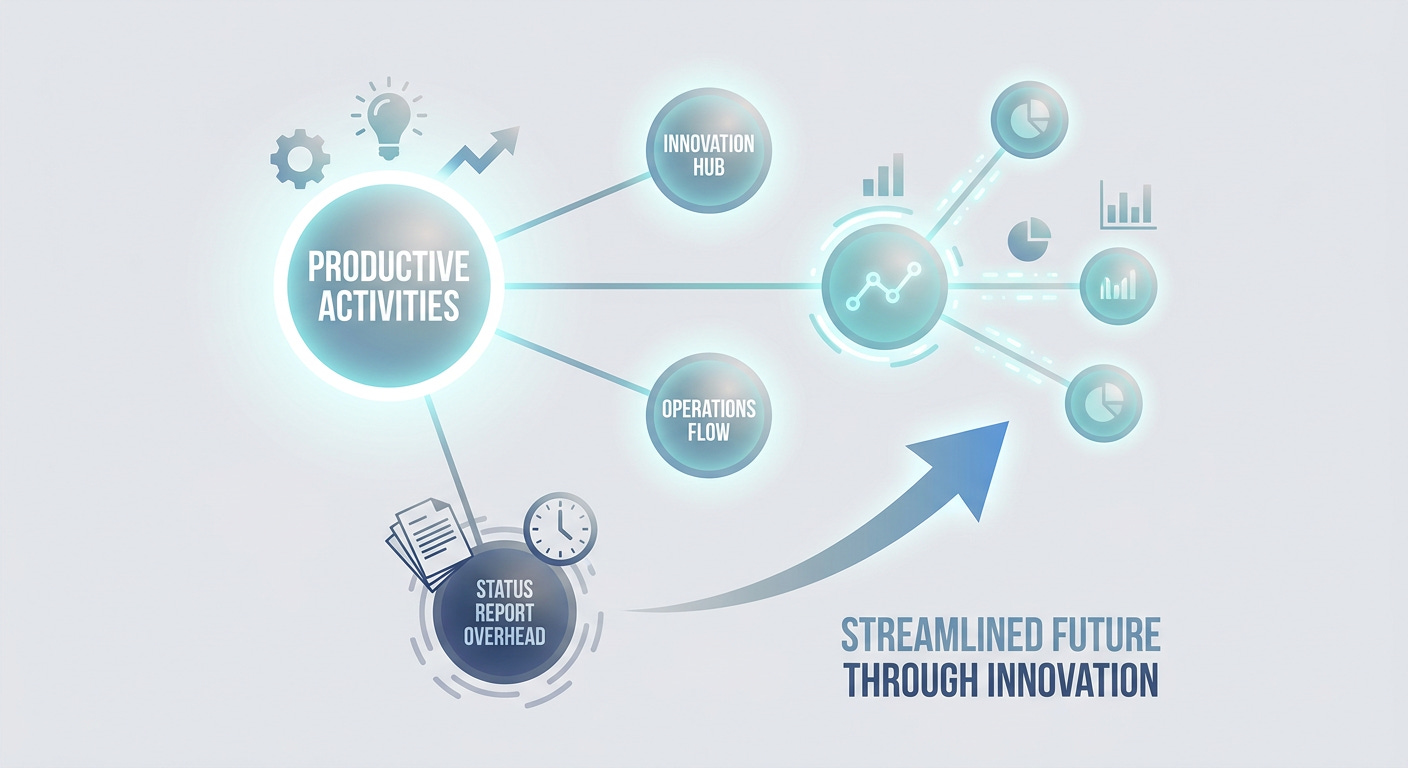
Today, in 2026, the original premise of the status report has collapsed. Your leaders, today, can ask AI to summarize what happened this week from the actual artifacts of work. You can look at Teams messages, the document edits, the ticket movements, the calendar items, the deployments, the deliverables. The AI can compile that summary in seconds. It’s more accurate than what the human author would have written, because the human author has incentives to perform the week back rather than describe it. The AI has no such incentive. It just reports what happened.
If the original purpose of the status report was visibility, that purpose is now better served by other means. Cheaper, faster, more accurate, and available on demand instead of on a calendar.
So why are we still writing them? A few reasons and none of them are very flattering. We write them because we’ve always written them, and the routine has become identity.
We write them because the act of writing the report has become the way the writer feels they’ve done the week’s work, even when the report is the only thing they actually finished.
We write them because the recipient asked for them once, three years ago, and nobody has ever asked whether the recipient still wants them.
We write them because nobody is willing to be the person who stops, and nobody is willing to be the person who tells someone else to stop.
None of these reasons survive the needle test. None of these reasons connect to actual progress on what matters!
The Three Categories
Walk through the recurring written reports in your organization. Each one falls into one of three categories.
Category 1: Reports that drive a decision.
A budget update that determines whether to approve next quarter’s spend. A sales pipeline review that changes how resources are deployed. A risk register that surfaces something requiring intervention. These reports earn their hours. They produce decisions. The needle moves because of them.
These should be kept. Probably sharpened, probably shortened, definitely AI-assisted in their production. But kept.
Category 2: Reports that are read, but don’t drive a decision.
The weekly team summary that goes to the manager, who skims it but never acts on it. The monthly project update that the steering committee reads but never modifies the project based on. The quarterly review that produces follow-up questions but rarely follow-up action. These are reports that have an audience but no consequence.
These are the hardest to eliminate, because someone is technically reading them. The reading feels like it justifies the writing. It doesn’t. If the reading doesn’t produce a decision or a change, the report is consuming attention without producing leverage. The right move is to convert these to on-demand. The recipient asks for the summary when they actually need it. The producer isn’t on a calendar.
Category 3: Reports that are barely read.
The status email that gets a 12% open rate. The project update that nobody opens. The dashboard that has not been viewed in three months. The annual report that took six weeks to produce and got read for ten minutes total across the entire intended audience.
These should not exist. Cut them. The recipients won’t notice. If they do notice, that’s the moment to ask whether they actually need the report, in which case you can replace it with something better. Most of the time, they won’t notice.
The Needle Test for Reports
Here’s the test, applied to every recurring report you produce or receive.
If this report were not produced this cycle, what would happen? Would any decision change? Would any action be different? Would the work move slower or faster?
Stop and sit with that. For most of the reports you produce, the honest answer is “nothing would change.” The report wouldn’t arrive. Nobody would notice. The work would proceed exactly as it does now.
That is a report that isn’t moving the needle. That is a report that should not exist.
The objection most leaders raise here is “but what if leadership wants to know?” The answer is to give leadership a better way to know. Not the recurring report. The on-demand AI summary. Generated when leadership actually wants it. Pulled from the underlying work artifacts in real time. More accurate than the human-authored version. Available in seconds.
Good leadership doesn’t actually want a status report. Good leadership wants visibility. Those are not the same thing.
What to Replace Them With
Three replacement patterns work, and each one connects to a different reader need.
For decisions:
Keep the report. Sharpen it. Use AI to draft the first version from real artifacts, then have the human author edit and add judgment. The shape of the report stays. The hours invested drop. The decisions still get made.
For visibility without decisions:
On-demand AI summaries. Configure your AI tools to compile weekly summaries from your team’s actual work. Look at the commits, documents, deliverables, and constituent communications. Look at the things that move the needle on your core purpose. Make these available in a shared space. Anyone who wants the summary can pull it. Nobody is forced to write or read on a schedule.
For ritual or habit:
Stop. The report exists for no reason that survives the needle test. Cancel it. Tell the audience you’re cancelling it. Offer a replacement only if anyone actually objects. Most won’t.
The third category is the one most leaders find hardest to act on. Cancelling a report feels like loss. Adding a report feels like investment. The political math always favors the addition. AI changes the equation only because it lowers the cost of the alternative, but only the leader can make the choice.
The Deeper Problem
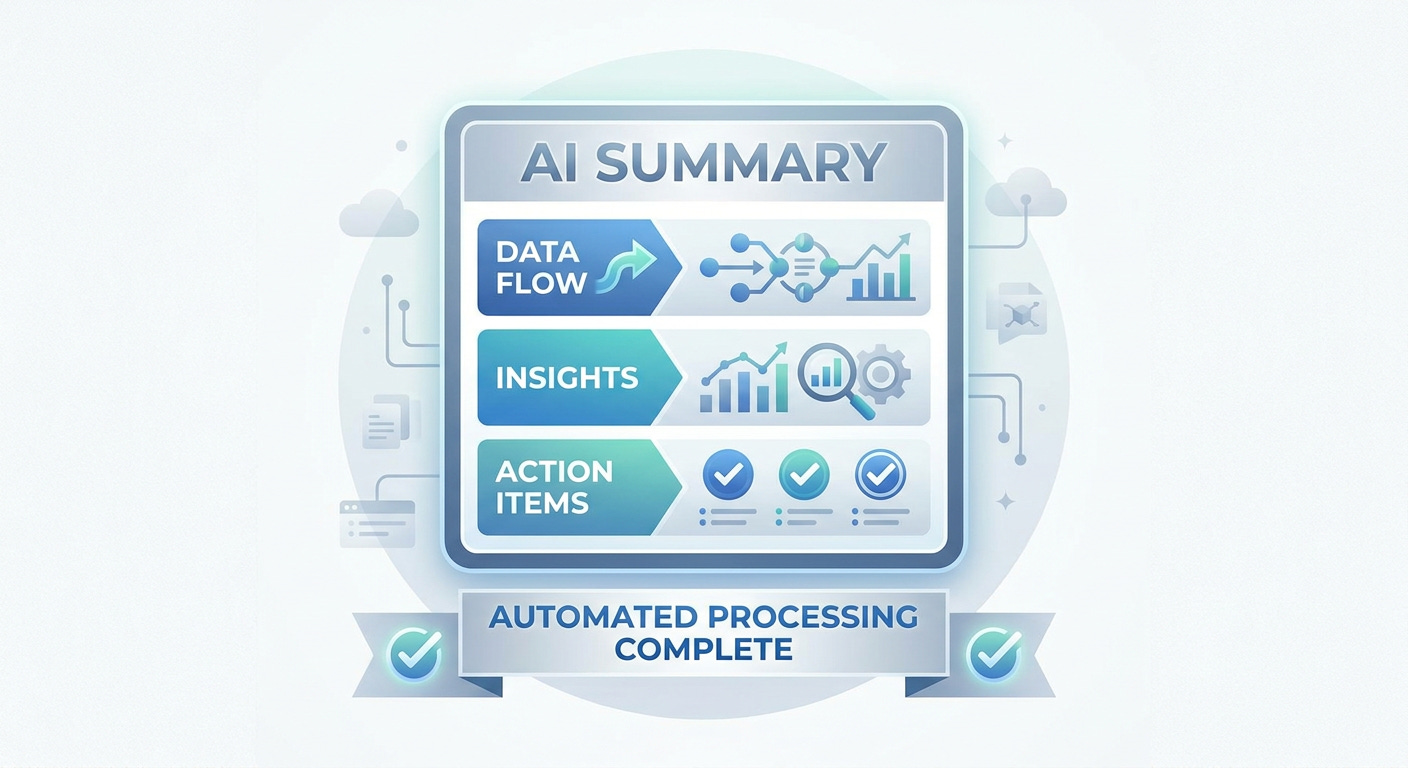
The reason status reports proliferate in organizations is that we’ve gotten lazy about what we measure. We measure activity instead of outcomes. We measure effort instead of progress. We measure inputs instead of things that actually move needles.
A weekly status report is, in its most common form, a list of activities. I had three meetings. I sent two emails. I reviewed four documents. The activities feel like proof of work, but they aren’t proof of progress. None of them tell you whether anything moved.
Compare that to a report that connects to a needle. Project X moved from 60% to 75% completion this week. Customer churn dropped from 4% to 3.2%. Two of our three quarterly milestones are now on target. These are reports about outcomes. They tell you whether the needle is moving. They are short, because outcomes can be expressed in numbers and numbers don’t need many words.
The activity-based status report is a symptom of unclear goals. The needle-based status report is a symptom of clear ones. If your team’s status reports read like activity logs, the problem isn’t the reports. The problem is that the team hasn’t been told clearly enough what they’re supposed to move, so they fall back on what they did.
This is the deeper structural critique. The status report problem and the goals problem are the same problem. A team with a clear needle doesn’t need to write activity logs, because the needle itself is the report. Did it move? By how much? What’s the bottleneck? That’s the entire status update.
If your organization is producing mounds of activity-based status reports, you don’t have a reporting problem. You have a goals problem. The reports are working as designed. They’re showing you that nobody has clear enough goals for outcomes to be the natural unit of measurement.
The elimination of the report is the easy part. The elimination of the goal-haziness underneath it is the work that actually matters.
The Annual Report Is the Boss of This Category
I want to call out one specific case before I close, because it’s the largest single instance of this problem in many organizations.
The annual report. The year-in-review document. The “what we accomplished this year” packet. Many organizations spend weeks producing one. The graphic design, the photo selection, the carefully framed statistics, the donor-facing narrative, the leadership letters, the financial summaries.
For most organizations, the annual report is the most expensive single piece of recurring written work the organization produces. And for most organizations, the annual report is read by a tiny fraction of its intended audience for a fraction of the time the producers spent on it.
The annual report should be on the chopping block. Not because the work it describes doesn’t matter. The work matters. But the report, as a 60-page document produced over six weeks and read for ten minutes by 12% of the intended audience. That report isn’t the right artifact for the job.
The replacement isn’t “a shorter annual report.” The replacement is to think about what the annual report is actually supposed to do, and design directly for that outcome.
If it’s donor cultivation, the right artifact is probably a series of personal videos and individual donor calls, not a glossy document.
If it’s institutional credibility for grants and partnerships, the right artifact is probably a tight one-pager and a website with on-demand depth, not the printed pack.
If it’s internal celebration of the year’s wins, the right artifact is probably an in-person event with a story arc, not a document.
The annual report exists in many organizations because nobody has asked the question. It’s one of the highest-leverage eliminations available to most leaders, and it’s one of the rarest to actually attempt. I get it. You “have to have” an annual report. Just think about whether or not you are actually communicating on the needle movers.
One Take-away
Today, I want to ask you to spend half an hour thinking about all of the reports you have.
Make a list of every recurring written report you produce or are responsible for. Status updates. Project reports. Weekly summaries. Monthly briefings. Quarterly reviews. The annual report.
For each one, ask the test question.
If this report were not produced this cycle, what decision would change? What action would differ?
If the answer is nothing, that report is on the chopping block. Send a message to the recipient. I’m pausing this report for the next month. If you find you actually need it, let me know and we’ll figure out a better way to give you what you need.
Then wait. See who reaches out. The number will be smaller than you expect.
Tell me what you cancelled. Tell me whether anyone noticed.
The status report has been silently consuming hours of your team’s most senior people for years. Many of those reports were never serving the purpose anyone intended. The AI era makes the alternative cheap. The needle test makes the choice clear.
Justify everything you keep.
Eliminate everything else.
Especially the reports nobody actually reads.
Thanks for reading AI, Innovation, and Faith! This is Part 5 of The Elimination Project. Part 1 (the manifesto), Part 2 (meetings), Part 3 (subscription decay), and Part 4 (email) build the foundation. Part 6 takes on approval chains. The politically hardest elimination in the series.