


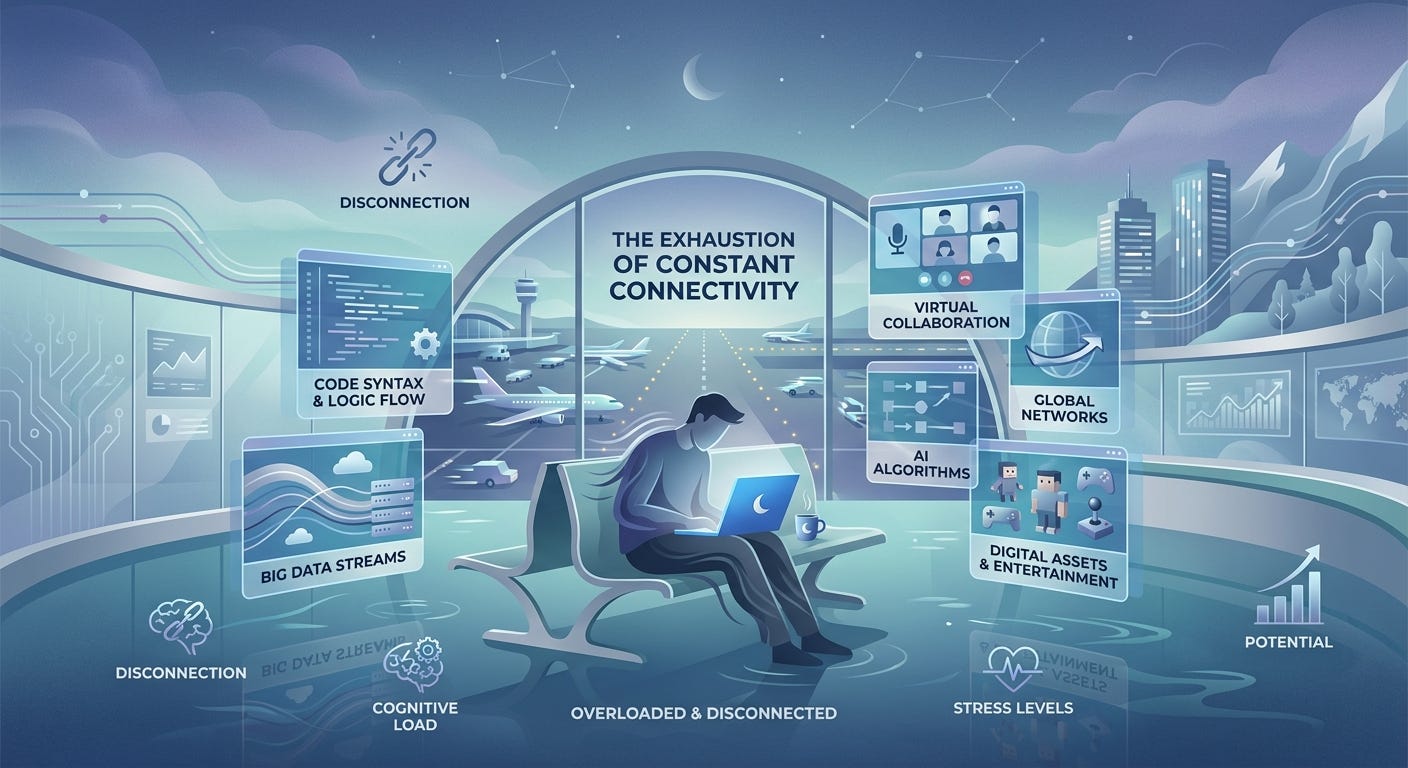
I sat down at the airport last Tuesday at 3:47 AM with a coffee, three open Claude Code windows, a Power Automate flow running in the background, and a Copilot agent processing incoming information By 11:15 I had landed at my destination and completed what would have taken me six months to do just a few months ago.
I had gone from ideation at 3:47 AM to a fully deployed and functioning video game upon landing (after 22 iterations on the flight).
By 12:30, I was sitting at Chipotle with the same three Claude code windows open doing even more work. By 9:30 PM, my inbox had a net increase of 22 emails. I was behind again.
If you had asked me in 2023 what AI was going to do for me, I would have said something like, “Give me my life back!” I’ve written about the AI dividend previously. The idea that these tools, properly stewarded, would pay us back in two currencies: dollars and hours. I still believe in the dollars part. The hours part is where I owe you a confession.
The hours never came. In fact, I think I am doing 30 times more work, but I am not working fewer hours.
What’s the Research Say?
Cal Newport recently flagged a new study that put numbers on something I’ve felt for the better part of a year. Among knowledge workers using AI tools, the time devoted to focused, uninterrupted work… the kind required to actually think, to write something true, to solve a hard problem, fell by 9%. Among workers not using AI, that number didn’t move at all.
Read that again. The people using the tools that were supposed to free them up to do deeper work are doing less of it. We’re doing more work… a lot more work. We just aren’t freeing ourselves up to do the thinking type of work.
A Berkeley professor quoted in the same piece said something that has been bothering me since I read it. AI makes additional tasks feel easy and accessible, creating a sense of momentum. That resonates with me. I am creating way more things than I have ever created in my life. Arguably, I’ve created years worth of work in just a few months. The problem is creating does not equal moving the metrics that really count.
The unfortunate truth is that AI didn’t shrink our workload, but it expanded our appetite. I have more ideas today than I’ve ever had. I can prototype things in hours instead of months. The problem is this. I’m struggling to turn off the creativity and have no time left for reflection.
The Same Trick, Different Wrapper
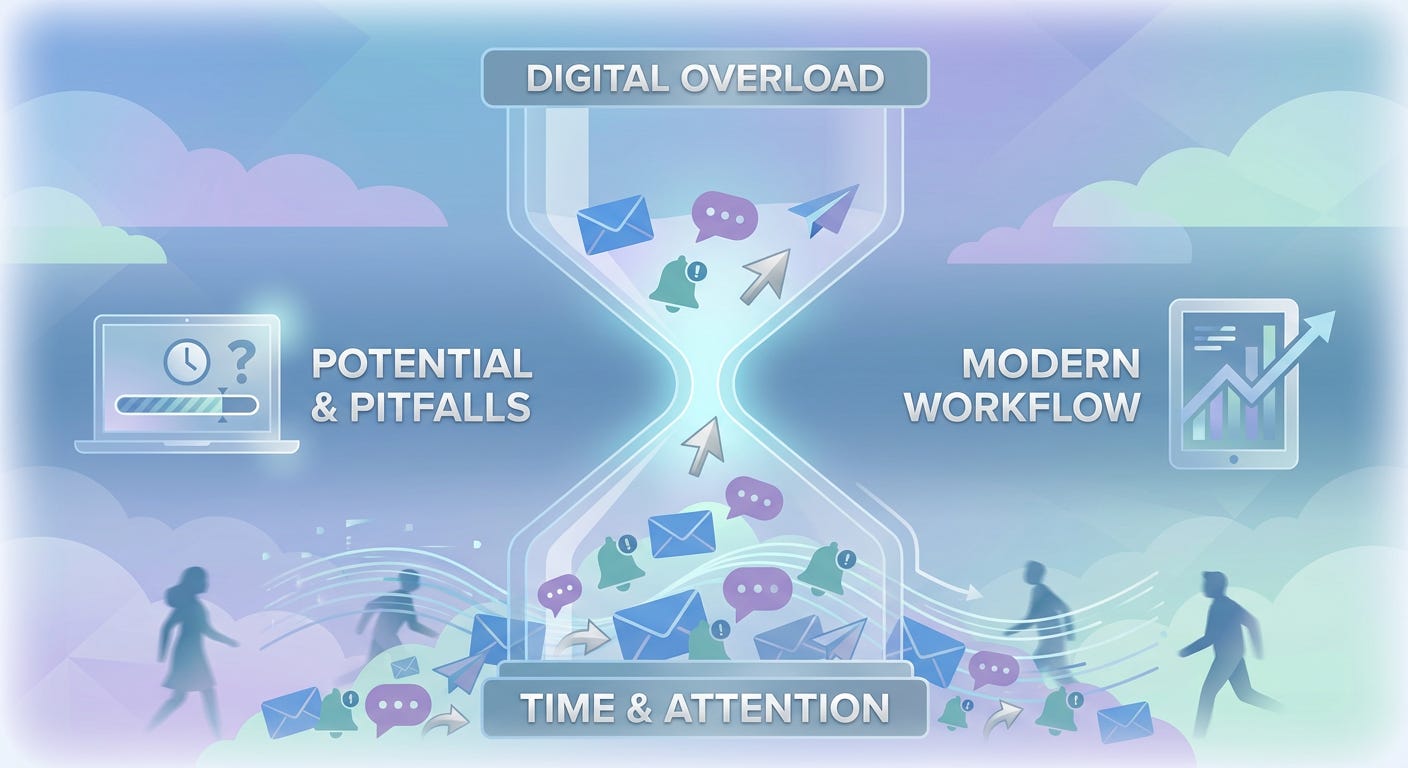
I feel like we’ve seen this movie before. Email was supposed to give us back time. Instead it gives us 250 messages a day. It’s effortless, so now we end up with way more email than is needed. Smartphones were supposed to make us efficient. They made us reachable at any time. Teams/Slack was supposed to reduce meetings. Now we have digital meetings and Teams/Slack threads about the meetings.
Each new productivity technology arrives wrapped in the language of freeing us up. Each one ends up consuming the very margin it promised to create. We don’t get hours back. We just get more capacity to fill and we always, always fill it.
This isn’t the fault of the technology. It’s a story as old as Genesis 3. By the sweat of your brow you will eat bread. We are bent toward toil, even when toil isn’t required of us.
The Dividend, Rightly Understood
When I first wrote about the AI dividend, I framed it mostly in financial terms. Organizations using AI well would see real returns. They should see efficiency gains, cost reductions, and scale advantages. That’s true and I still stand by it.
Looking back at the article, I undersold the most important part of the dividend. It’s easily overlooked and I think most of us are underselling it as well.
The financial dividend is real but secondary. The time dividend is the one that actually changes a life, a family, a ministry, and gives back. Unfortunately, few of us are cashing in on that dividend.
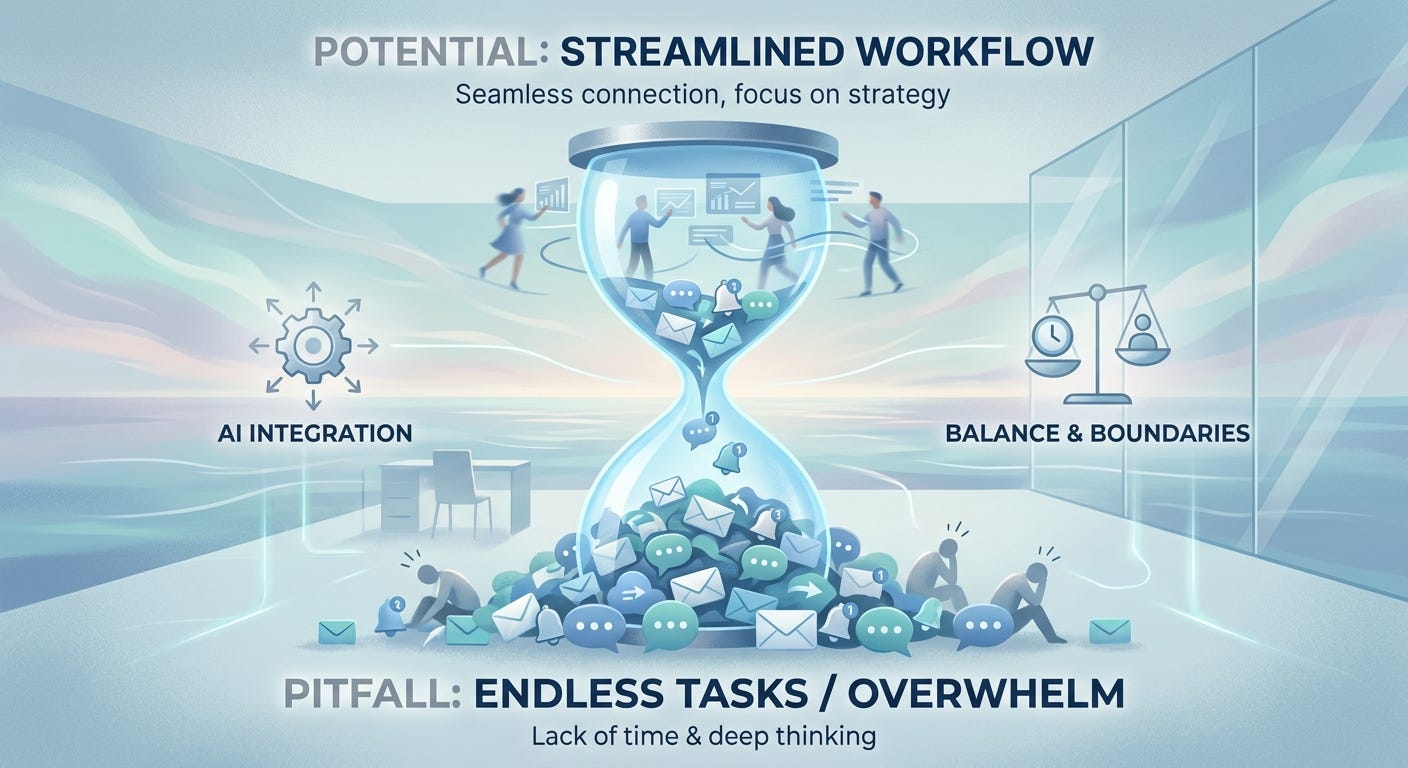
We’re taking the same eight hours we always had, cramming three times as much output into them, and patting ourselves on the back for “leveraging AI.” We’re reading more, replying faster, producing more decks, sending more emails, generating more reports. At the same time, we’re more tired, not less. We’re more fragmented, not more whole. Our deep work hours are vanishing while our shallow work hours are expanding and taking over.
Here’s a question for you. When was the last time AI gave you back an actual hour? Not a “wow, that would have taken me three hours” hour… but an hour where you closed the laptop and went outside?
I had to think hard. And I’m the guy who writes about this stuff. I frequently (daily) say how much more I am doing because of AI. I can’t remember the last time I personally benefited from some downtime because of AI.
What We’re Doing Instead
Here’s the trap that I feel like I’m in. We treat AI as a multiplier on volume rather than a multiplier on margin.
Maybe you use Copilot or Claude to help you draft twenty emails so we can send twenty emails. It hasn’t freed us up to take a walk or to just contemplate.
We use Copilot to summarize three meetings… so we can attend three more. It hasn’t meant we get to skip two meetings. It means we have even more meetings.
I’m beginning to think that we’ve built these AI tools to do the wrong thing.
A Different Way to Score the Game
Newport offers a question I’ve been thinking about for days.
Are you producing more valuable output than before or just more output?
That distinction is the whole ballgame. Volume is not value and speed is not depth. Replying to 47 emails before 9 AM is not the same as writing one paragraph that changes how someone thinks. Also, writing 47 emails is just going to create more email. Odds are, it doesn’t really move the needle on the metrics that matter the most.
My thoughts on this topic is that I am going to make an intentional effort to use AI to protect my deep work, not expand the shallow stuff around it.
Mary chose the better portion. Martha was the one drowning in tasks. Jesus didn’t gently optimize Martha’s task list. He told her she was anxious and troubled about many things, and that one thing was needed.
One thing.
I think most of us, with AI in hand, are now anxious and troubled about more things, faster. AI isn’t freeing us up, it’s giving us more work.
How Will I do This?
A few practices I’m experimenting with. None of them are clever and all of them are hard.
Audit the dividend monthly.
I plan to sit down and ask honestly each month, What did AI give me back this month? If the answer is “more output,” that’s the warning light, not the win.Refuse to fill recovered time.
When AI saves me 45 minutes on a task, I am trying (not succeeding) to leave that 45 minutes empty. Read something, visit with a friend, or just reflect. The recovered time is the dividend. Spending it on more work is canceling the check.Score by depth, not throughput.
At the end of each week, I’m asking, “What did I think hard about this week? Not, how much did I ship? That’s important, but only one metric. Throughput is what AI optimizes for and depth is what I’m responsible for.Protect a deep work block daily.
AI handles the shallow. The 60-minute time block belongs to the work only I can do. I’ve been blocking at least 1-hour per day for the past couple of years. Time blocking allows me to focus on something other than another meeting.
None of these are productivity hacks. These are disciplines wearing productivity clothes. It takes dedication and time, but I’m convinced that it is worth it. We have to intentionally claim the AI dividend before it claims us.
The Reflection
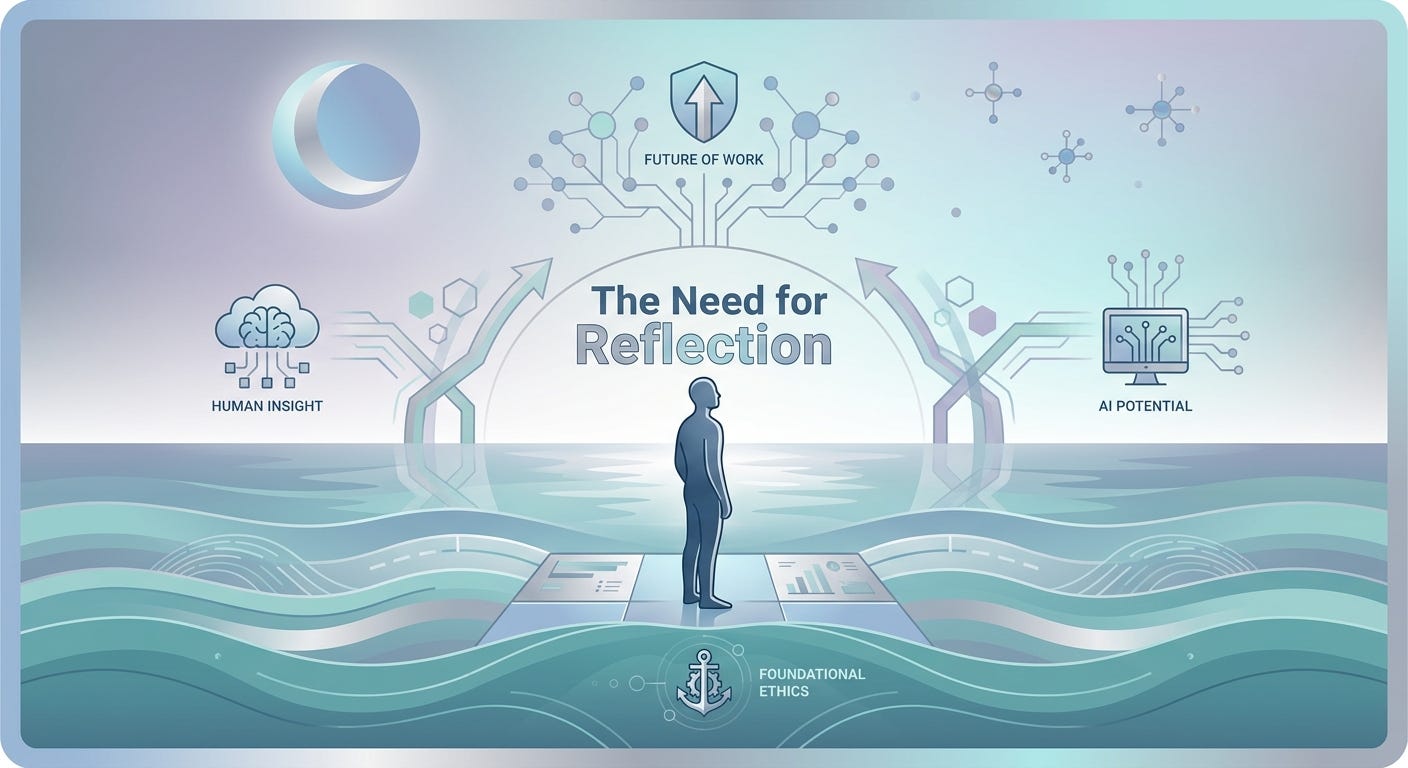
The God of the Bible built rest into the architecture of the week before sin entered the world. Sabbath wasn’t a recovery mechanism for tired people. It was a rhythm for whole ones. Six and one. Work and rest. The point of the six was never to consume the one.
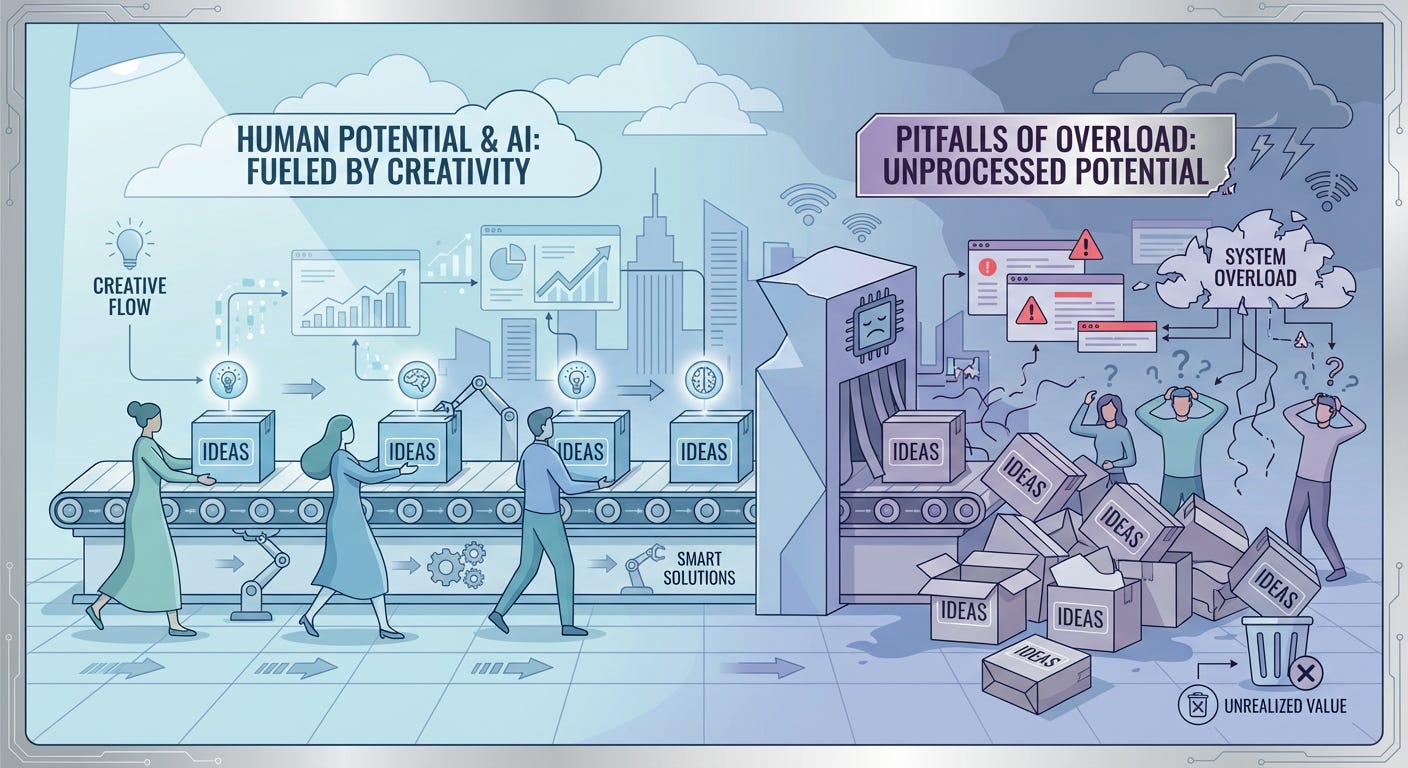
We’ve built tools that can do what used to take us six days in only a few hours. We have been really good at filling the rest of the time with more six-day work. We turned a gift into another deadline.
If AI is going to pay a dividend worth collecting, it has to come back to us as time. We have to stop treating that time as more inventory to spend. The dividend was never the speed. The dividend was the margin the speed was supposed to create.
One Take-away
This week, find one task that AI legitimately saves you significant time on. Track exactly what you do with the recovered minutes. If those minutes got swallowed by more work, that’s a problem.
Here’s the good news. The dividend is sitting there. Are you willing to actually take it?
Wholeheartedly agree. There is a corporate shift that will need to happen, as well (and given our insatiable desire for more and faster, it never will). That is, if we can do in 20 what used to take us 40, then organizations need to require (and expect) 20, not 40.
Don, The discipline of refusing to fill recovered time is a counterintuitive but powerful one!