


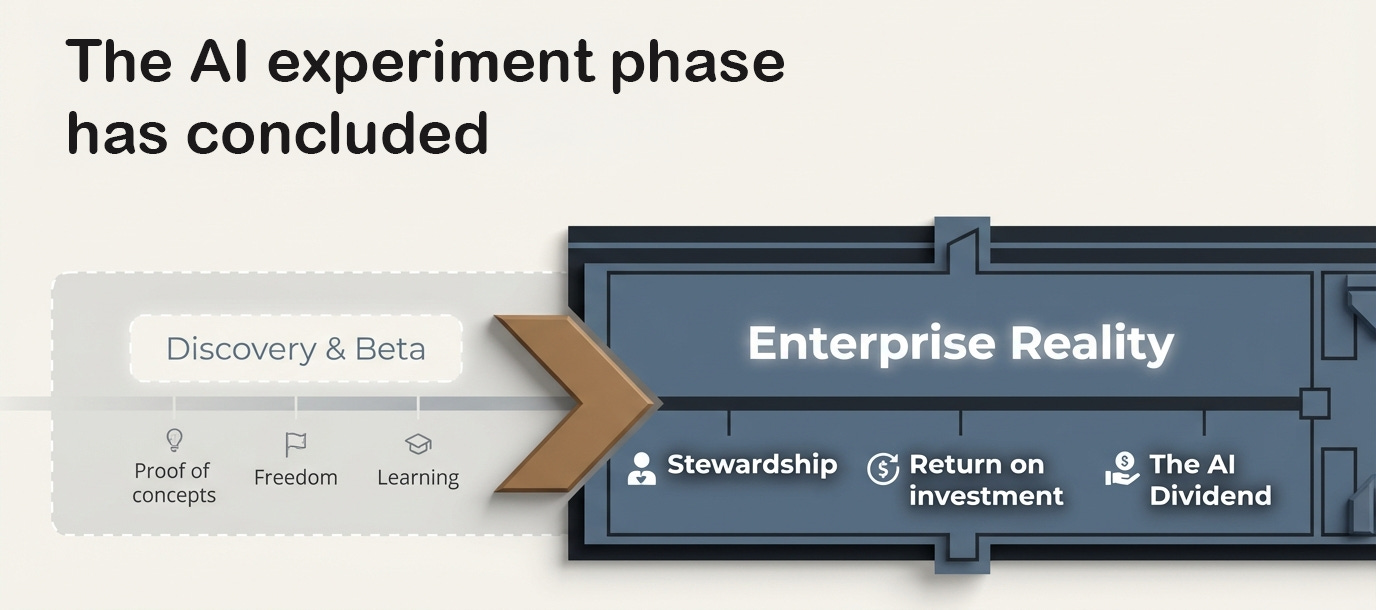
Most companies are a few years into the AI experiment. Early on, many organizations gave a good bit of freedom to innovators to explore and create AI beta tools. This was a time of learning and discovery to figure out what is actually possible for AI. No one wanted to be left behind, so the expeeriments began!
Here is a question nobody in your next AI strategy meeting is probably going to ask.
What do we actually get for this?
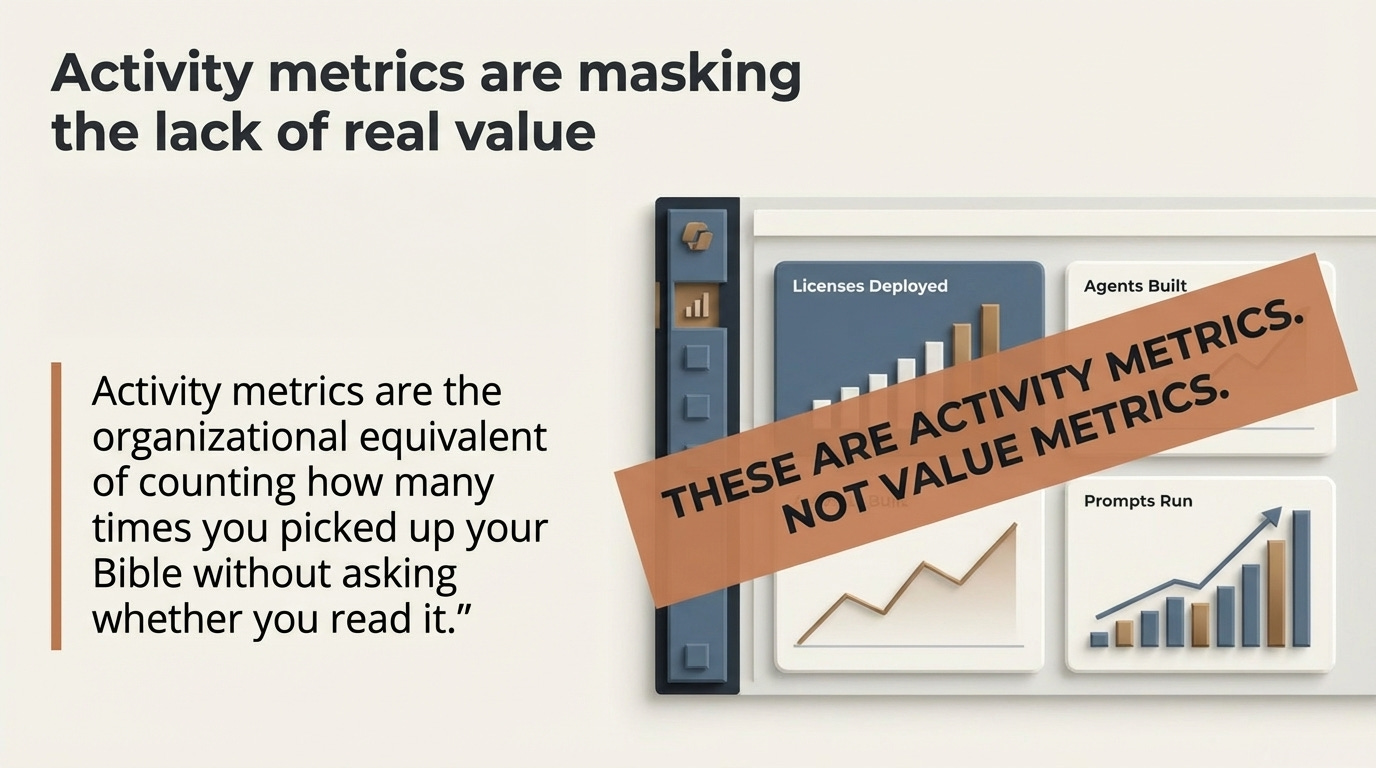
Not “how many people are using our tools.” Not “how many licenses did we deploy.” Not “how many agents did we build.” Those are activity metrics and are the organizational equivalent of counting how many times you picked up your Bible without asking whether you read it.
Most organizations have no honest answer to that question. Including, probably, yours.
I say that as someone who has spent the last three years building AI adoption inside a mission-driven organization. I’ve made the case to leaders of other organizations not as open as our own. I believe AI has exponential potential, but I also think those of us leading it have a stewardship obligation to prove value.
Early on, AI innovators built tons of proof-of-concept tools and minimum viable product solutions. Today, we’re long passed startup mode and are moving firmly into enterprise solutions. Leader of most organizations are beginning to look for the AI dividend.
What’s the real value?
Sometimes, when I visit with leaders of other organizations, the AI success dashboards measure usage. How many times was Copilot opened, how many prompts ran, and how many agents were deployed? These all pointed toward adoption curves trending upward. That’s great news! When in startup mode, those are things we all celebrated.
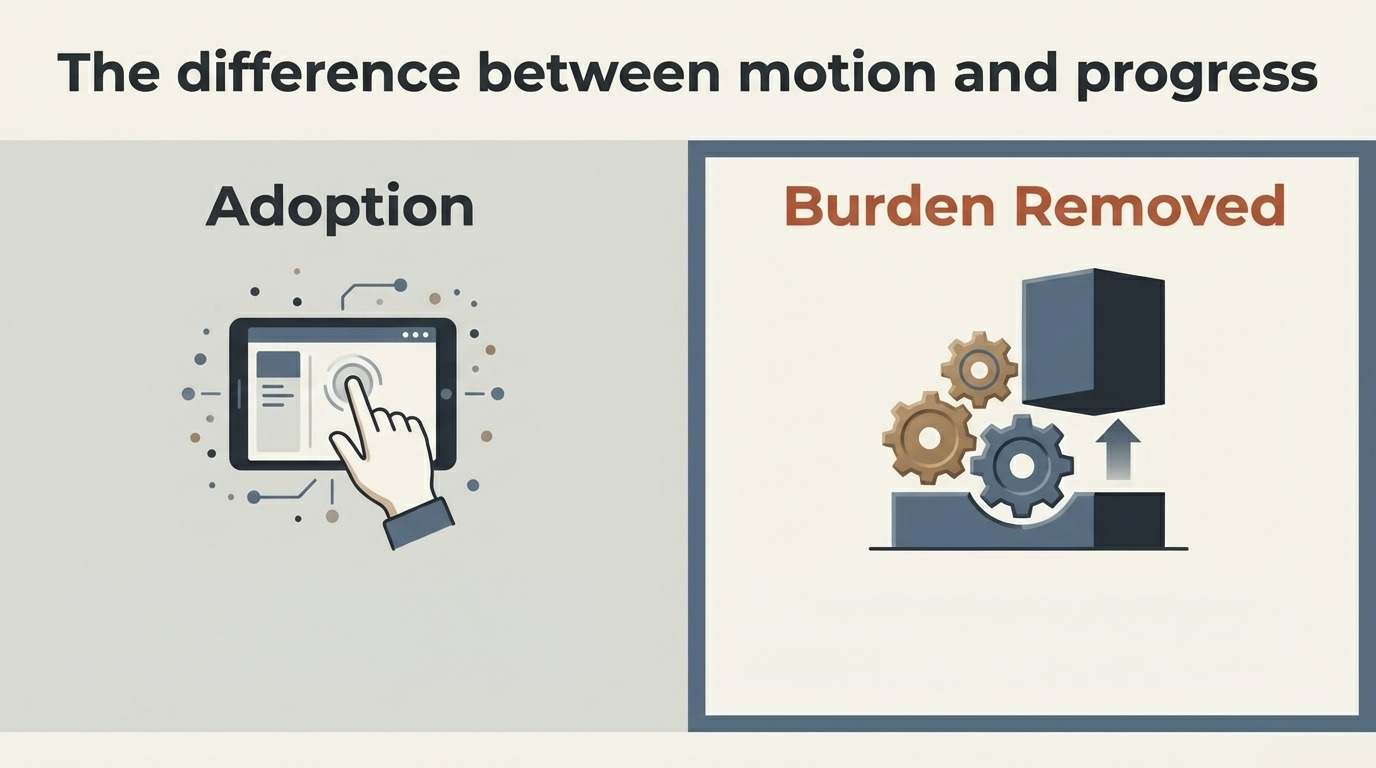
It’s time that we begin to measure something more important than adoption. We need to begin measure how much burden has been removed.
There is a massive difference between adoption curves and how the needle is being moved on key organizational metrics. One tells you that people touched the tools. The other tells you that something that used to consume your people no longer does. One is motion. The other is progress.
I have been guilty of celebrating AI adoption based entirely on usage data. As we have seen widespread adoption, I am more focused on what changed. I’m more focused on how many hours have been freed up and redeployed somewhere that mattered.
Early on, we had a lot of activity, but we had no measurable dividend. Now, let’s focus on dividend.
What the AI Dividend Actually Is
The AI Dividend is a documented, verified reduction in administrative cost and effort that can be traced directly to AI-driven transformation. Not a projection. Not a theory. A number you can defend.
It works like this.
Before you deploy anything, you establish a baseline. How many people are involved in this workflow? How many hours per cycle does it consume? How long does end-to-end processing take? What does it cost, internally and externally? You write that down before deployment. That number becomes the standard against which your investment will be judged.
After deployment, you measure the same things. The difference is your Dividend.
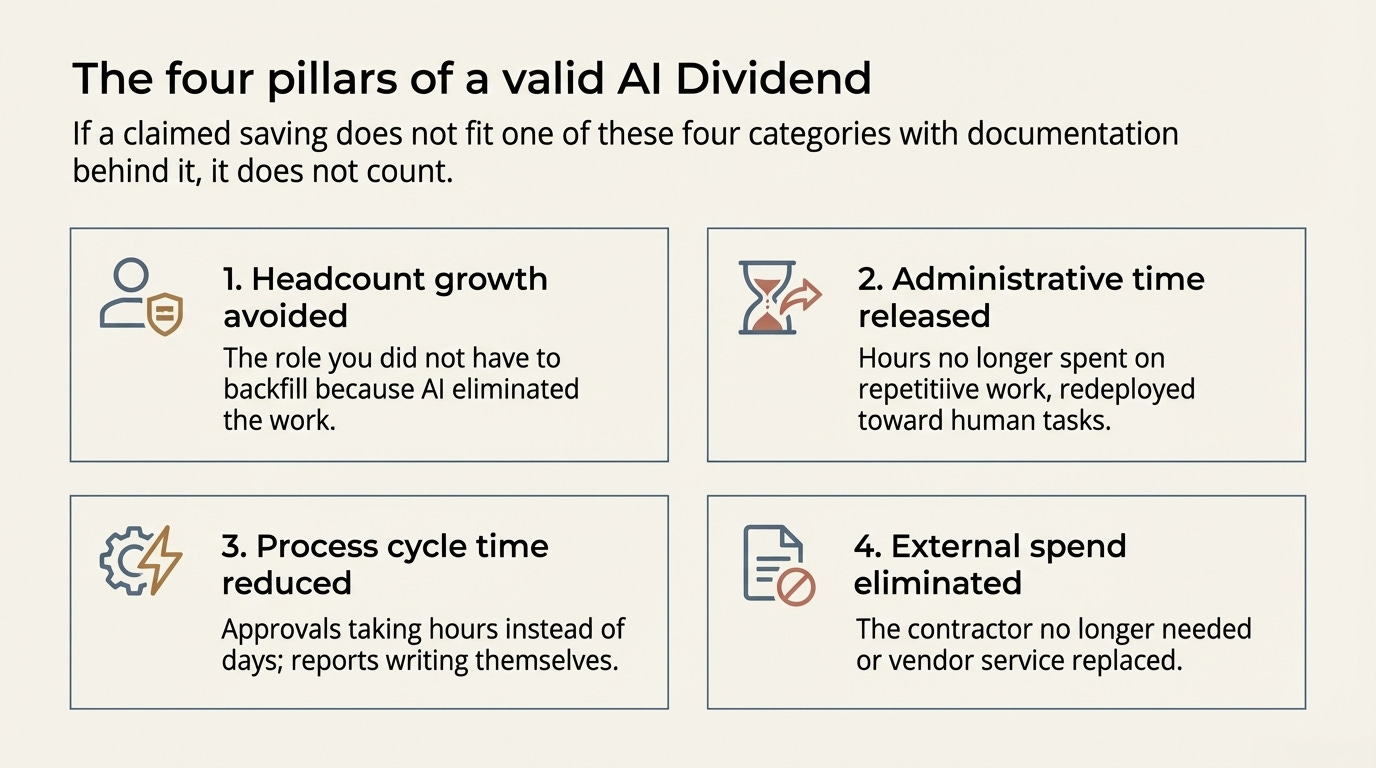
Four things qualify:
Headcount growth avoided. The role you did not have to backfill because AI eliminated the work it would have done.
Administrative time released. Hours your people no longer spend on low-value repetitive work, redeployed toward things that actually require a human being. This includes the ruthless elimination of mundane tasks that have no direct impact on your organizational objectives.
Process cycle time reduced. Approvals that used to take days taking hours. Reports that used to take a week now write themselves while you sleep.
External spend eliminated. The contractor you no longer need. The vendor service replaced by an AI-enabled workflow.
That’s it. If a claimed saving does not fit one of those four categories with documentation behind it, it does not count.
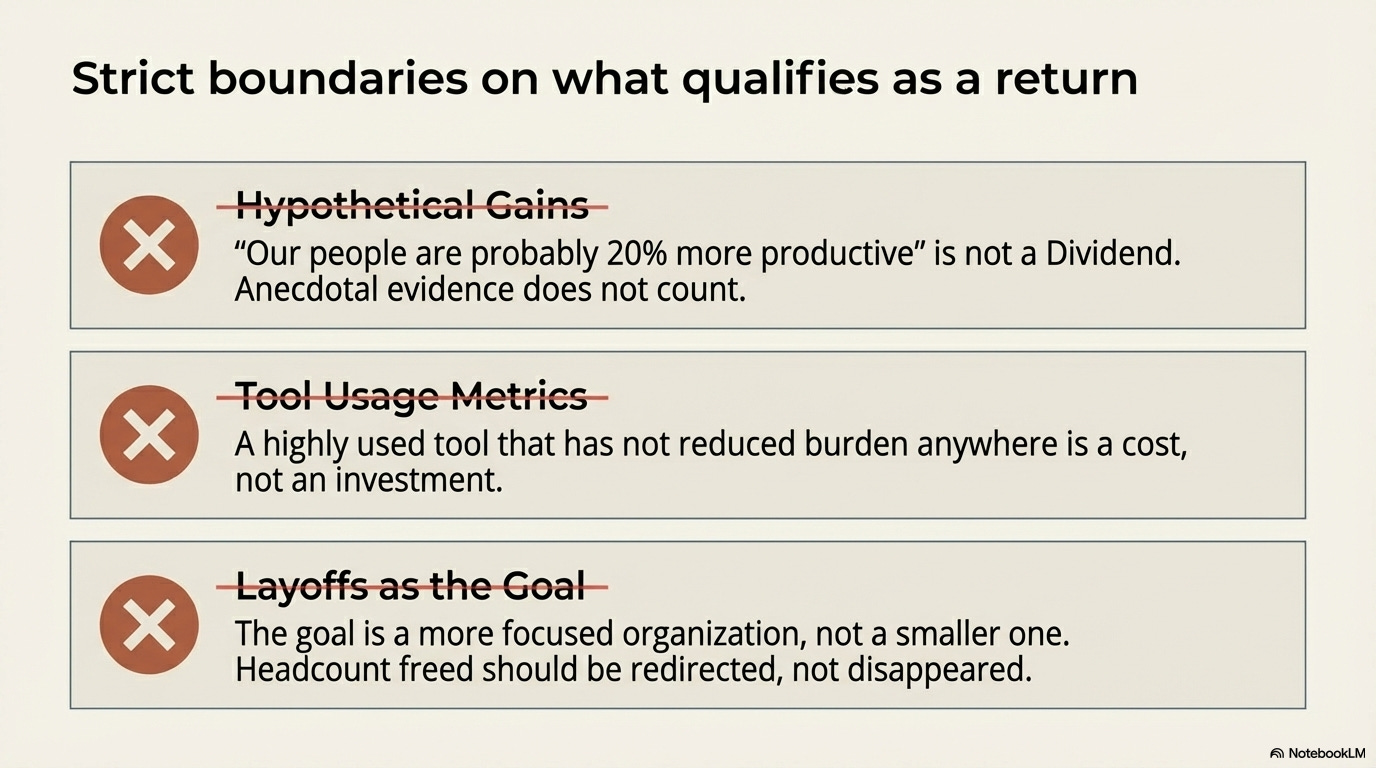
What Doesn’t Count
What doesn’t count matters as much as what does count.
Hypothetical productivity gains without a baseline do not count. “Our people are probably 20% more productive” is not a Dividend. Anecdotal doesn’t count.
Tool usage metrics do not count. A highly used tool that has not reduced burden anywhere is a cost, not an investment.
Layoffs are not a success measure. The goal is not a smaller organization. The goal is a more focused one. Headcount freed through AI transformation should not disappear from your budget. It should be redirected toward the work you actually exist to do.
What You Should Do with the Dividend
Here is where most organizations stop. They measure the savings, feel good about it, and let the money dissolve back into general operating expenses. Next budget cycle, nobody remembers where it went.
That is not stewardship. That is leakage.
The Dividend only means something if you decide in advance what you are going to do with it. Here is a framework I want you to consider.
A majority of realized savings should flow directly to your field operations. Whatever your organization exists to accomplish, that is where the money should go. If AI is freeing up administrative capacity, the whole point is that more of your resources reach the mission. If the savings do not show up there, the transformation was not real.
How much? Start with 60% going back into the reason your organization exists.
A meaningful percentage needs to be reinvested into AI infrastructure. The organizations that will compound their gains are the ones that treat AI as a platform, not a project. That means investing in the agents, the data infrastructure, the training, and the governance that makes the next wave of automation possible. You cannot harvest future dividends without planting the seeds now.
How much? Start with 25% of savings being poured right back into new AI infrastructure.
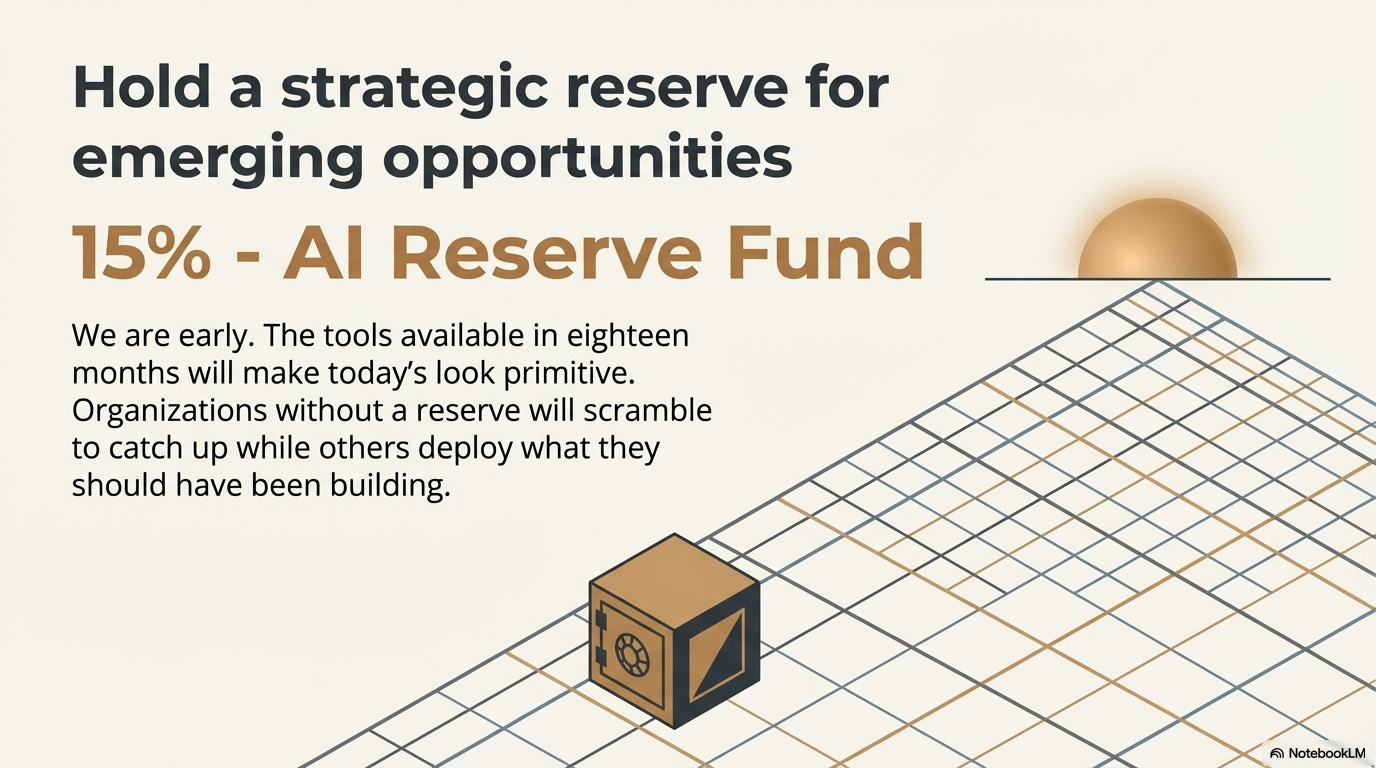
A reserve should be held for emerging opportunities and future innovation. We are early. The tools available in eighteen months will make today’s tools look primitive. (I know that sounds like hype. It is not.) Organizations that have no strategic reserve will find themselves scrambling to catch up while others are already deploying what they should have been building.
How much? I suggest putting 15% in an AI reserve fund. It’s hard to predict where AI is going to be in six months, much less two years from now. It’s wise to set aside some funding for the unknown.
The exact percentages matter less than the discipline of deciding them before the savings arrive. Write it down. Make it policy. Hold yourself to it.
Why This Is a Stewardship Question
Here is the reframe that changed how I think about this.
Every dollar spent on AI that does not produce a documented return in either productivity or financial savings is a dollar that did not go to the people and work your organization exists to serve. Every administrative hour that AI was supposed to free but did not is an hour that stayed in the back office instead of going where it was needed most.
That is not a technology problem. That is a stewardship problem.
Organizations that treat AI as a discretionary technology expense will keep shopping for the next tool when the current one does not deliver. Organizations that treat it as a capital investment expected to generate a return will build measurement frameworks, demand accountability, and make better decisions the next time around.
The difference between those two organizations is discipline.
The Uncomfortable Part
Most organizations never build this framework because measurement creates accountability. Accountability means some initiatives will be exposed as cost without return. Leaders who championed them will have to give an account for that. It is much easier to keep showing the usage dashboard and calling it progress.
Here is what I keep coming back to. If we believe AI can free our people to do more of what only people can do, we have an obligation to prove it. We don’t do this to report back to donors, investors, or leadership. We do this because we believe in the mission and we want to be good stewards for that mission.
The potential is enormous. The discipline to capture it honestly is what separates organizations that transform from organizations that adopt a lot of tools and wonder why nothing changed. This is the difference between an organization that uses AI and an AI-Driven Organization.
So, here is the question worth bringing to your next AI strategy meeting.
If you had to document, right now, what your AI investment has actually returned and where every dollar of savings went, what would that document say?
If you can’t answer that, this might be the most important thing you learn today.