


The central theological argument for how the church should hold AI.
Supplement, Not Substitute
When I heard about a sermon that was preached by AI, I had questions. I had to go find out more. Here’s what I found.
It was a real church service on June 2023, St. Paul’s Church in Fuerth, Bavaria and over 300 people attended. A theologian named Jonas Simmerlein had fed ChatGPT a prompt and a theme, then stepped back. He later said that 98% of what happened that Sunday came from the machine.
People said, “Everything was there. The structure was tight. The theology was sound. The sermon covered leaving the past behind, facing the present, overcoming fear of death, trusting Jesus Christ. It didn’t stumble. It didn’t ramble.” By many measurable standards, it was competent.
One congregant walked out and told reporters: “There was no heart and no soul.”
She was right and she said what most of us feel. It’s sometimes lost in all of the talk about what AI can do.

This Is Already Happening
Many people would like to believe this is an experiment at the fringe. It isn’t. I continuously hear stories from leaders asking how this should be addressed. Recently, I had a professor tell me that many pastors in his state were using AI in ways that are unethical. I agree with him.
As of 2025, 64% of pastors use AI for sermon preparation. That’s up from 19% just two years earlier. One of the fastest technology adoptions in modern church history. Scroll through ministry forums, pastor Facebook groups, church tech newsletters. The question isn’t whether AI is in the pulpit. It’s how far in, and how quietly.
One Lutheran pastor described opening ChatGPT during a particularly hard week, plugging in the week’s Scripture, and receiving a 900-word sermon in under thirty seconds. Their reaction, “This is really good, and this feels wrong.”
The pastor was giving honest, gut feedback. I believe that the church needs to go further than honest discomfort. We need a framework for why it’s wrong. If you are a reader of my posts, you’ll know that I’m very positive on what AI can do. I also, from time to time, write about the times when people are crossing the line between good usage of AI and unethical usasge of AI.
Is This Really New?
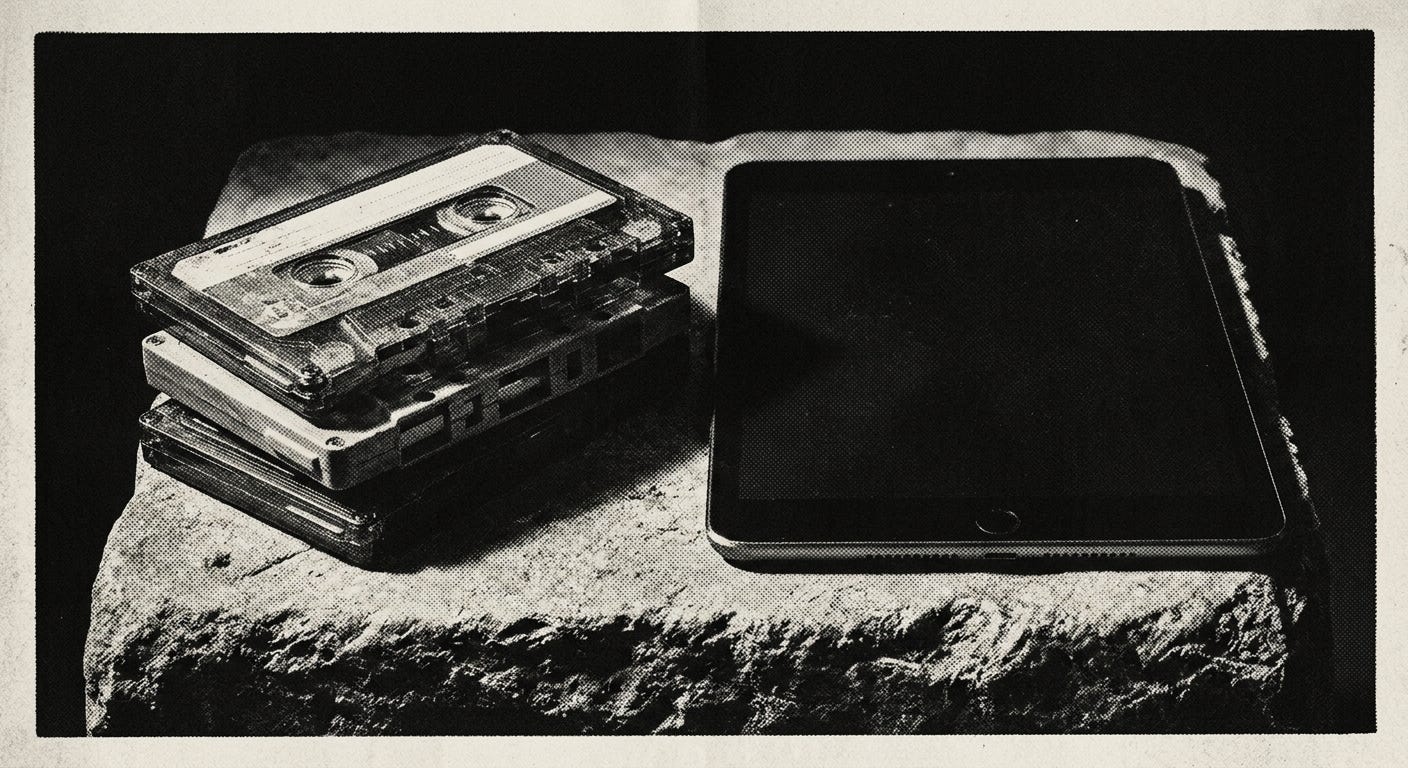
To be fair, this isn’t the first time pastors have taken shortcuts. For years, ministers bought cassette tapes of other pastors’ sermons and delivered them from their own pulpits. Years later, that evolved to downloaded audio files. Eventually online sermon database subscriptions emerged. They had full manuscripts, illustrations included, and ready to “adapt” for their own usage. Unfortunately, the church world has always had its Saturday night specials.
AI didn’t invent the temptation to take the homeletical shortcut. It’s just removed every last barrier to giving in to it. What used to require finding the tape, purchasing the subscription, at least doing the work of adaptation, now takes thirty seconds and a well written prompt. The path of least resistance has never been shorter. Which means the discipline required to resist it has never been more necessary.

The Difference That Changes Everything
This topic will get people upset quickly. Some are very convicted that there is no place for AI with the church. There are people who are using it widely. I believe there is a place for using AI, but it depends upon how it is being used. Here’s the framework for two different approaches to using AI. The framework can be summed up by two words.
Supplement.
Substitute.
A supplement extends what’s already there. A substitute replaces what’s no longer there.
When AI helps a pastor research a text, suggests an illustration, flags a theological issue in a draft, that’s a supplement. The pastor is still the author. The sermon still passed through a human soul before it reached the congregation.
When AI writes the sermon and the pastor delivers it, that’s a substitute. The congregation is receiving content that was never carried through a human mind wrestling with Scripture, a human heart, the Holy Spirit, or a human life marked by the failures and graces being preached about.

Why This Is Theological, Not Just Practical
One pastor asked a question, “Why can’t the Holy Spirit work through AI?”
I’m not one that puts limits on what God can or cannot do. What I do know is what God has consistently chosen to do and the pattern.
The God of the Bible did not send information. He sent Himself. “The Word became flesh and dwelt among us” (John 1:14). Not a document. Not a broadcast. A person, in a body, who walked specific roads, touched specific people, died a specific death, and rose from the dead.
That logic runs through the entire New Testament. Paul didn’t just write letters. He sent people with the letters. He sent Tychicus, Epaphroditus, and Timothy because he understood that the carrier is part of the message. “I hope to come to you and talk face to face” (2 John 12). The apostolic pattern treated embodied presence as the normative vehicle of gospel proclamation.
This is why one theologian, pushing back on AI preaching, said the struggle to write a sermon isn’t a problem to be solved. The drudgery is part of the point. The pastor who sits with a text, reading, praying, struggling, reading again, and praying is being formed by that process. That formation shapes what comes out of their mouth on Sunday. You can’t outsource formation. You can only skip it. And when you skip it, the congregation pays the price without knowing why.
Even Jonas Simmerlein, the man who designed the Germany experiment, felt it. Standing in his own church service, he said afterward: “The pastor is in the congregation. The pastor lives with them. The pastor buries the people. The pastor knows them from the beginning. Artificial intelligence cannot do that. It does not know the congregation.”
He built the thing and he understood what was missing.
Souls Care for Souls
I say this often when sharing with people about the limits of AI and ministry.
Souls care for souls. Algorithms don’t care for souls. Soul care must be done by souls.
A sermon is not an information delivery mechanism. It is a pastoral act. One person, under the authority of Scripture, standing before other persons and saying: I have met this God. He is real. He has met me in my failure and my grief and my confusion. And he will meet you too.
That witness requires a witness. Someone who has actually been met. An algorithm has not been met by anything. It has been trained on the record of those who have. That’s not the same thing.
A Korean pastors conference earlier this year put it this way, the preacher is one who embraces souls beyond data. AI can generate a message, but it cannot say it has actually experienced that message.
A pastor of 32 years wrote: “The gospel is more than words. It’s the evidence of a changed life. What a congregation is looking for is evidence that the pastor has been with Jesus.”
And a congregant in New York, after a rabbi revealed mid-service that his sermon had been written by ChatGPT, said this: “I like what you write a lot more. It comes from an actually living being, with a great brain and a compassionate, beating heart.”
Congregations feel the absence and they feel it even when they can’t name it. The woman in Bavaria named it. There was no heart and no soul. She wasn’t making a theological argument. She was reporting what she experienced. I believe that she was right.
Where the Line Gets Blurry
AI as a research assistant, that a pastor then wrestles into something personal, a tool for illustrations or checking theological accuracy, that’s supplement territory. The human is still the author in all the ways that matter.
AI as the author, with the pastor as editor or simply the voice, that’s substitution, regardless of how polished the output is.
The test to apply. Did this pass through a human soul? Did someone pray over it, struggle with it, carry it to the text and back again? Is there a person behind this whose life is accountable to what is being said?
If yes, I would consider this using AI as a supplement. If not, I would consider this using AI as a substitute.
In practice, this line isn’t always as clean as I have written above. The principle is clear. Start with presence. Start with the human. Let AI extend that. Don’t let it replace it. The message is inseparable from the messenger who is called by God and set apart for ministry (Hebrews 5:4; 1 Timothy 3:1-7).
The God of the Bible is not a God of efficiency. He chose the slow path. Thirty years of ordinary life before three years of ministry. He chose twelve specific, ordinary people over a broadcast strategy. He chose a cross over a manifesto.
That logic doesn’t get suspended when we have better tools. If anything, better tools make it more important to hold the line. As believers, we are called to “test everything; hold fast what is good” (1 Thessalonians 5:21, ESV), and this includes evaluating new tools through a biblical lens.
The human is irreplaceable. This isn’t because humans produce better content than AI, but because the gospel travels through people. It always has and the God who chose to become one of us didn’t do it by accident.
The Faithful Intelligence series addresses how the church should respond to the challenges presented in an age of Artificial Intelligence. If you haven’t read first article in this series, The Medium is the Message, check it out!
Next up? Made in the Image of God, Not the Image of Data — what the imago Dei tells us about what AI can and cannot do.
“Just because we can, doesn’t mean we should” applies here. Didn’t Apostle Paul say something similar in 1 Corinthians 10:23 and 6:12? Freedom and ability cannot override scriptural principles. I appreciate the clarity in the reasoning. You make it easy to explain to those on both ends of the AI-use spectrum.