


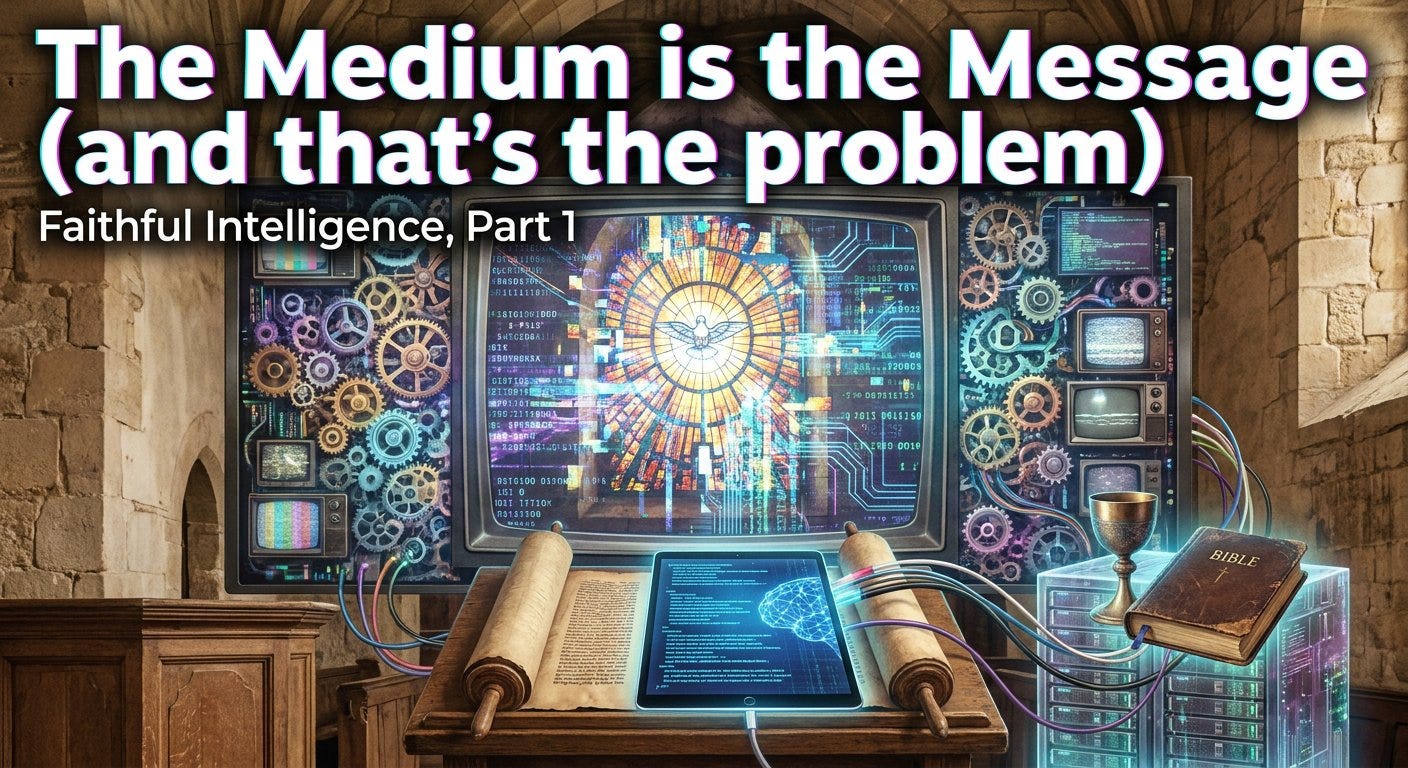
I’ve been carrying a quote around in my head for a few months now.
It’s not from a tech conference, not from an AI power user thread, not from a white paper on digital transformation, and not from someone’s twitter feed. The quote’s from a Canadian media theorist who died in 1980, and it may be the most important thing anyone has said about artificial intelligence without ever having seen it.
Marshall McLuhan wrote,
“The medium is the message.”
Most people read that line and nod like they understand it. I confess… the first time I read it, I just sort of skipped right over it. Then it hit me. The same people who think they understand it are the same people who are asking AI to rewrite their emails.
After reflecting on his book, here’s what I believe McLuhan meant, and why it’s a vitally important conversation the church is not quite having yet.

We Keep Asking the Wrong Question
Every time a new technology shows up, we ask the same question.
What can this do for me?
The printing press. The telephone. Television. The internet. The smartphone. Now AI. We’ve always led with utility. What can I do faster? What can I do cheaper? What can I do that I couldn’t do before?
Those aren’t bad questions. They’re just not the first question we should be asking.
McLuhan’s insight was simpler and stranger than most people realize. He wasn’t saying the content doesn’t matter. He was saying the container shapes you before the content ever reaches you. The medium doesn’t just carry the message. The medium is a message. It’s one you’re receiving whether you’re paying attention or not.
Television didn’t just deliver news. It restructured how we process information, shortening attention spans, turning ideas into images, making us comfortable being passive consumers of someone else’s reality. We didn’t decide to do this. It happened to us. The medium shaped us while we were busy watching the content.
The printing press didn’t just distribute the Bible. It restructured how Europeans thought, moved authority away from oral tradition and toward text, and made the individual reader the final interpreter of meaning. That wasn’t a choice. It was an effect of the innovation.
Every medium does something to you. The question is whether you notice before it’s too late to be intentional about it.
What AI Is Actually Doing
Here’s what I’ve noticed, and I say this as someone who works in, teaches, and speaks about AI. I also use AI every single day.
AI is very good at making things feel easier than they are.
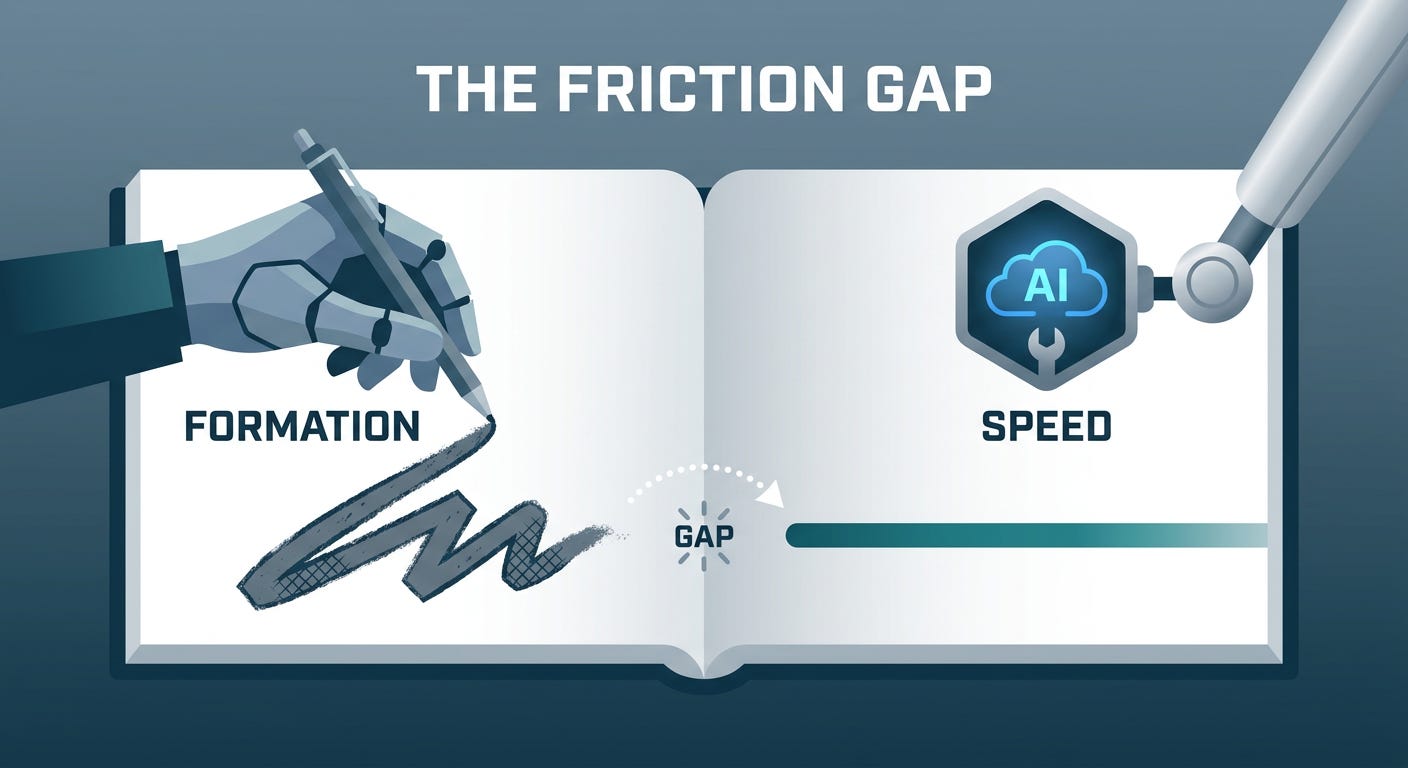
I don’t mean it’s deceptive. I mean it removes friction. And friction, it turns out, does more for us than we give it credit for. The struggle to find the right word teaches us something about the word. The difficulty of organizing a complex argument forces us to actually understand it. The time it takes to draft a letter from scratch makes us think carefully about whether we should send it at all.
When AI takes friction away, it takes some of that formation with it. The intern learning the context and process that’s intuitive for the five-year worker can’t really be replicated by AI.
There’s a subtler effect too. AI rewards fluency over depth. It produces content that sounds authoritative whether or not the ideas underneath it are sound. AI optimizes for output, for completion, for the appearance of done. Left unchecked, it trains us to mistake activity for thinking.
In the church, which is already fighting a cultural tendency toward shallow engagement, performative productivity, and the appearance of fruitfulness over the reality of it, is walking into this without nearly enough conversation about what the medium is doing to us.
The Specific Problem for Ministry
Hear what I’m saying carefully. I’m not making a technophobe argument. Far from it! I’m making the opposite argument.
The church needs to engage AI. Seriously, strategically, and now. We can’t afford to ignore AI, but there are things about ministry that the medium of AI works against.
Presence.
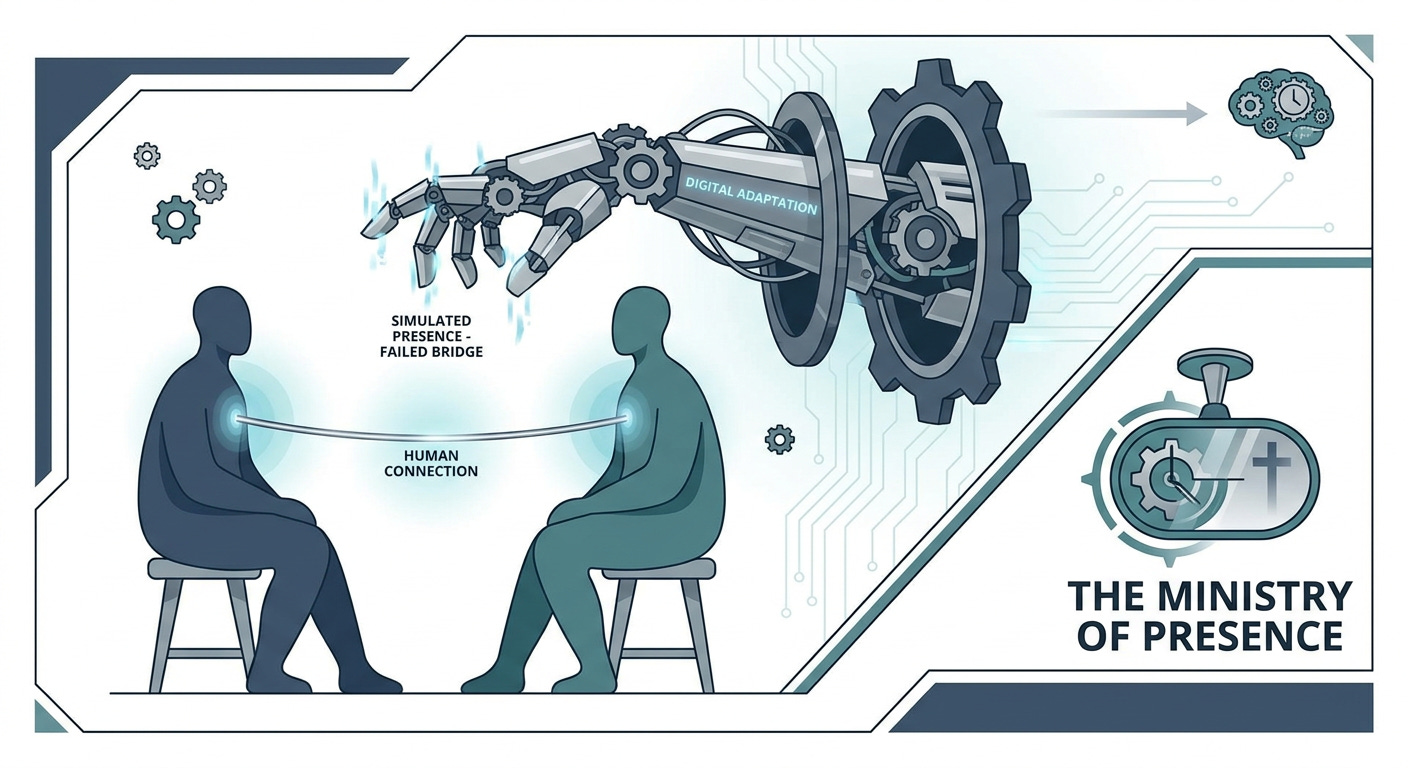
The gospel travels through people. Not content and not information… People. Twenty-four years of overseas mission work taught me that presence is not optional. You can’t disciple at scale without presence. You can’t intercede for someone you haven’t sat with. AI is very good at simulating presence, but make no mistake about it. AI is not presence and can’t be presence.
Formation.
Discipleship doesn’t happen overnight. Scripture works on us over years. The spiritual disciplines exist precisely because the God of the Bible is interested in who we’re becoming, not just what we’re producing. A medium that rewards speed and volume is in tension with that from the start.
Dependence.
Prayer assumes that we need something we cannot generate ourselves. That posture, of genuine dependence on the God of the Bible, is one of the first things efficiency culture erodes. AI is very good at filling gaps. The problem is that some of those gaps are supposed to stay open.
None of this means AI is our enemy. It means AI is a tool with a character, and that character shapes us.
What McLuhan Would Tell Us to Do
McLuhan wasn’t anti-technology. He actually spent his career studying it because he thought understanding it was the only hope of not being consumed by it.
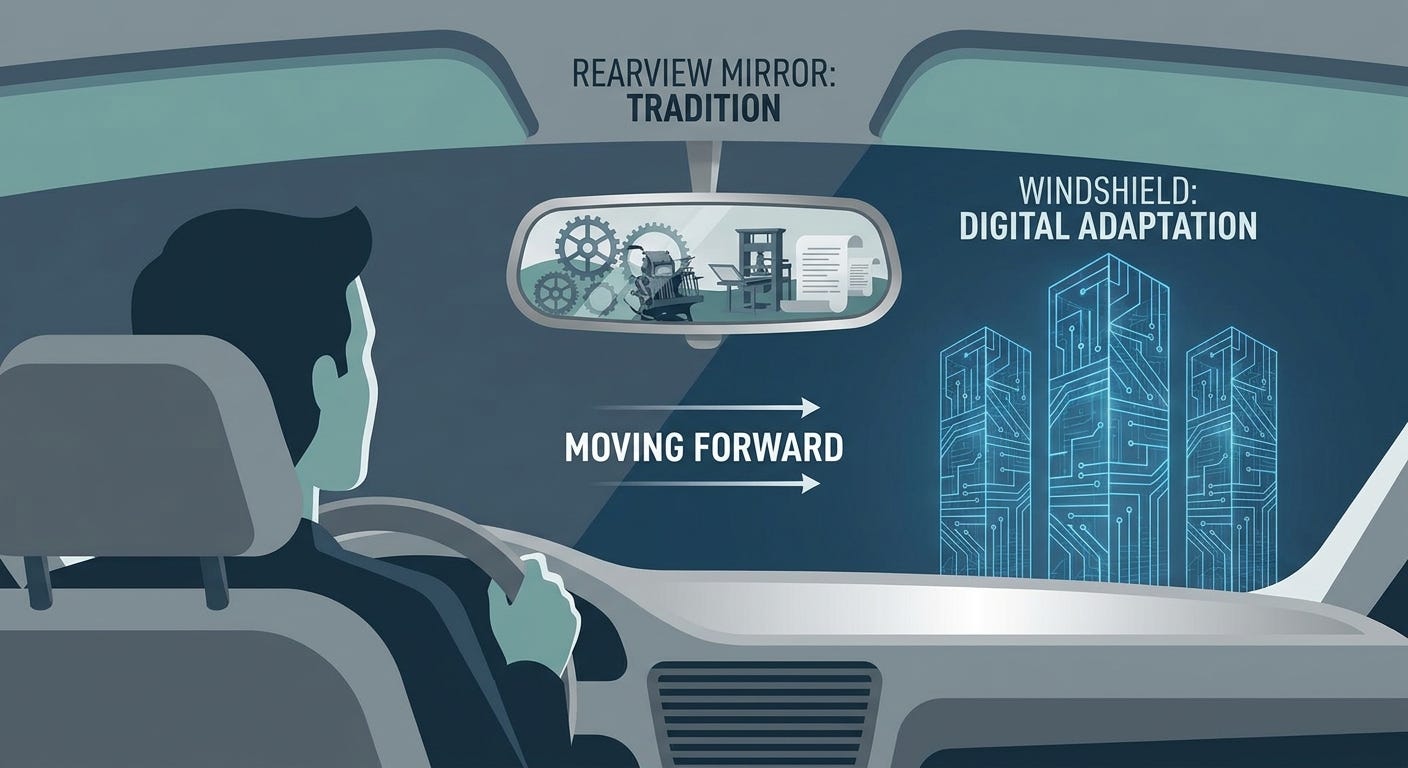
His prescription was what he called the “rearview mirror” problem. We tend to understand new technologies by looking backward, by seeing what they replace and only noticing their effects after they’ve already shaped us. The antidote is to look forward, to ask what a technology will do before it has done it.
That’s what this series is going to be about… Let’s look forward and not just look back at what;s changed.
Before the church decides how to deploy AI, we need to ask what AI will do to the church. Before ministry leaders start automating workflows, researching sermons with AI assistance, or building chatbots to engage their congregation, we need to know what they’re actually picking up.
Faithful intelligence isn’t intelligence that refuses AI. It’s intelligence that picks up AI with its eyes open, with a theological framework in hand, and with enough self-awareness to notice when the medium is changing us.
That’s the project I’m starting today.
Over the next several articles, I’m going to work through the framework I’ve been developing. What it means to use AI as a supplement rather than a substitute. What the image of God tells us about what AI can’t do. Where efficiency thinking goes wrong. What AI simply cannot replicate. And what a thoughtful AI governance posture actually looks like for a ministry organization.
I use AI tools more than your average user. I’m not standing outside looking in. I’m certainly not a naysayer when it comes to AI. This series is a practitioner’s conversation, from someone who believes the Great Commission and the rise of AI are on a collision course that the church is not yet ready for.
Let’s get ready.
Next: Supplement, Not Substitute. The central theological argument for how the church should hold AI.
This is a great start to the series. I really hope you are going to speak more about the following: "And friction, it turns out, does more for us than we give it credit for."
Fiction is uncomfortable, time consuming, frustrating and many people do everything to avoid it.
But it is necessary for growth, learning and wisdom. I don't hear people speak about friction enough, yet we experience it daily. If AI is able to ease or minimize the friction, we could be losing something very valuable for ourselves.
“The gospel travels through people. Not content and not information… People.” What a timely reminder.