


How long does it take to make a decision?
I’m not talking about the big, existential decisions. Those get plenty of attention. I mean the medium ones. These are the ones that require data, input from a few people, and a clear-headed assessment of tradeoffs. The kind of decision that, in theory, should take a day or two at most, but in practice takes a month.
A month of emails. A month of waiting for the right people to get in the same room. A month of gathering data that already exists somewhere in the organization but nobody can find quickly. A month of building a presentation that summarizes the data for the people who need to decide.
And after the month goes by, the meeting gets rescheduled.
Sound familiar? This has happened to me more times than I can count.
Slow decisions are a symptom
Having talked to lots of people about the problem of slow decisions, I was surprised that many people saw this as an inevitable necessity of working on teams, especially in large organizations. It’s just something you have to deal with. Others see these slow decisions as doing their due diligence, exercising caution, using wisdom, and being responsible.
Wrong.
Slow decisions are a symptom. And the disease isn’t insufficient caution, it’s a broken decision architecture.
Decision architecture is the system, formal or informal, by which your organization moves from question to conclusion.
It includes how data gets gathered, how options get evaluated, who gets a voice, what gets escalated, and how long each step takes. Most organizations have never designed this system intentionally. It’s just evolved and like most things that evolve without intentional design, it’s full of inefficiencies, redundancies, and cultural baggage from decisions made years ago that nobody remembers making.
The AI-driven organization redesigns this system on purpose. AI is the tool that makes this redesign possible. In large organizations, it simply wasn’t possible before AI.
The Goal
There’s a big difference between faster and better. Faster decisions made with bad information or insufficient analysis are just confidently wrong decisions. The AI-driven organization isn’t trying to skip steps. It’s trying to eliminate the steps that don’t add value, the waiting, the searching, and the synthesizing. This allows the steps that do add value to get the time and attention they deserve.
The goal isn’t faster decisions. The goal is better decisions, made in less time.
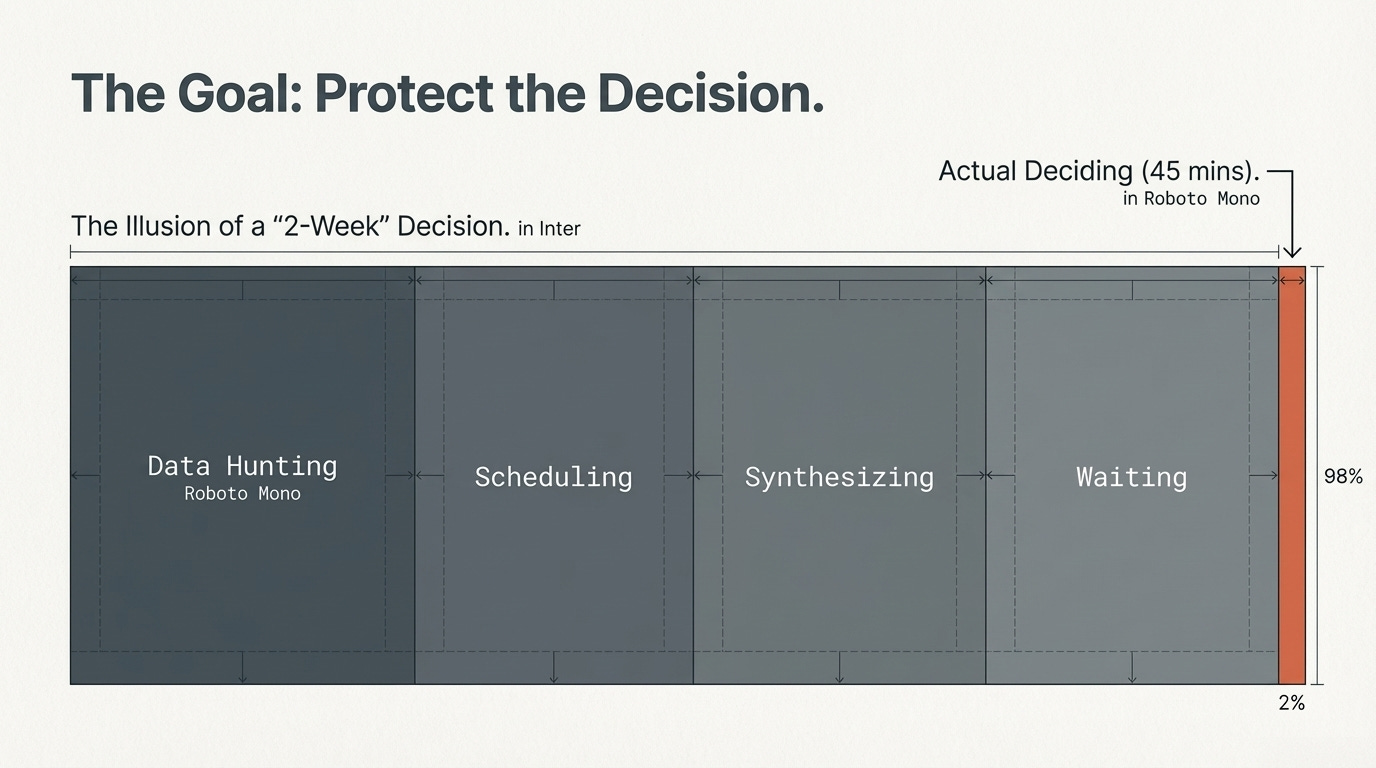
Think about where time actually goes in a typical decision cycle.
Someone hopefully identifies the question that needs an answer. (You’d be surprised at how often this step is skipped)
They spend days gathering data from three different people and systems that don’t talk to each other.
They spend days synthesizing the data into something readable.
They spend half a day building a deck to present it.
They schedule a meeting.
The meeting eventually happens.
The decision gets made (or deferred). In the end, that meeting probably lasted 30 to 45 minutes.
Out of this overly optimistic two-week decision making process, less than an hour of it was actual decision-making. The rest was gathering information, logistics, formatting, and waiting. In reality, most decisions take much longer than two-weeks.
AI can compress the logistics of decision making dramatically. AI’s not cutting corners, it’s actually protecting the decision itself.
Three Requirements for Effective Decision Making
What does a redesigned decision architecture actually look like?
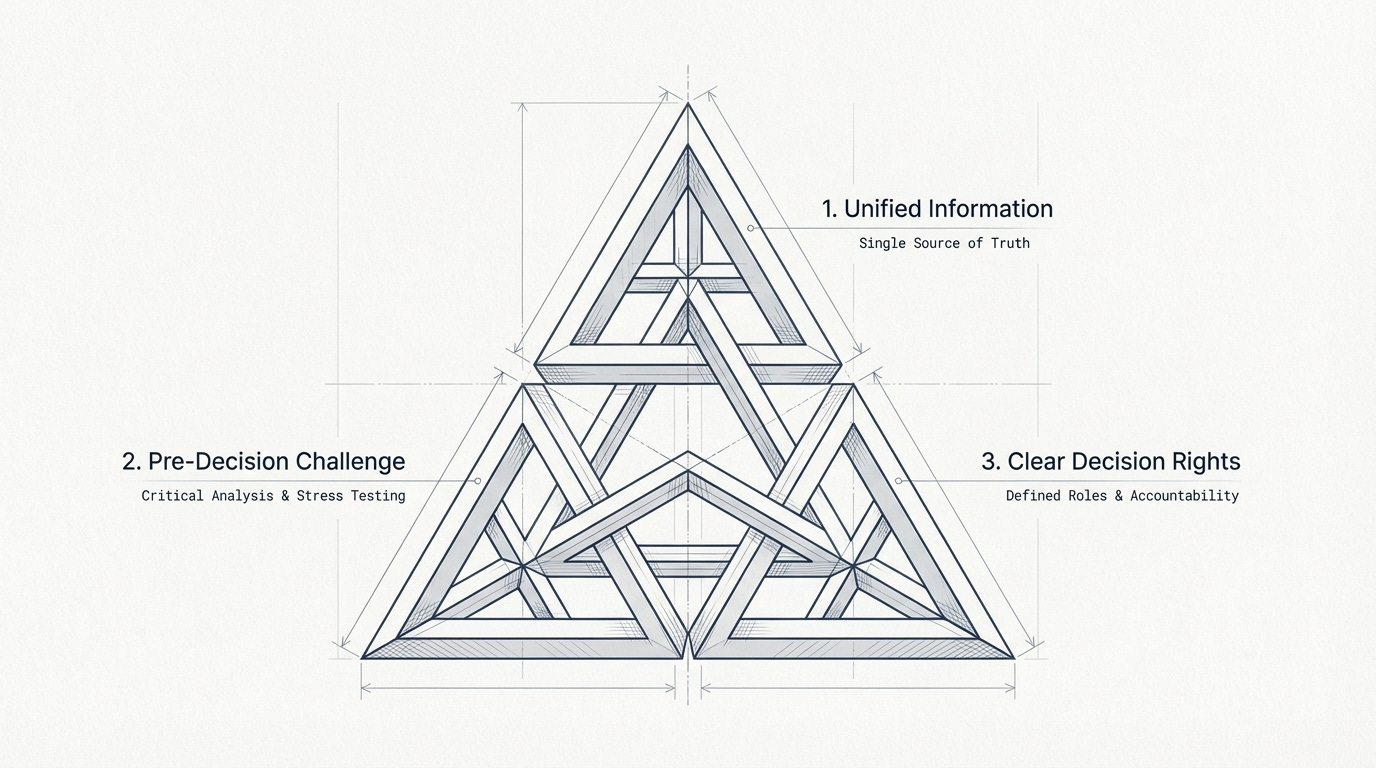
The AI-driven organization builds three things into how it makes decisions.
A Unified Information Layer
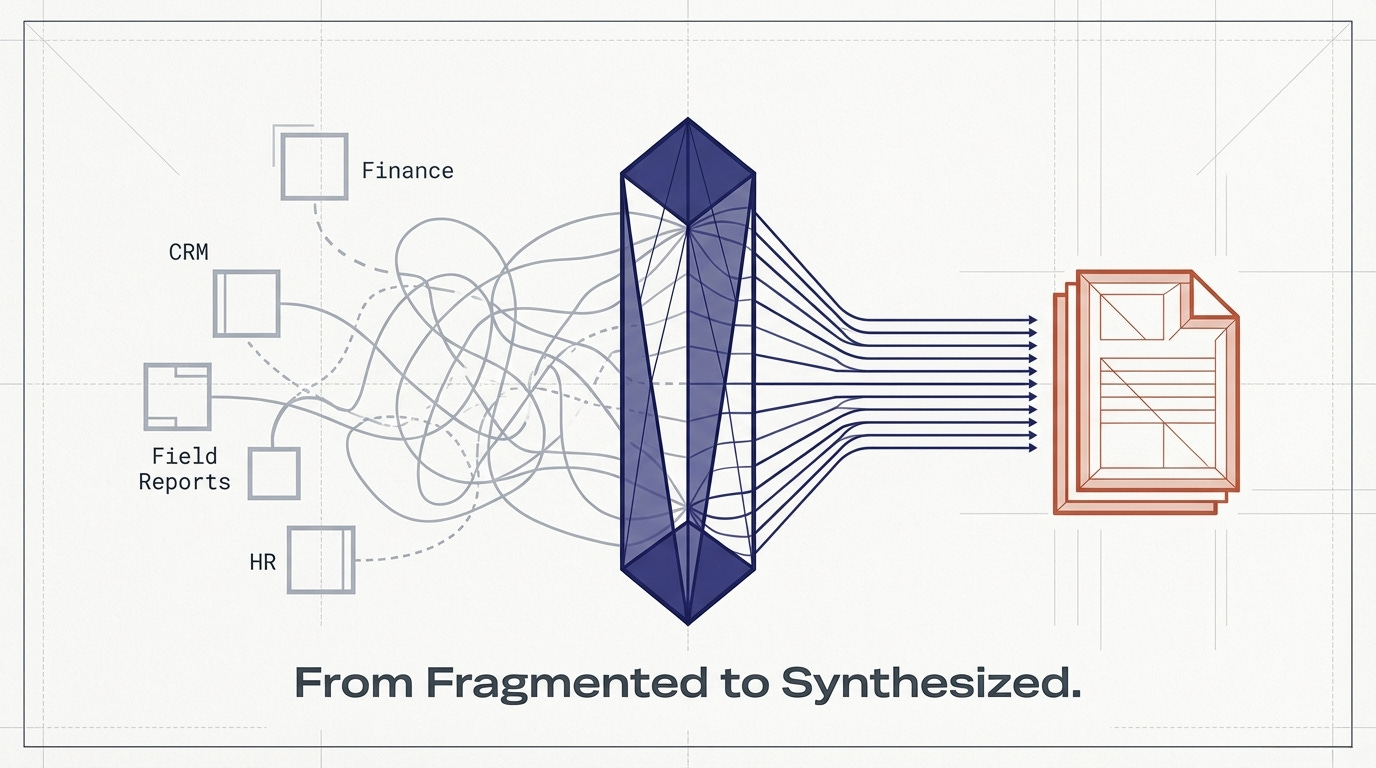
One of the most common friction points in organizational decision-making is that the data exists, but it’s distributed across systems that don’t talk to each other. CRM here. Finance there. Field reports somewhere else. HR data in another tool entirely. The person trying to make a decision spends most of their time finding and reconciling information rather than analyzing it.
AI doesn’t fix broken data infrastructure on its own, but it dramatically lowers the cost of synthesis once the data exists. An AI-assisted briefing can pull from multiple sources, identify patterns, surface anomalies, and present options in a fraction of the time a human analyst would need. Organizations that invest in making their data accessible are the ones that see the biggest returns from AI in their decision cycles.
A Pre-Decision Challenge Process.
This is the CRIT framework from Geoff Woods and discussed in Article 4 of this series, applied specifically to decisions. Before any significant decision reaches the approval stage, it goes through a structured AI-assisted challenges:
What assumptions are we making?
What alternatives haven’t we considered?
What’s the strongest case against the option we’re leaning toward?
What do we not know that we should?
This isn’t red tape. It’s challenging the definition of the problem and solutions. The thirty minutes spent on a pre-decision challenge can save six months of course correction later.Clear decision rights.
This one has nothing to do with AI, but AI makes the absence of it more painful. When decision rights are unclear, everything escalates. Every medium level decision becomes a senior-leader decision because nobody is sure who has authority to decide. AI can help you move faster, but if every decision still needs to travel up three levels of the org chart before it gets made, the speed gains will disappear.
The AI-driven organization is also clear about who decides what. AI informs. Humans decide. And the humans who decide are the ones closest to the relevant information and context. Note, this is not necessarily the most senior leader in the room.
Values
Slow decisions in faith-based organizations are often defended as spiritual discernment. The truth is, sometimes they are because of spiritual discernment. There are decisions that genuinely require prayer, waiting, community input, and time. I’m not arguing against that.
But there’s a difference between Spirit-led patience and organizational paralysis masquerading as spiritual language.
I’ve watched organizations spend eighteen months “discerning” a decision that had a clear answer in month three. The waiting wasn’t producing more clarity. It wasn’t building momentum. Quite the opposite. It was producing more anxiety, more drift, and more lost opportunity. The mission was moving on without them. I’ve said it other articles, but it’s worthy of repeating:
Caution without action isn’t wisdom. It’s just slower failure.
The AI-driven organization learns to distinguish between decisions that genuinely require extended discernment and decisions that just feel uncomfortable. For the latter, AI can help compress the timeline without compromising the quality of the outcome. For the former, AI can help prepare the ground, gathering the information, modeling the scenarios, surfacing the tradeoffs, so that when the moment of decision comes, it’s informed rather than impulsive.
Today’s Challenge
Pick a decision your organization is currently sitting on. One that’s been in process longer than it should. Then ask honestly: Where is the time going?
Is it waiting for data that should already be accessible?
Is it waiting for a meeting that keeps getting rescheduled?
Is it waiting for a leader who hasn’t given a clear recommendation?
Is it waiting because the decision rights are unclear?
Is it waiting because no one knows who is supposed to make the decision?
Map out your decision architecture on a whiteboard. Find the bottleneck. Then ask the question, “What would AI need to do to cut this time in half?”
The answer is usually simpler than you think.
The AI-driven organization doesn’t just make faster decisions. It makes better ones because it stops wasting the time that should be spent thinking on the time spent just trying to find the information to think with.
Article 6 of 10 in “The AI-Driven Organization” series. Next up: The Bias We Don’t See — every organization has assumptions it’s been protecting without knowing it, and AI has a way of finding them.