


Let me describe a day that probably sounds familiar.
You begin the day with the best intentions. You have a list of high value activities you plan to accomplish. Things that actually matter and could move the mission forward.
Then this day happens to you.
An urgent email needs a response which creates four more emails. A meeting runs long. Someone needs a decision that only you can make. A report is due. A donor update needs sening. A team member has a crisis. Before you know it, it’s the end of the day and the strategic work, the real work, is still sitting on the back burner where it began early in the morning.
You didn’t fail at your job today. You just got swallowed by it. Now scale that up across your entire organization and consider the impact.
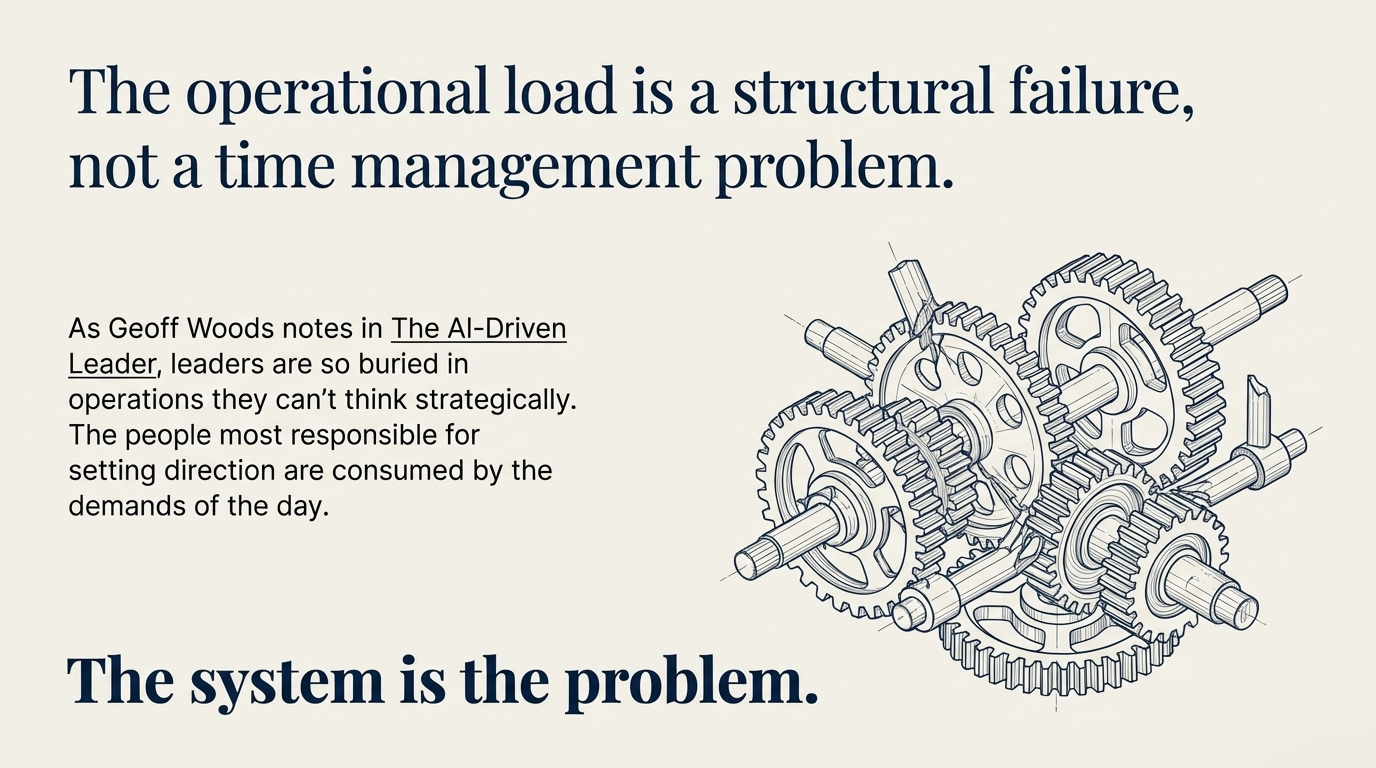
This is the operational overwhelm problem. It’s not a time management problem. It’s not a productivity problem. It’s a structural problem and it’s one of the primary reasons most organizations will never become truly AI-driven, no matter how many tools they adopt.
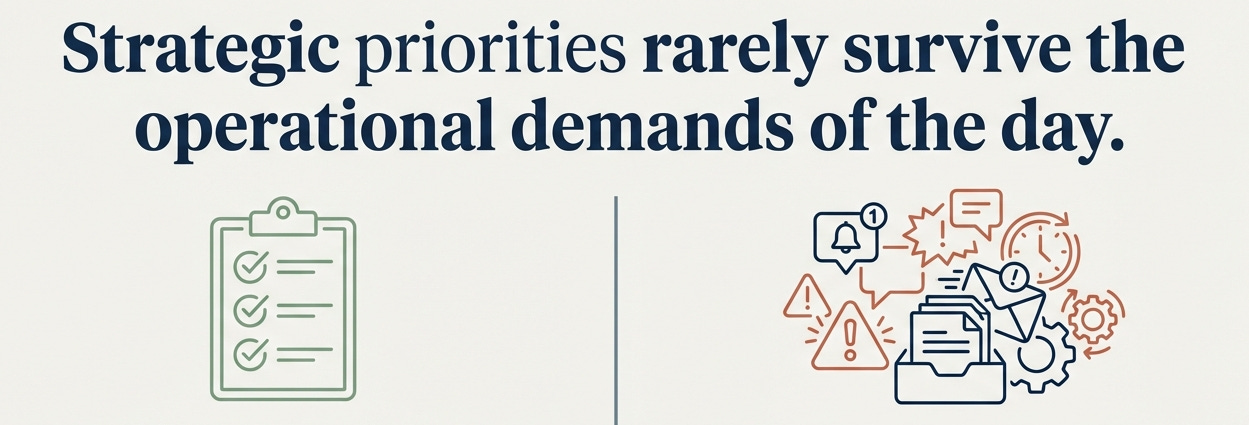
Geoff Woods puts his finger on it clearly in The AI-Driven Leader: most leaders are so buried in operations they can’t think strategically. The irony is brutal. The people most responsible for setting direction are the ones most consumed by the demands of the day. They’re running fast, working hard, but not going where the mission actually needs to go.
Most leaders are so buried in operations
they can’t think strategically.
Geoff Woods
It’s not just leaders who are drowning. It’s entire organizations.
Think about what operational overwhelm looks like at the organizational level.
Field workers generating reports that take hours to write, not because the work is complex, but because systems are broken. Teams producing content for one language when they need content in twelve. Finance teams manually reconciling data that should be automated. Teams onboarding new members with processes built ten years ago. IT departments putting out fires instead of building infrastructure for the future.
Everyone is busy. Genuinely, exhaustingly busy. In many organizations, most of the busy isn’t moving the mission forward. It’s just busy.
This is the gap that AI can close. Not by replacing people, but by removing the friction that keeps people from doing the work only they can do. That’s the 20x worker principle in practice. You don’t add capacity by adding headcount, you add capacity by removing things you shouldn’t be doing and for everything that shouldn’t require a human in the first place. People, Process, and Technology. Fix the Processes and Technology before addign more People.
What percentage of your team’s time is spent on work that actually requires a human?
Not work that humans are currently doing, instead, work that requires a human. Work where judgment, relationship, discernment, creativity, and presence are genuinely irreplaceable.
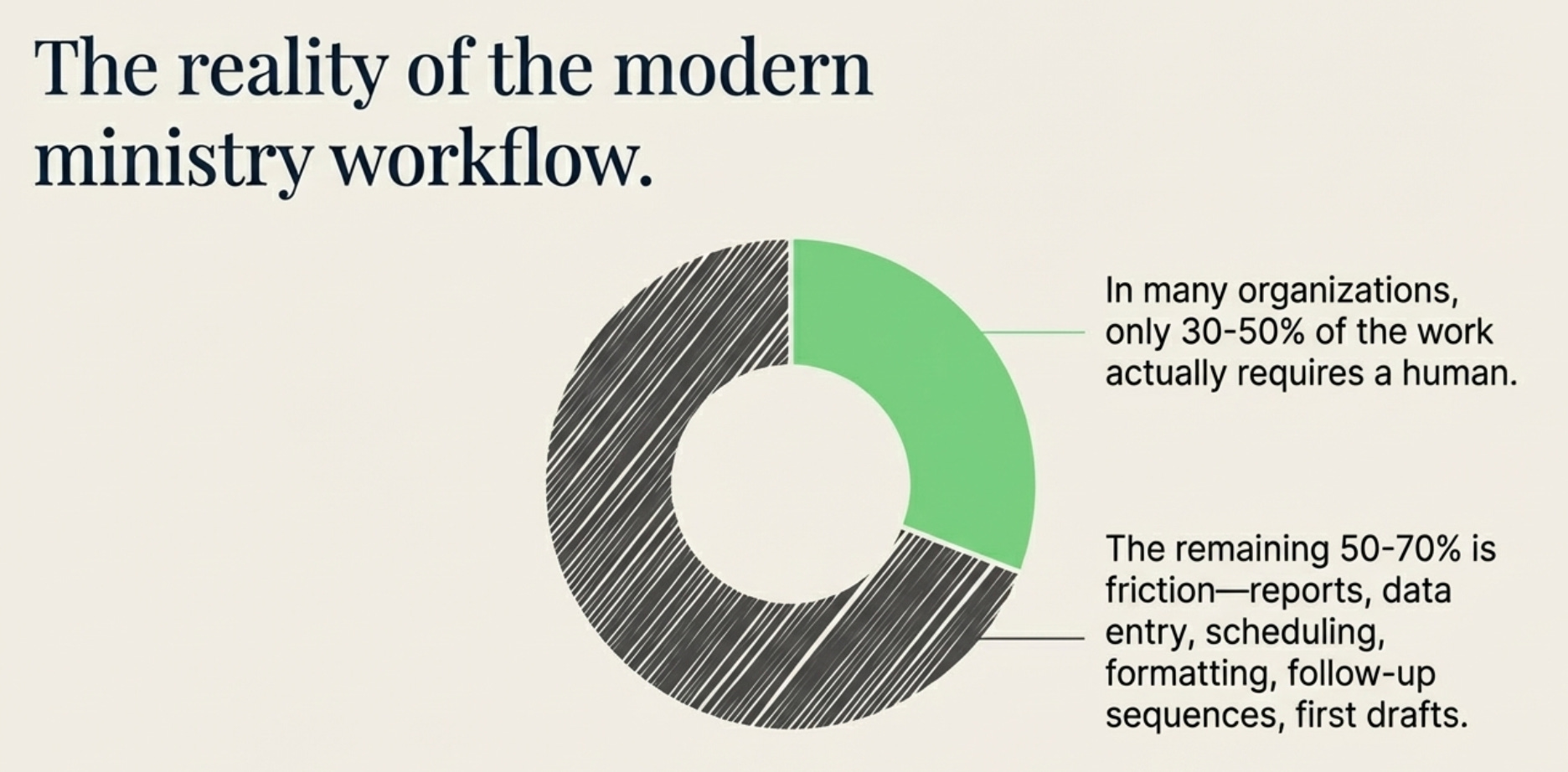
I’ve asked dozens of leaders this question. The honest answers are sometimes uncomfortable. In some organizations, the number is somewhere between 30 and 50 percent. The rest of the work, the reports, the data entry, the scheduling, the formatting, the follow-up sequences, the first drafts, and the research is work that AI can do, assist with, or dramatically accelerate.
The system is the problem.
So what does the AI-driven organization do differently?
It starts by asking a different question. Instead of “How do we get more done?” instead, it asks, “What are we doing that doesn’t need to be done by a human at all?”
That shift sounds simple. It’s not, because in most organizations, the operational load has been normalized for so long that people can’t see it anymore. The three-hour report is just how reports get done. The disconnected systems are just how information gets tracked. The manual processes are just how the organization works.
When organizations don’t have time to do what the system requires, too often, they get more people to do it.
Until someone decides it doesn’t have to be like this.
One of the frameworks from the 20x ministry article that I keep coming back to is this. The best person to identify what shouldn’t require a human is the person who feels the friction every day. The person who writes the same report every month. The coordinator who sends the same follow-up email every Monday. The administrator who manually compiles data that already exists in three different systems.
Ask your team, “What do you do all the time that feels like it shouldn’t require a human?”
Then build AI solutions for that.
I want to be clear about something because what I’m saying can be misconstrued.
The goal is not to automate everything. The goal is to protect the irreplaceable things by clearing everything else out of the way.
When a someone spends hours writing a report, those are hours not spent in relationship with the people they came to serve. When a worker spends half a day each week on administrative follow-up, that’s half a day not spent having the conversations that move people toward the mission field.
AI doesn’t replace the missionary. It gives the missionary their time back.
That’s not efficiency. That’s faithfulness. It’s stewarding the calling well and organizations that understand this, that frame AI adoption not as a cost-cutting measure but as a mission-expanding one, are the ones that are going to build something transformative.
Leadership challenge for this week.
Pick one team in your organization. One department, one function, one group of people, and an individual. Sit with them and ask a single question: “What tasks do you do every week that feel like they shouldn’t require a human?”
Don’t judge the answers. Don’t immediately jump to solutions. Just listen.
What you’ll hear is a map of where your organization is leaking time, capacity, and mission energy. It’s also a map of where AI can start doing its most important work, not replacing your people, but releasing them.
The AI-driven organization doesn’t ask its people to work harder. It asks the machines to work harder so the people don’t have to.
That’s the shift. And it starts with a single honest conversation.
Article 2 of 10 in “The AI-Driven Organization” series. Next up: AI as Thought Partner, Not Task Robot. because there’s a difference between using AI to do things faster and using AI to think better.