


Here’s how most organizations are using AI right now.
Someone discovers that ChatGPT can write a first draft of a newsletter in three minutes instead of three hours. Word spreads. A few more people start using it for emails, social posts, meeting summaries. Productivity numbers tick up. Leadership nods approvingly. A line item gets added to the annual report: “AI adoption underway.”
And that’s it.
They’ve automated a few tasks. Saved a few hours. Made a few processes faster. And quietly missed the most important thing AI can actually do for an organization.
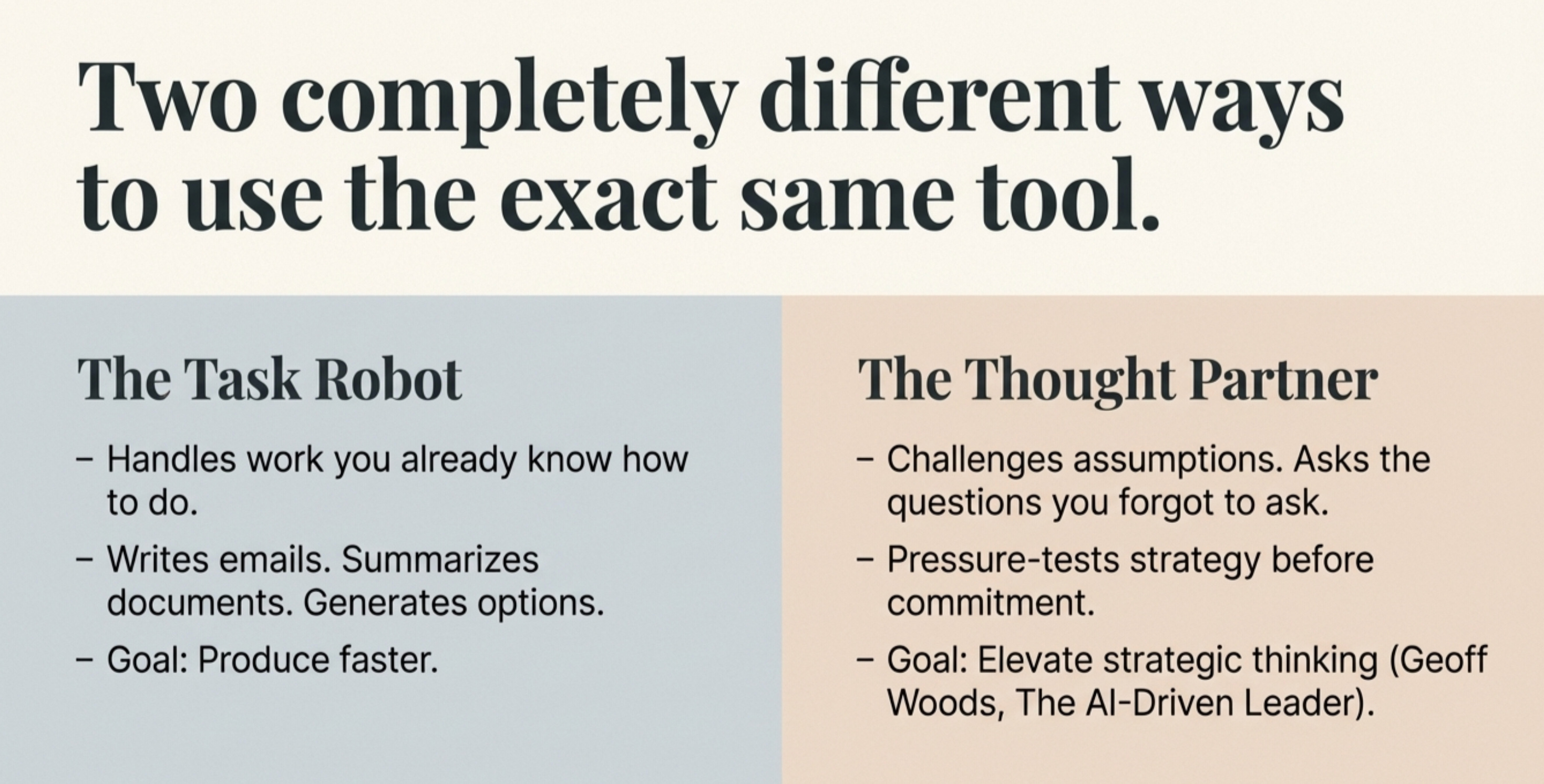
There’s a difference, a significant one, between using AI as a task robot and using AI as a thought partner.
The task robot handles the work you already know how to do. Write this email. Summarize this document. Generate three options for this social post. It’s faster, it’s useful, and it’s where almost everyone starts.
The thought partner does something harder and more valuable. It challenges your assumptions. It asks the question you forgot to ask. It pressure-tests your strategy before you’ve committed to it. It helps you think… not just produce.
Geoff Woods frames this well in The AI-Driven Leader: The goal isn’t to use AI to craft better emails. It’s to use AI to elevate your strategic thinking. Most organizations stop at the emails.
Wrong move.
Concrete Example
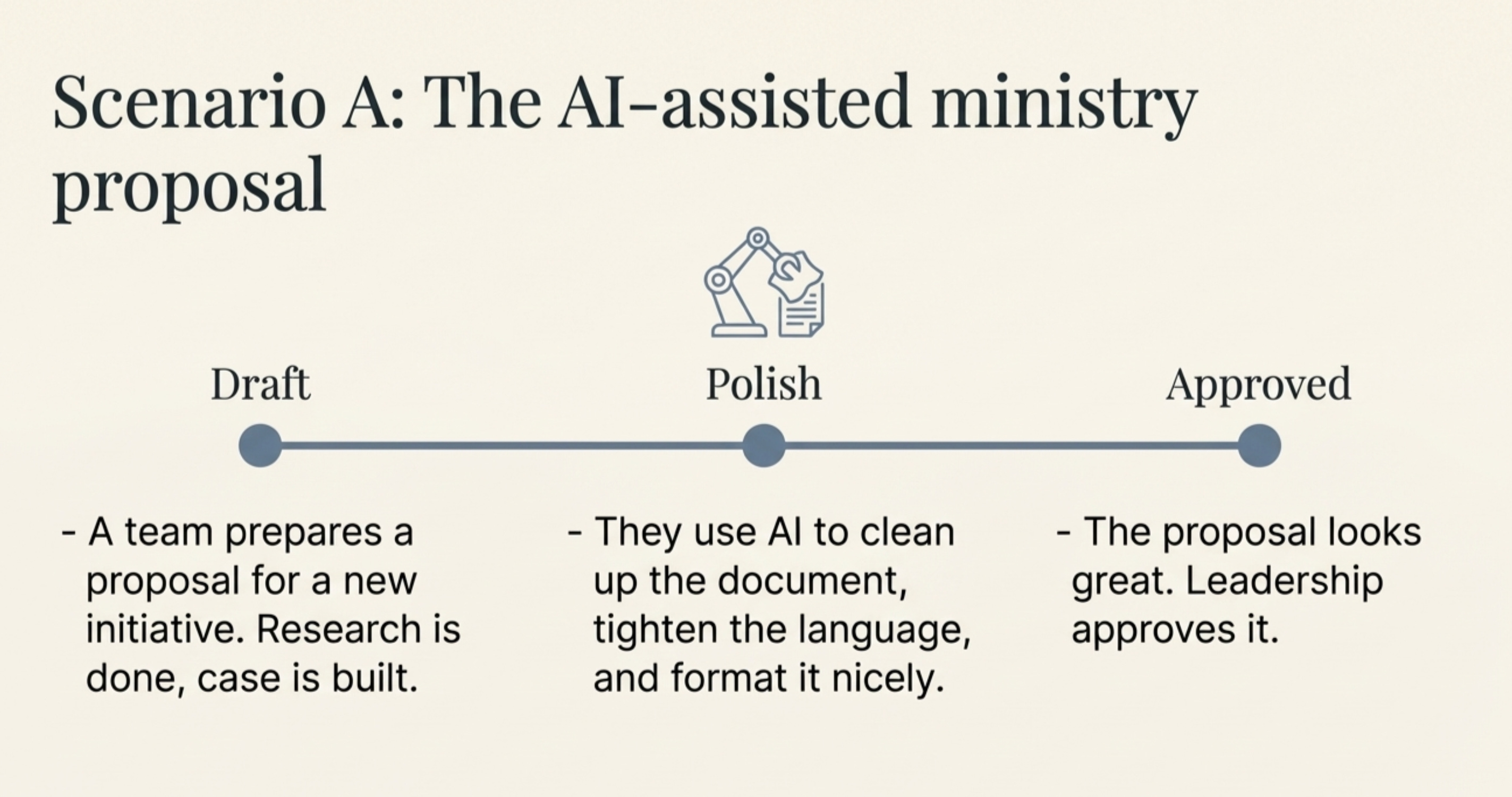
Scenario A: The AI-assisted ministry proposal
A team is preparing a proposal for a new initiative. They’ve done their research, built their case, and they’re confident in the direction. They use AI to clean up the document, tighten the language, and format it nicely. Proposal looks great and it’s approved.
Six months later the initiative stalls, for reasons that were visible in the assumptions all along. Nobody challenged them. The AI made the document better, but it never made the thinking better. No one asked it to.
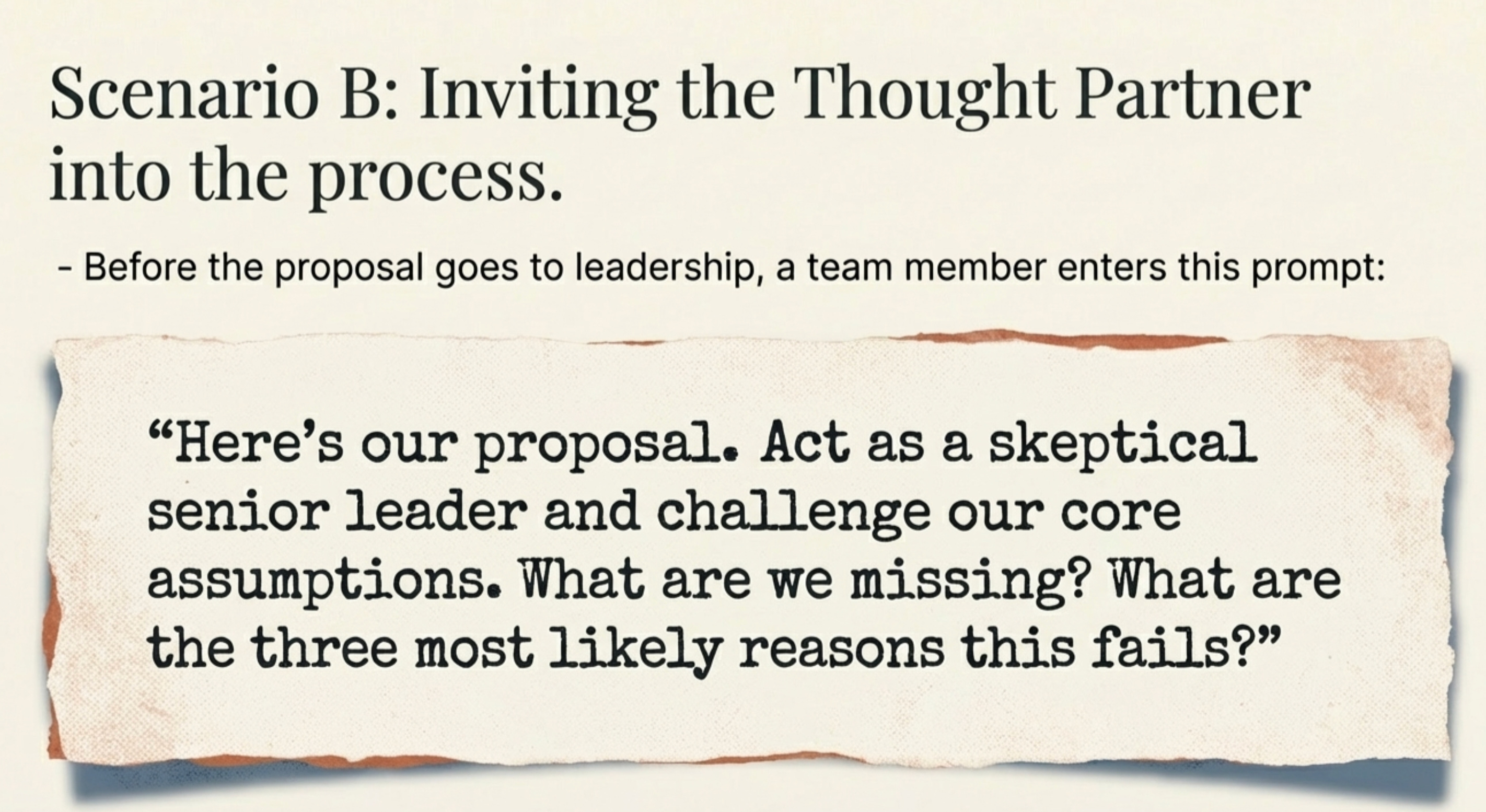
Scenario B: Inviting the Thought Partner into the Process
Now run the same scenario with AI as a thought partner.
Before the proposal goes to leadership, someone on the team prompts the AI: “Here’s our proposal. Act as a skeptical senior leader and challenge our core assumptions. What are we missing? What are the three most likely reasons this fails?”
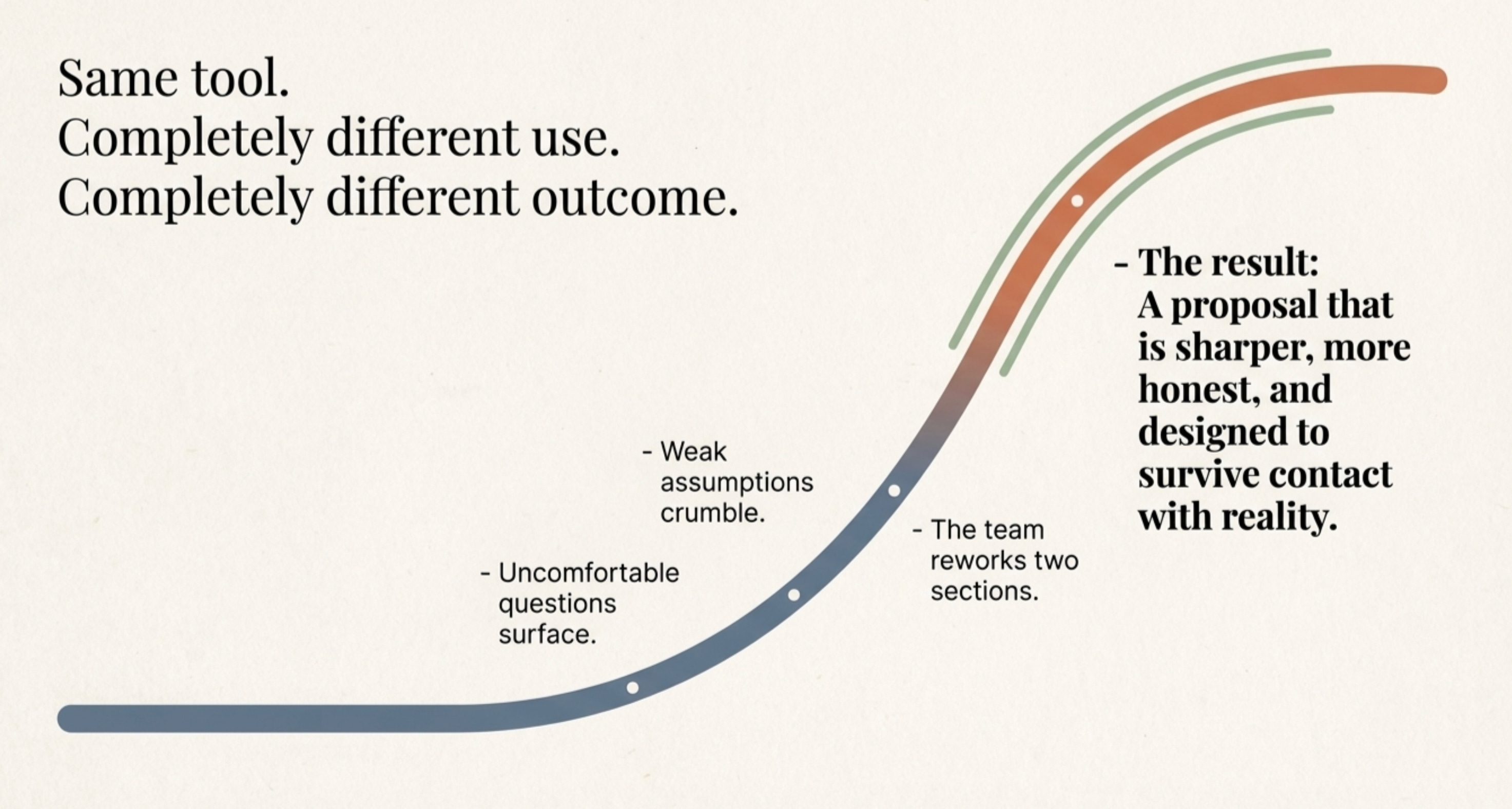
Uncomfortable questions surface. Some assumptions crumble. The team reworks two sections. The proposal is sharper, more honest, and more likely to survive contact with reality.
Same tool. Completely different use. Completely different outcome.
This is how I love using AI as a thought partner. To ask me the uncomfortable questions and to challenge my preconceived ideas.
This is the shift that separates organizations that tinker with AI from organizations that are genuinely transformed by it.
This is not primarily a technology shift. This a culture shift.
For AI to function as a thought partner at the organizational level, people have to be willing to have their thinking challenged… by a machine and before they present it to humans. That requires a level of epistemic humility that doesn’t come naturally to most institutions, especially ones with strong cultures, long histories, and deeply held convictions about how things should work.
Some people dabble in AI, but they stop short of real AI-transformation. Smart, gifted leaders who are completely comfortable using AI to produce content, but genuinely uncomfortable using it to question their conclusions. Because when AI challenges your strategy, it’s not just challenging your strategy. It’s challenging the culture and assumptions behind it.
That’s exactly why you should let it.
Practically, what does this look like at the organizational level?
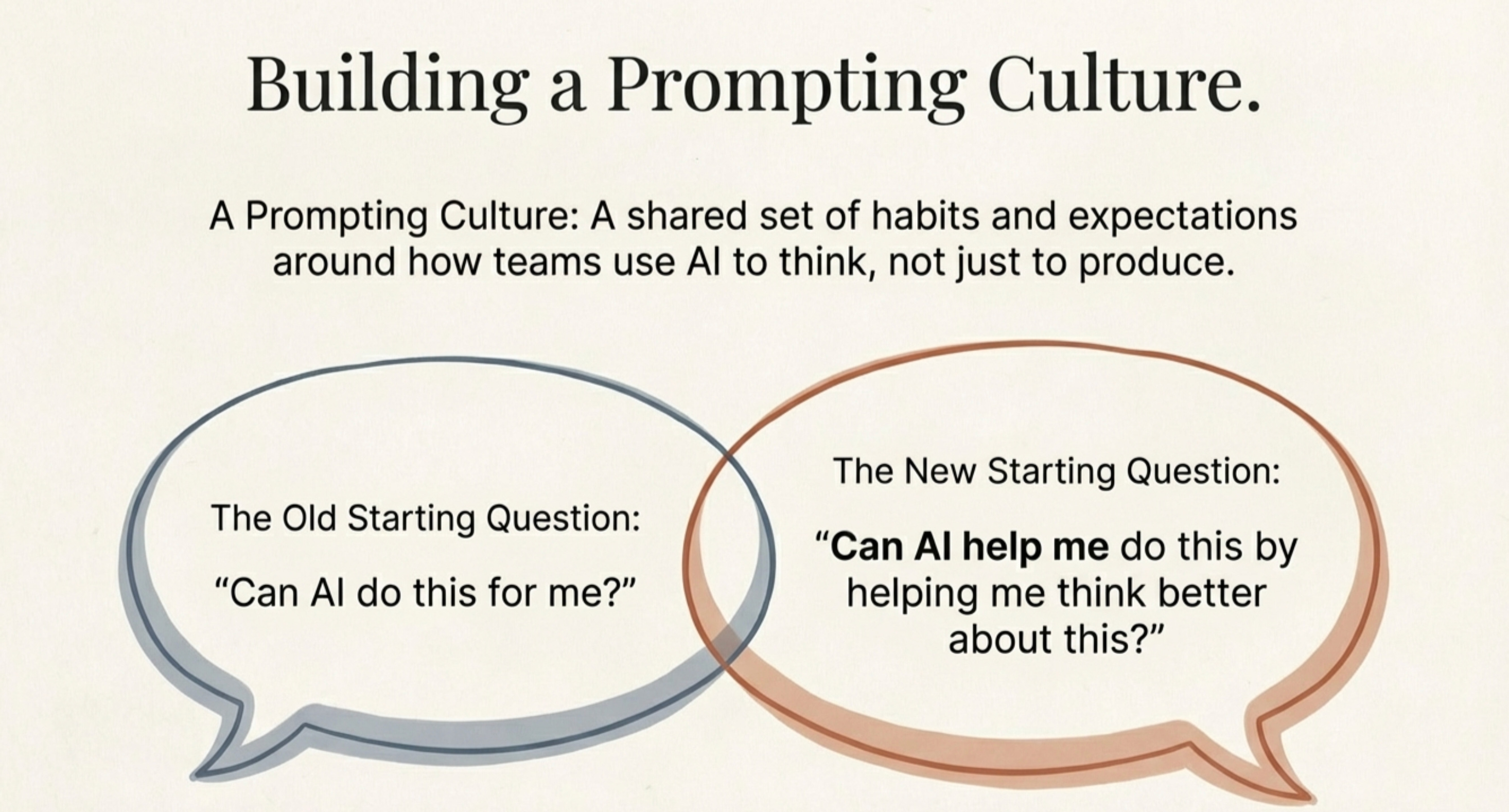
It starts with building what I’d call a prompting culture, a shared set of habits and expectations around how teams use AI to think, not just to produce.
A few examples of what this looks like in practice:
Before any major proposal or decision, someone on the team runs it through an adversarial prompt. “What are the three strongest arguments against this? What are we assuming that might be wrong?” Not to kill the idea, but to stress test it.
In strategy sessions, AI gets invited into the room as a thought partner, not as a note-taker. Teams share context, share constraints, and ask AI to generate options they haven’t considered, surface non-obvious risks, or identify where their goals are in tension with each other.
For individual contributors, the habit shifts from “Let AI do this task” to “Let AI help me think through this problem.” Workers don’t just ask AI to help write the report. They ask AI to help them identify what the most important thing to communicate actually is. The question becomes, “How might we?”
This isn’t complicated. It’s a different starting question. Instead of “Can AI do this for me?” the question becomes “Can AI help me do this by helping me think better about this?”
Here’s why this matters so much for faith-based organizations specifically.
Souls care for souls. Algorithms don’t care for souls.
Our work is irreducibly human. Relationship, presence, discernment, and prayer are things things AI cannot do. But the thinking behind our strategies, our proposals, our priorities? That can absolutely be sharpened by a good thought partner.
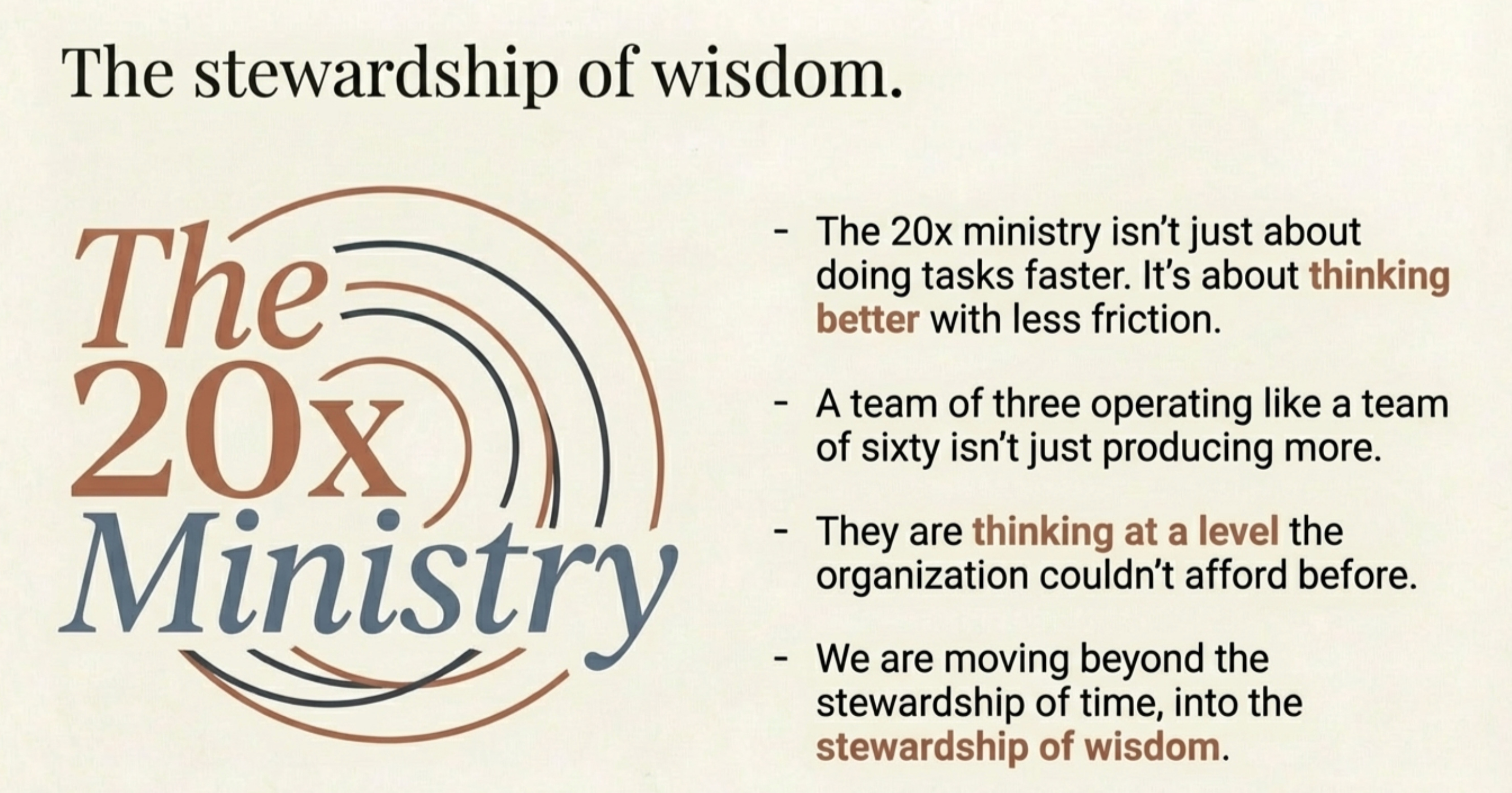
The 20x ministry isn’t just about doing tasks faster. It’s about thinking better with less friction. The team of three that operates like a team of sixty isn’t just producing more, they’re thinking at a level the organization couldn’t afford before.
This is stewardship. Not of time, but of wisdom. High value activities are actually given high value.
Practical Challenge:
The practical challenge for today is a small one, but it will feel uncomfortable the first time you do it.
Take something you’re currently working on, a proposal, a strategy, a plan, or a communication. Something you feel reasonably good about.
Then ask AI this:
“Here’s what I’m working on. Act as a thoughtful, honest critic.
What are the three weakest points in my thinking?
What am I assuming that I haven’t validated?
What’s the most important question I’m not asking?”
Read the response without defending yourself.
Then decide what to do with it.
That’s the difference between a task robot and a thought partner. And your organization needs the thought partner far more than it needs faster emails.
Article 3 of 10 in “The AI-Driven Organization” series. Next up: The CRIT Framework at Scale — a simple, repeatable way to build assumption-challenging into your organizational DNA.
In Claude Code, I have recently started naming the reviewers based on people I have known down through the years who best represent that reviewer's perspective. Then, when Claude presents a plan to implement some new thing, I respond with "Ask Sally and Jorge to review that". One of those is a CPA and one of those is a software architect.
Because the reviewers are defined in my CLAUDE.md (the prompt file for the main agent), Claude knows what kinds of reviews I'm asking for . The reviewers frequently disagree with me and with one another which tends to produce a better outcome than a single review.
I may be headed to a place where I just ask Claude to have the "Review Team" review a plan or something it produced to get the right blend of perspectives.
I see lots of value in using AI to stretch our thinking and bring in different perspectives. Great advice!