


Consider two organizations doing similar work with similar budgets.
The first has a communications team of eight. They produce content for three platforms, in one language, on a bi-weekly schedule, and they’re stretched thin. Requests pile up, the team is tired, and their leadership keeps asking for more. They keep explaining why more isn’t possible without more people. They need more headcount just to keep their head above water.
The second has a communications team of two. They produce content for five platforms, in nine languages, on a daily schedule. They use AI at every stage of the workflow. From ideation, drafting, translation, checking, scheduling, and performance analysis, they have incorporated AI. They’re not working harder. They’re working differently.
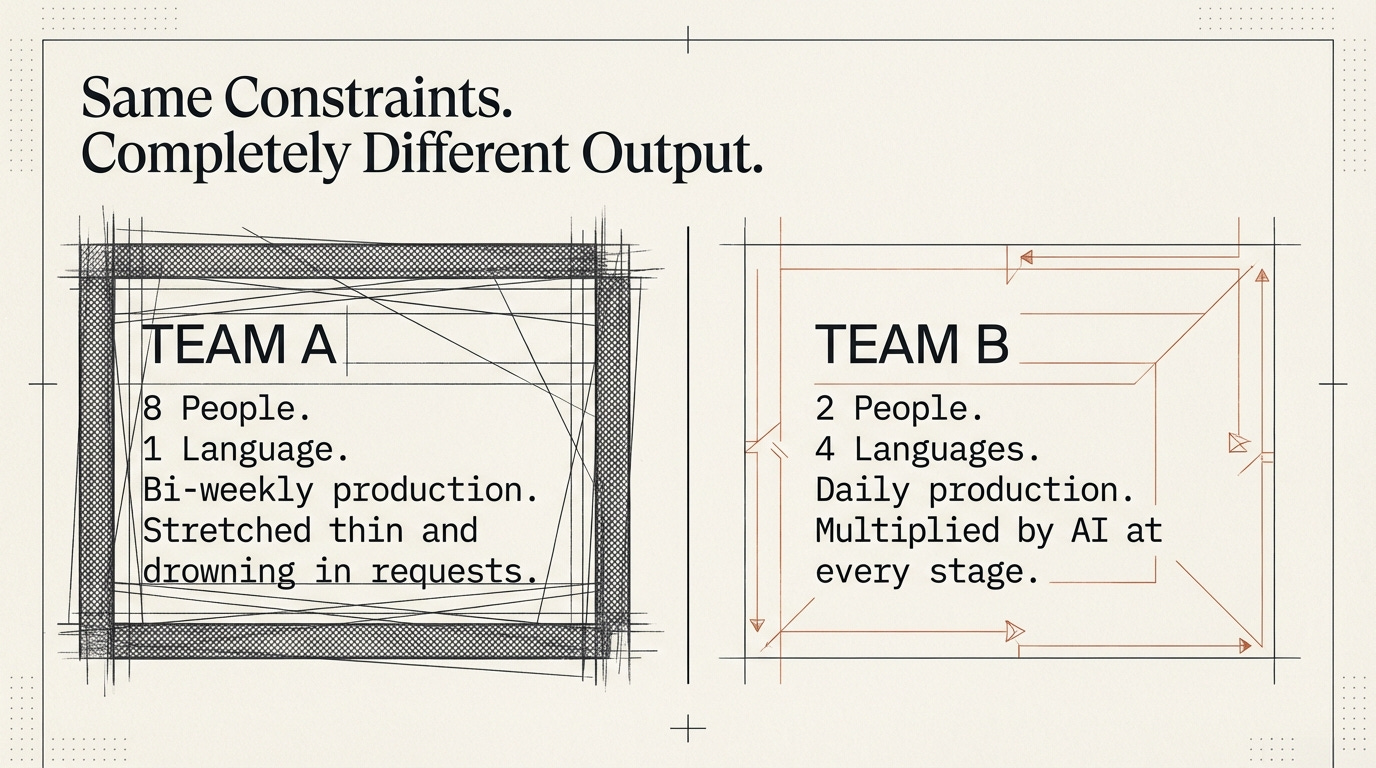
Both teams have the same space and same resource constraints. They have completely different output.
Most people look at the first challenge as a staffing problem. I propose that this isn’t a staffing problem. I believe that the problem’s not using technology to it’s greatest potential.
The concept of the 10x employee gets thrown around a lot in tech circles. Last week, I introduced the concept of the 20x Ministry. The idea is simple. Some people produce ten times the output of their peers, not because they’re ten times smarter or work ten times harder, but because of how they work, the tools they use, the processes they’ve built, and the friction they’ve eliminated.
AI has changed this equation for everyone.
The 10x employee used to be a rare individual with unusual skills and habits. Today, AI gives almost anyone the ability to dramatically multiply their output, but only if the organization builds the right conditions for it.
That’s the shift organizations need to understand. It’s not about finding 10x people. It’s about building 10x conditions and empowering 10x people. When individuals operate at 10x, teams of 10x people perform at exponentially greater performance. The outcome is even great than 10x. I suggest that the real outcome is closer to a 20x ministry!
Overpromises
Allow me to acknowledge something. I think the hype around AI multiplication often overpromises in the wrong places.
Some roles genuinely cannot scale with AI. The pastor sitting with a grieving family. The church planter building trust within a community. The counselor walking someone through trauma. The mentor investing in a young leader. Each of these roles require human presence, wisdom, discernment, and soul care. These are things AI cannot replicate and we shouldn’t try to us AI in these situations. If your job is primarily relational, AI isn’t going to multiply your output twentyfold. Nor should it.
Can AI help in these roles? Yes! Most roles exist on a spectrum and the support structures behind the irreplaceable human work absolutely can scale.
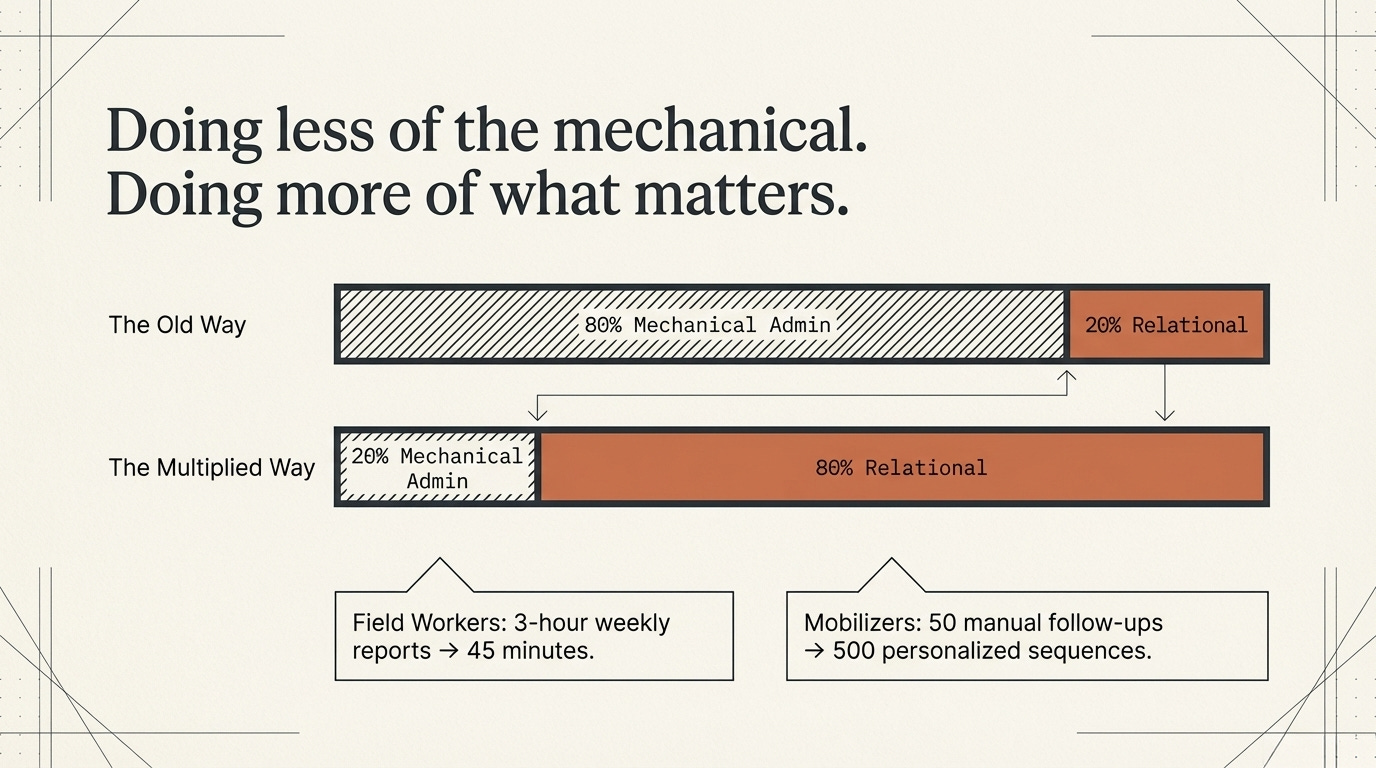
The field worker who spends five hours on weekly reports and admin work can now spend half an hour because AI handles the first draft, the formatting, and the synthesis. This leaves the worker to add the judgment and nuance only they can provide. That’s not 20x, but it’s meaningful, and it gives back hours every week that go directly back into the relational work.
Traditional thinking solves problems like these by assigning more people to admin roles to expand the work. Often, this expansion of admin workers results in more admin work because now, there is more capacity for admin work. No one feels the pressure to stop and ask, why are we doing this? Using AI allows us to redeploy admin roles are redeployed to mission critical roles?
The mobilization coordinator who used to manually follow up with fifty candidates a week can now create personalized communication sequences for hundreds of people because AI handles the sequencing and drafting while the coordinator handles the conversations that actually need a human. That might result in greater than 10x.
The videographer who used to spend six weeks tagging, renaming, organizing, and uploading hundreds of videos can now do the same work in a few days. Maybe AI can do it while the videographer is shooting new footage. This wouldn’t be a marginal improvement. This would be transformational
And then there are the examples that genuinely break the old paradigm. Work that used to require a team of multiple people across months. Things like research synthesis, translation projects, curriculum adaptation, data analysis, and grant writing can now be done by one person with the right skills much faster. These might not be jobs that just anyone can do, but the right people with subject matter expertise can multiply themselves many times over.
What’s Changed
Think about what has already changed in a single generation. A small legal team that once needed months and multiple associates to review thousands of documents for discovery can now do the same work in days, if not hours, with far fewer people. The human judgment is still required, but the mechanical reading is not.
A marketing team that once needed a staff of designers, copywriters, and translators to launch a campaign in three languages now does it with two people and AI handling the first drafts, the adaptation, and the formatting. The strategy is still human. The production is not.
A software development team that once spent weeks creating proof of concept code now delivers the same in hours.
A data analyst who once spent weeks cleaning and synthesizing spreadsheets now gets results in an afternoon.
A small business owner who once needed to hire a communications firm to produce professional content now does it solo.
These aren’t edge cases anymore. These are the new baseline for organizations that have figured out how to leverage AI. The work that required fifty people a generation ago might require five today. Not because people matter less, but because the tools have changed what’s possible.
In every case, the human isn’t doing less. They’re doing more of what matters. AI is doing more of what doesn’t require them.
This is the 10x principle applied at the individual level. Not ten times more staff. Ten times more capacity from the staff you already have with the work being more fulfilling and connected to what really matters.
How do we miss this?
Here’s where many organizations get this wrong. They deploy AI tools and expect multiplication to happen automatically. They buy the subscriptions, send the announcement email, maybe hold some training sessions, and then wait for productivity to go up.
It doesn’t work that way. Multiplication doesn’t happen because tools exist. It happens because people change how they work. And people change how they work when their organization gives them permission, time, and support to do so. Organizations change their structures because of the new AI reality.
It’s possible for gifted, capable people to sit on powerful AI tools for months without meaningfully integrating them, not because they couldn’t, but because the culture never signaled that it was safe to experiment, to iterate, to spend time building new workflows instead of just using the old ones faster.
You cannot buy your way to a multiplied team. You have to build your way there.
So what does building look like?
Three things have to be true for multiplication to happen at scale across your organization.
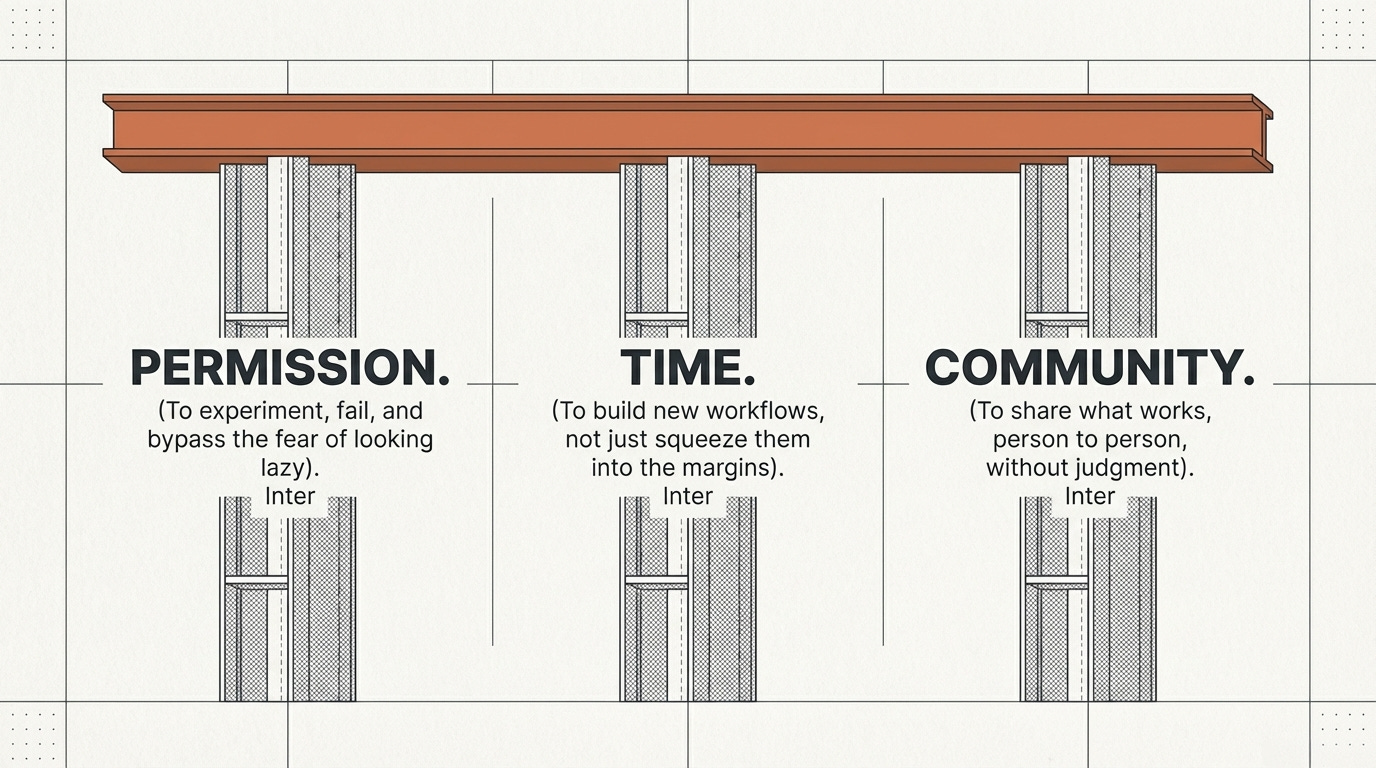
People need permission to experiment.
This sounds obvious. It isn’t. In most organizations, especially risk-averse, mission-driven ones, people are quietly afraid that using AI will be seen as cutting corners, being lazy, or producing inauthentic work. Leaders have to name this fear directly and dispel it. Not just once, but repeatedly, visibly, with their own example. When the leader says “Here’s how I used AI to prepare for this meeting,” that’s permission. That’s culture.
People need time to build.
The transition from old workflows to multiplied workflows doesn’t happen in the margins. It requires dedicated time to experiment, fail, iterate, and establish new habits. Organizations that expect people to transform their workflows while still hitting all their current deadlines are setting up for failure. Build in the time, protect it, and treat it like an investment, because that’s what it is.
People need a community to learn with.
The fastest path to multiplication isn’t a training video. It’s a colleague in the next office, or the next time zone, saying “Here’s what I tried, here’s what worked, here’s what didn’t.” Create the conditions for that exchange, a shared channel, a monthly rhythm, and lunch and learns. Create a space where people can show their experiments without judgment.
The Uncomfortable part
Not everyone will multiply at the same rate. Some people will embrace this and run. Others will move slowly, cautiously, or not at all. And leaders will be tempted to either force the pace or give up on the slower movers entirely.
Neither is right.
The people who resist aren’t lazy. These people often the most experienced and have the most invested in the way things currently work. They’ve built their competence around a set of skills and processes, and AI asks them to rebuild. That’s genuinely hard. It deserves patience, not just a mandate.
But patience doesn’t mean indefinite waiting. The mission is too important and the window is too short for organizations to let fear of change set the pace. In the AI-Driven Organization, I said:
Caution without action isn’t wisdom. It’s just slower failure.
The goal is a culture where multiplication is normal, expected, and celebrated. Where the question isn’t “Are you using AI?” but instead, “What has AI made possible for you this week that wasn’t possible before?”
That’s the question to contemplate today. This isn’t an audit. It’s an invitation to reflect.
The multiplied organization isn’t built from the top down. It’s built person by person, workflow by workflow, until one day you look up and realize your team of ten is doing the work of a hundred or more and still has time left over for the things that only humans can do.
Article 5 of 10 in “The AI-Driven Organization” series. Next up: The Decision Architecture — how AI-driven organizations collapse the time between data and decision, and why slow decisions are a values problem as much as a process problem.