


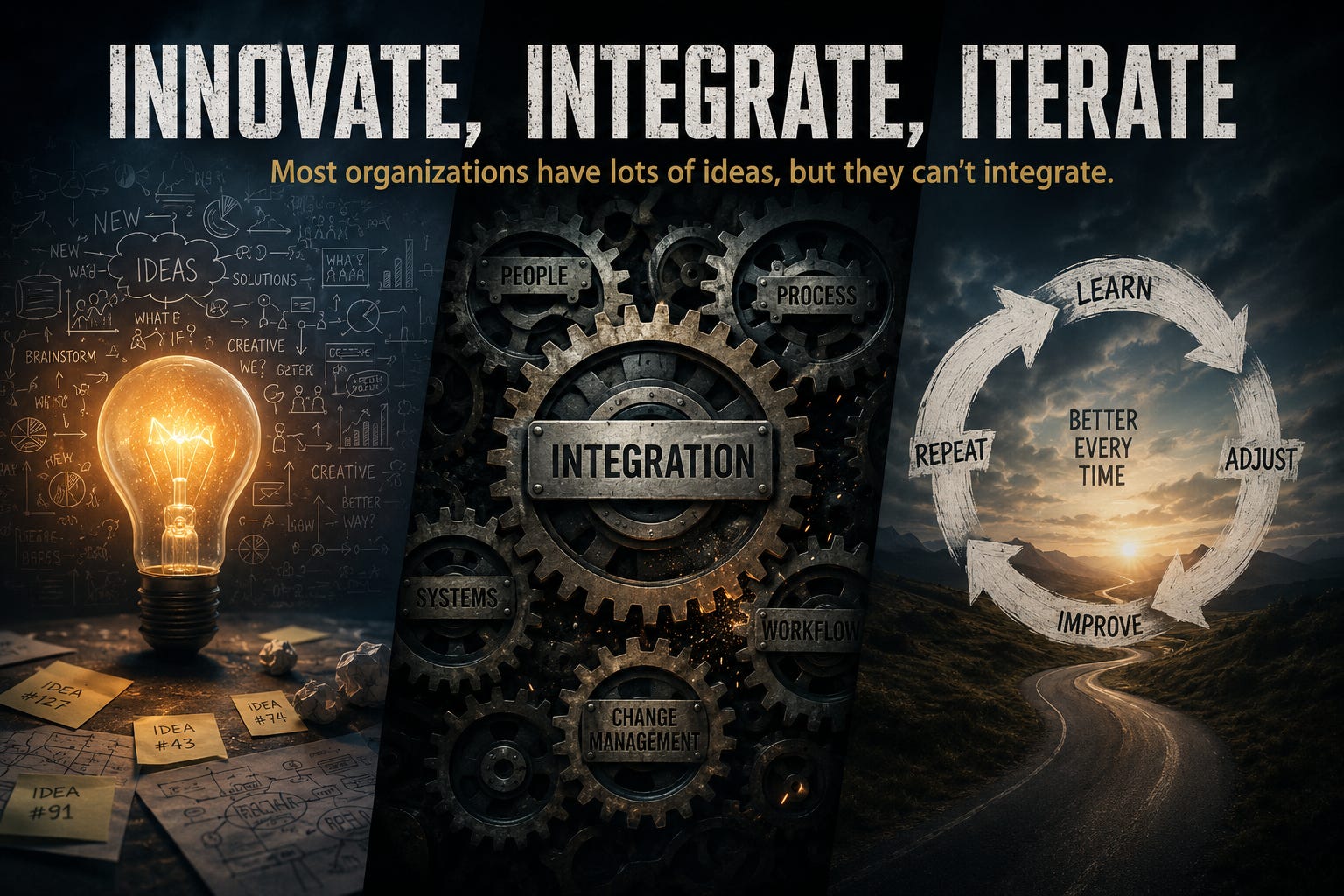
Allow me to clear up a myth. The problem in most organizations isn’t a shortage of ideas. Sometimes it is. Some places really have gone dry, and if that’s you, that’s a different article, but that’s not the common failure. Walk into many organizations and you’ll find whiteboards full of ideas, innovation offsite meetings, and a “culture of experimentation” printed on a wall somewhere. Ideas aren’t the scarce resource.
The breakdown happens after innovation. It occurs one step later. The breakdown happens at integration.
Confession time
As I wrote about in another article, I sometimes feel as though I have more ideas than any one organization could ever possibly integrate. That’s a problme that I’m learning to manage.
For a long time I thought the ideas were my contribution. Generate enough of them, throw them at the wall, some of them stick, and surely progress follows. It doesn’t. What actually happens is you build up a backlog of good thinking that never touches the real work. The idea gets applause in the meeting and then goes nowhere, because nobody owned the far harder question of how it actually fits into the way the organization already runs.
Innovation without integration is a graveyard of good ideas. Beautiful headstones, every one of them, but they’re still dead. The operationalization of the ideas is the challenge.
Why integration is the part nobody wants
I’ll say what is obvious. At least for me, innovation is fun… integration is not. If that’s you… surround yourself with people who find joy in the integration phase.
Innovation is the ideation session, the prototype, and the buzz of “How might we?” It’s celebrated. It sometimes gets a budget line and the leadership shout-out. Integration is the slow, unglamorous work of rewiring an actual workflow so the new thing survives contact with reality. It means changing how people already do their jobs. It means retiring something. It means somebody has to own the messy middle where the new idea and the old system grind against each other. It’s where the friction lives.
Nobody puts “Q3 integrating” on a highlight reel. Too often, we innovate, we get that dopamine hit, and we move on to the next shiny thing before the last one ever took root.
That’s why so many organizations feel busy and innovative, yet they somehow never actually change. At best, they’re stacking ideas, but not integrating them.
AI is making this problem a much bigger and not solving anything without intentionality. AI has made idea generation and iterative creation nearly free. You can produce a hundred plausible strategies before it’s time for lunch. The bottleneck is not enough ideas. It was always going to be whether your organization can absorb them into how it really operates. In an AI-saturated world, integration isn’t the boring step.
Integration is a design problem
When integration fails, we usually blame people. People didn’t adopt it or they resisted. As a result, they went back to the old ways of doing things. Most of the time the idea just wasn’t designed to fit or even be implemented.
How might we integrate better? It starts by recognizing the positive aspects of the existing system. The old workflow isn’t in your way. It’s the ground you have to build these new solutions upon. Integration asks harder questions than innovation ever does. What does this replace? Who has to change what they do on Monday morning? Where does this touch the three other things nobody mentioned in the brainstorm? What breaks if this works?
An idea that can’t answer those questions isn’t ready.
Then comes the part everyone forgets… iterate
Say you do the hard thing. You integrate. The new idea is live, running inside the real workflow, actually being used. You’re still not done. You’ve just reached the starting line of the part that lasts forever.
The moment something is integrated, it begins to calcify. The workaround becomes the standard. The standard becomes “how we’ve always done it.” And a few years later that once-brilliant integrated idea is the very bloat a future team will have to fight to remove. Integration without iteration is just innovation with a longer shelf life.
Iteration is the discipline of coming back. It’s the idea of asking, now that this is real and we’ve watched it live in the wild, what did we get wrong? What did we learn that we couldn’t have known in the planning room? What’s the next small, honest adjustment? Or major adjustment?
Innovation is a moment. Integration is a decision. Iteration is a posture. It’s the humility to admit version one was never going to be right, and the commitment to keep improving the thing long after the excitement has worn off.
Most organizations have the moment. Few make the decision. Almost none hold the posture.
The stewardship underneath it
Think of it like this. Ideas are sort of a gift. So is the capacity of the people around you to carry those ideas out. When I generate a hundred ideas and integrate none of them, I’m not being visionary. I’m being wasteful with something I was trusted to steward, both the idea and the people who’d have to live with it. Faithfulness with an idea doesn’t end when you think of it. It actually barely begins there. It shows up in the far less glamorous work of making it real, and then making it better.
What’s my final take on this?
Innovate? Absolutely! Keep those ideas coming. Also fall in love with integration, because that’s where value actually gets created and unfortunately, where most good ideas normally die. Finally, intentionally iterate because anything worth integrating is worth improving for as long as it lives.
Anybody can have the idea, but it’s the truly unicorn organization that can finish the idea and then refuse to stop.
This should be required reading for all C-suite occupants.