


AI, Innovation, and Faith — donbarger.com

“You Might Have Enough Ideas to Destroy Your Own Organization.” Jeff Wilkie didn’t say it as a warning. He said it as a fact.
Jeff Bezos had enough ideas to destroy Amazon. Wilkie would know. He was Amazon’s longtime operations chief, the person whose actual job was to catch what Bezos would break. What he observed wasn’t recklessness. It wasn’t poor judgment. It was actually entirely the opposite problem.
Bezos was too good at ideas. And ideas, released faster than an organization can absorb them, don’t accelerate growth. They create turbulence that looks like momentum until something breaks.
I read that and felt personally attacked!

Here’s My Confession
At any given moment, I am actively working on approximately 53 things at once. I say approximately because I genuinely lose count.
I enjoy it. I’m wired for it. The juggling of enormous, full-time-worthy projects simultaneously gives me energy. It keeps me up at night… in a good way. It’s more of my natural state. I find it energizing.
But let me tell you what happened last Wednesday.
We met with a team working on a significant AI, innovation, and design thinking initiative. Midway through the meeting, a thought landed with full force: SaaS (software as a service) is dead. We should just rebuild the software from the ground up and save hundreds of thousands of dollars.
For context: the SaaS company I was talking about rebuilding is an $810 million company. Not a small undertaking, but my initial thought was to just rebuild what they spent a decade building (poorly).
My team of three could just recreate their eight-hundred-million-dollar software platform used by millions of Americans. I was genuinely excited about it for about four minutes before I caught myself.
Who in the world am I kidding?
And then, this is the part that tells you everything you need to know about how my mind works, the very next thought was: I actually think we could do it... if we could just clear the calendar for a while and only focus on this.
We’re not going to do it… not because I stopped believing we could, but because I have 53 other projects already in flight, one of which is as globally disruptive the size of the lunar landing. The math doesn’t work. The absorption capacity doesn’t exist. Rebuilding an $810 million company’s software stack on top of everything else would have been the kind of idea that sounds like genius at 2pm and looks like chaos by Thursday morning.
Solutions in search of a problem. Every innovator has shipped one. Most of us won’t admit to it.
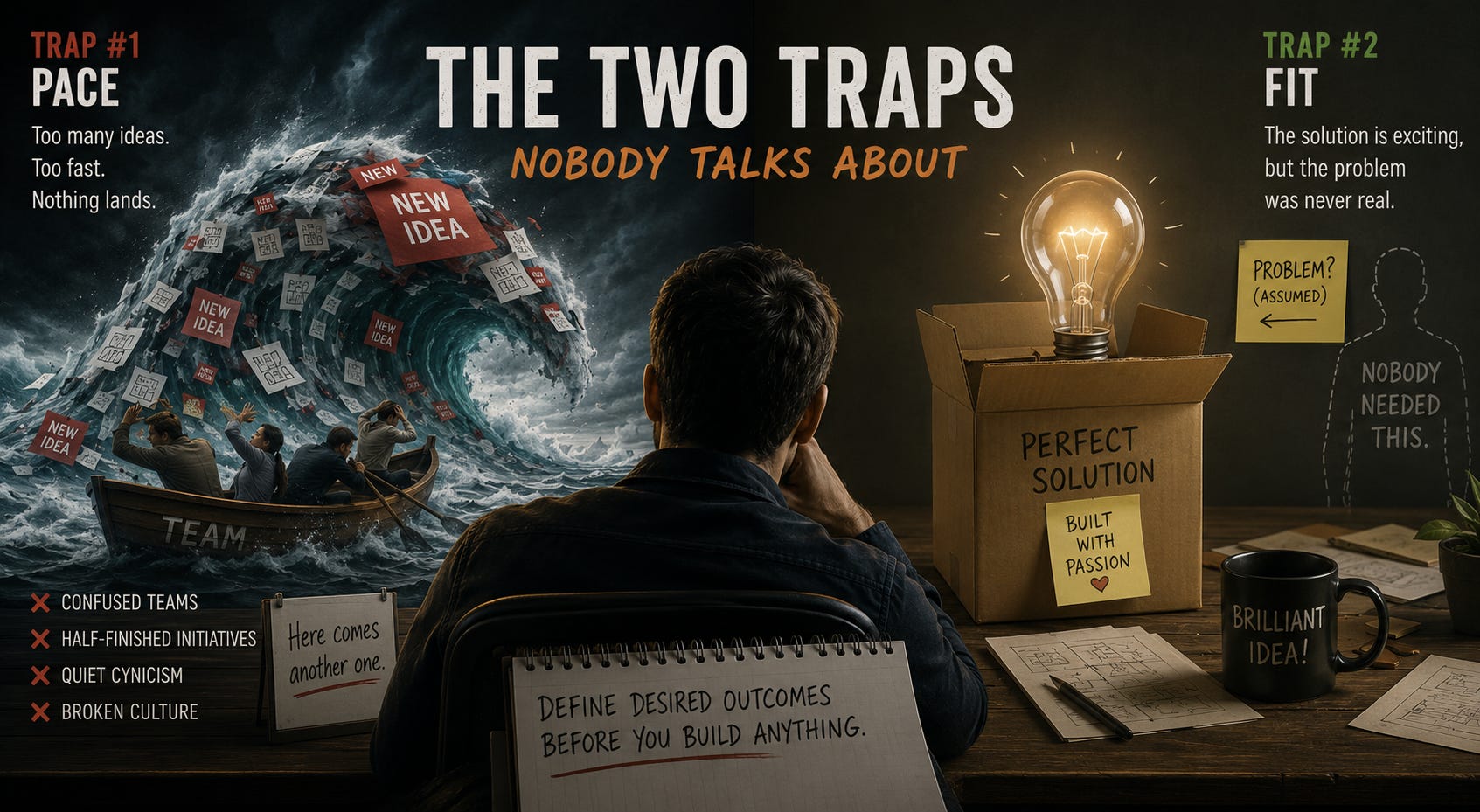
The Two Traps Nobody Talks About
The first trap is pace. You release ideas faster than your organization can absorb them. The next wave hits before the last one has landed. Teams get confused. Initiatives go half-finished. And a quiet cynicism sets in, here comes another one, even if the solutions are awesome and actually work, that kills culture faster than any failed product ever could.
The second trap is fit. The idea was so compelling in the ideation phase that somewhere along the way, the problem it was supposed to solve got assumed rather than validated. You built something nobody actually needed. Not because you weren’t smart. Because you fell in love with the solution before you confirmed the problem was real.
I have personal experience with both. Simultaneously, on occasion. This is why I am ruthless about defining desired outcomes before taking on new projects.
What Wilkie Actually Understood
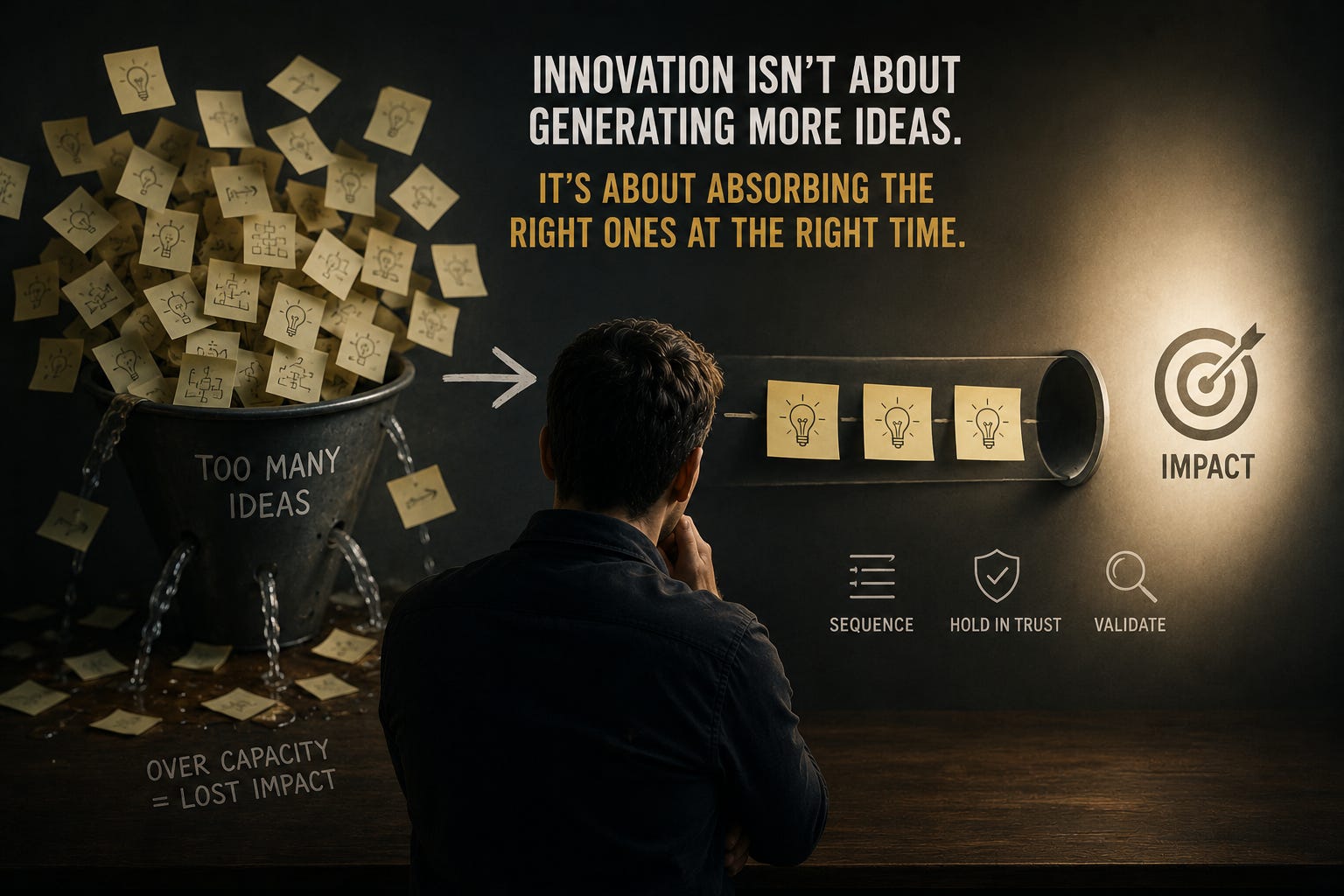
Wilkie’s value to Bezos wasn’t execution speed. It was absorption management. Any good innovation team absolutely must have this.
Every organization has a carrying capacity. This is a limit to how much change it can process before it starts dropping things. Exceed that limit and you don’t get faster results. You get confused teams, half-finished initiatives, and a culture that quietly stops trusting the next big idea because the last three haven’t landed yet.
The best innovation leaders don’t just generate. They sequence. They hold ideas in trust. They ask not can we build this? but can we absorb this right now, and does anyone actually need it?
That second question is the one I forget most often.
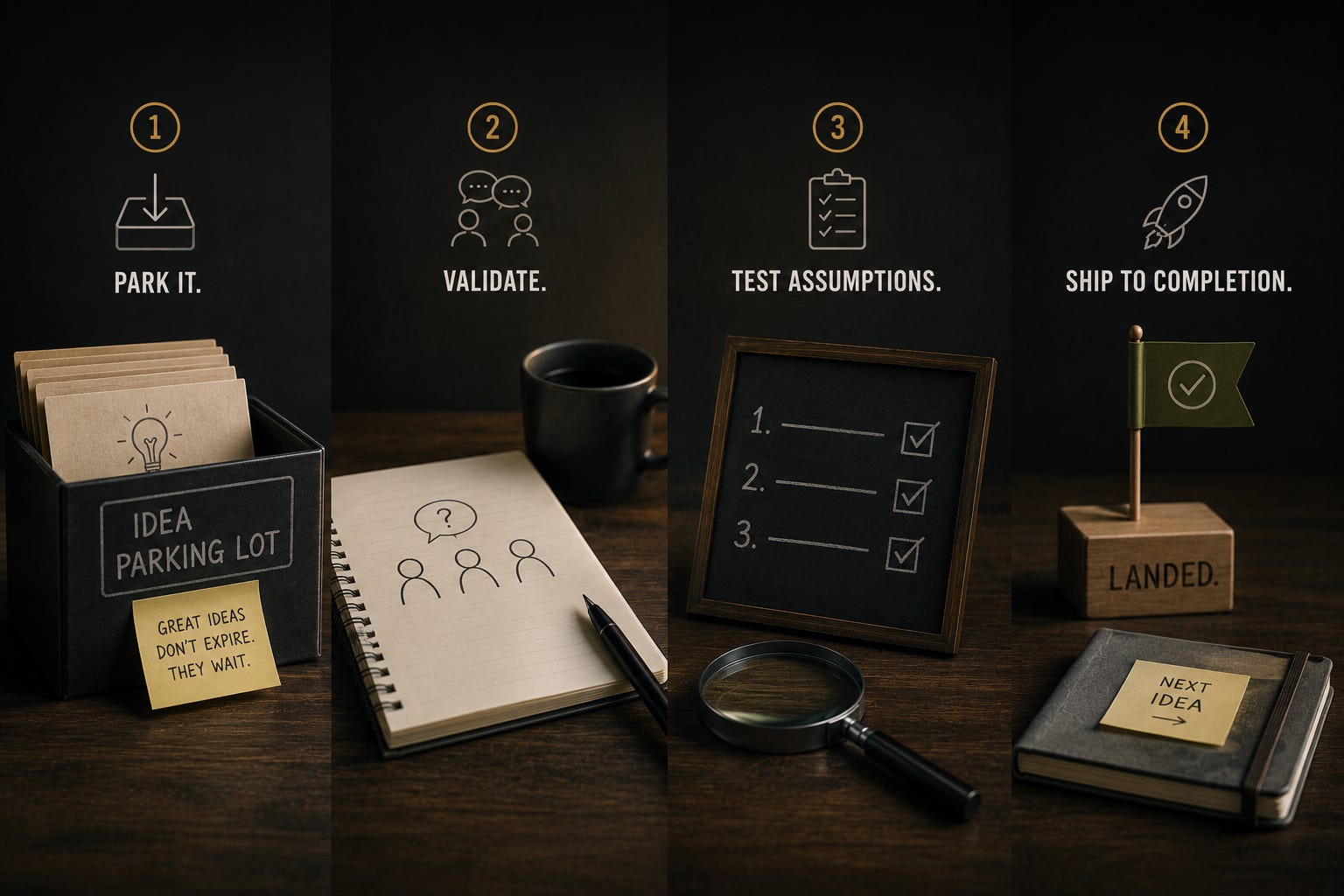
What to Actually Do About It
Build an idea parking lot and take it seriously.
Not a graveyard. A queue. Every idea gets captured, not killed. But capture is not commitment. We keep a backlog of innovation ideas. The discipline of writing it down and walking away is harder than it sounds for people wired to build solutions. Do it anyway. The $810 million rebuild is in my parking lot. It’ll stay there until the lunar landing idea is completed (hopefully in the next couple of years).
Validate the problem before you fall in love with the solution.
Spend time with the people who supposedly have the problem, not to pitch them your solution, but to find out if the pain is real enough to solve. If you can’t find three people who feel it viscerally, the idea goes back in the queue.
Name what has to be true.
For any idea to move forward, identify the two or three assumptions that have to hold for it to work. Test those assumptions cheaply before you commit resources. Most ideas die here. That’s the point.
Ship one thing to completion before releasing the next.
Completion isn’t launch. It’s landed. The team understands it, users are getting value, you’re not still putting out fires. Until it’s landed, the next idea waits. This is hard for someone who works on 53 things at a time.
Find Your Wilkie
This is the one most innovators skip. And it’s the most important.
Build a trusted inner circle, one or two people whose actual job is to push back without getting fired for it. Not yes people. Not critics for sport. People who believe in your vision enough to tell you when your pace is outrunning your organization’s capacity to absorb it.
Bezos had Wilkie. I have a small team that occasionally looks at my idea list the way someone may look at a toddler who has somehow climbed onto the roof. Impressed, alarmed, and committed to getting them down safely.
Without someone willing to tell you the truth about pace, the discipline has to be entirely internal. And internal discipline, for people wired like us, is notoriously unreliable when a genuinely exciting idea walks into a meeting room.
The Goal Isn’t Fewer Ideas
The goal is better leverage.
The innovators who actually move the needle aren’t the ones with the most ideas. They’re the ones who pick the right idea at the right moment, validate it fast, and drive it to completion before the next shiny thing pulls their attention sideways.
Your best ideas deserve an organization that can actually carry them. Which means your job isn’t just to generate. It’s to sequence. To hold some things in trust. To ask, honestly, not rhetorically, whether right now is the right moment, or whether the idea just feels urgent because you thought of it today.
I have 53 projects. One of them is the size of a lunar landing. The $810 million rebuild is not on the list.
For now…
Part 2: What happens after you build it, and why adoption is an art form that requires its own dedicated people.