



A few weeks ago I drove out to a farming town about an hour outside Lincoln, Nebraska. Population 900. It had one main street, and it ended in a cornfield.
I was there for three days with eight other people who were all leaders in tech, development, and community work. There was a historian, a former senator, a former attorney general, a lawyer, religious leaders, and several others. It was quite the mix of people.
Nine of us. That was the whole gathering.
I was asked to come talk about AI. These days, that’s usually how I end up in most rooms. What I didn’t expect was that the AI conversation would be the least interesting part of my weekend. Hopefully others found my discussion interesting, but I was drawn to the other discussions.
Dwight and Jon
The gathering is called The Hatch. Dwight and Jon started it.
They had been going to another conference for years, one of those events that starts small and good and then does what good events do. It grew. By the time they stopped going, it was a couple thousand people. It was too big for them.
The conference was good. The speakers were still strong. The programming was still good. But you couldn’t talk to anyone. You certainly couldn’t talk to the presenters. You sat in a room with two thousand people, absorbed some content, stood in a hallway, talked to some friends over meals, and went home.
They wanted more. They desired to go deep into topics that they cared about. What did the do? They started their own conference and invited who they wanted to hear from.
A conference about what Jon and Dwight are interested in
It’s actually pretty funny when you think about it. Two guys have unique interests and they decided to invite people to talk about the things they wanted to talk about. I chuckled more than once that weekend when I thought about how we all ended up in that small town.
The theme of the meeting? Seriously, it was what Jon and Dwight wanted to talk about. There’s no track structure or call for proposals or attendee survey for topics. The Hatch is a list of topics two guys were curious about and a list of people they wanted to hear from.
That process produced a better weekend than any curation committee I’ve ever seen. Because a committee optimizes for what an audience will register for, and Dwight and Jon are optimizing for whether they actually learn something. I like the way they think!
Present, Participate, Learn
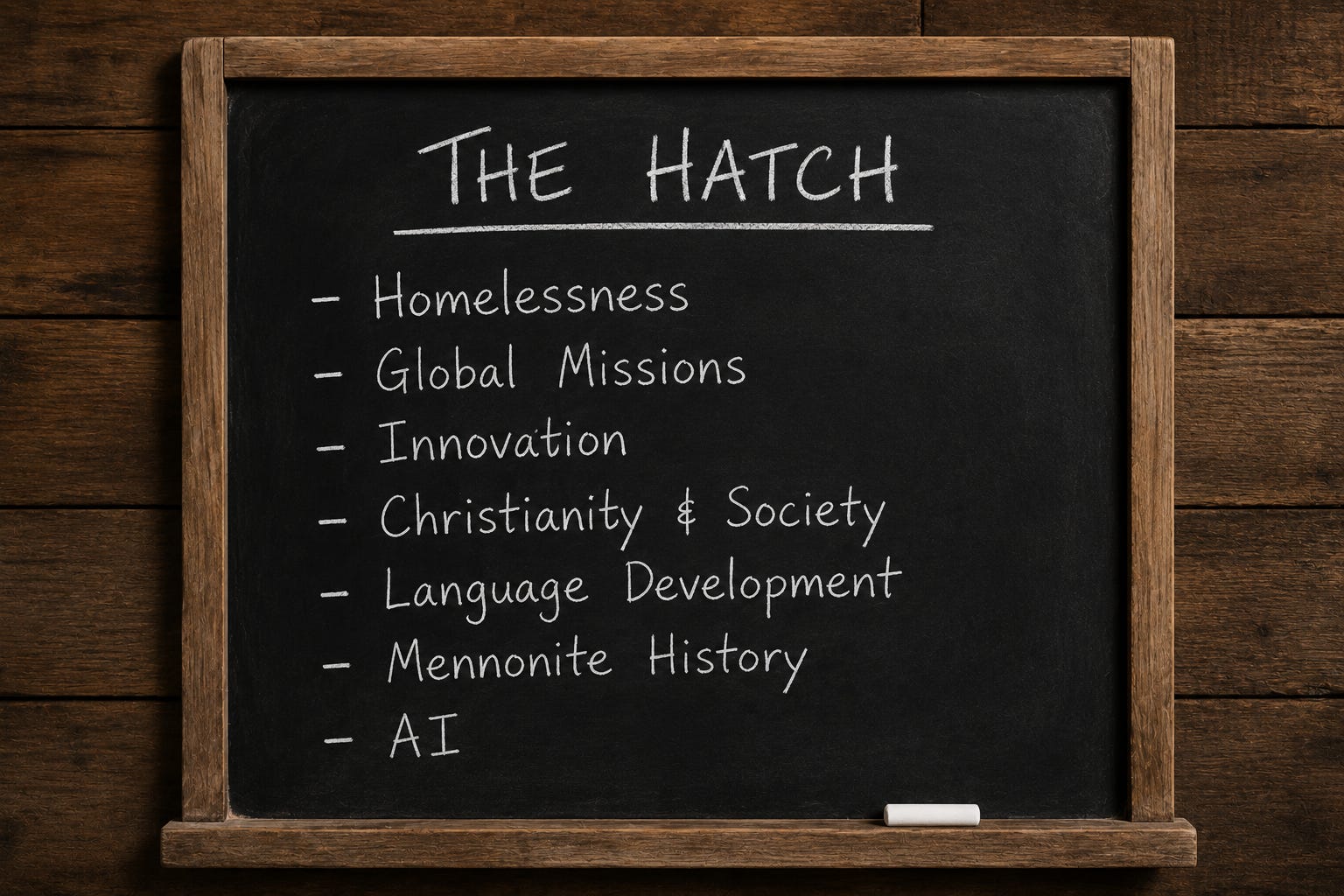
Over three days we heard about homelessness, global missions, innovation, AI, and the historical contribution of Christianity to a developing society, including how Christians influenced that society’s language.
We also heard the history of the small Mennonite town we were sitting in. Founded about a hundred and fifty years ago. Farming still holds most of the towns old character. The most fascinating session of the weekend was learning about when this town was frontier land. I say that as the guy who came to talk about frontier technology.
A hundred and fifty years is a long time to stay this size. The town isn’t small on the way to becoming something else. Small is what it is, and it’s still here.
My AI session was one item on that list. Nothing ties homelessness to Mennonite settlement history to language development to AI to foraging. No conference would ever program that agenda, because a conference has to tell you in advance what kind of conference it is. The Hatch doesn’t have to tell anyone anything. They’re not trying to attract a crowd. That’s what they were trying to move away from.
In a room of nine, presenting stops being presenting. As the weekend rolled on, you get about half way into your material before someone asks the question you were planning to address on slide eleven, and then we were just talking. The session becomes a conversation and the conversation goes somewhere you didn’t plan. Conversations went into meals and into the evenings.
I have given the AI talk many times. This is the first time in a while I’ve had to actually explain parts of it in real time, to people smart enough to push and small enough in number that I couldn’t deflect into the next slide.
This a different conference entirely.

Three slow days
Often in my work, I’m on what could be called the bleeding edge of innovation and technology. The team that I am a part of tests things before anyone asks us to. We often move faster than the teams and organization we serve, and we filter out most of what we try. Iteration and speed are part of the assignment.
Back in June, I wrote a post called Think Slow, Act Fast, about the 8.5 percent of projects that finish on time and on budget. The fix is almost always more thinking before you break ground. Sharpen the ax, then swing.
I still believe that. But that post was about the front end of a project. Slow down so the plan is right, then execute hard.
Nebraska was a different kind of slow, and it took a couple of weeks of reflection to see the difference. There was planning that went into the weekend, but the planning served the curiosities of the hosts. There was no project, no deliverable, and no ax to sharpen. The slowness wasn’t in service of a later sprint. The slowness and smallness was the whole point.
Three days in a Nebraska farm town is an absurd way to spend time if you measure by throughput. I could have consumed more information from a conference livestream, on double speed, in an afternoon. It would not have had depth.
I would have retained almost none of it, and none of it would have changed how I think. The information isn’t the constraint. Nine people sitting around a table for three days is a slower delivery mechanism than almost anything, but it reliably moves how you think.
The variable wasn’t speed. It was size.
Slow down to speed up is a line I have said myself, and it’s true enough. It’s also easy for me to accept, because it promises to give the speed back. Be patient now, go faster later. I can sign up for that deal.
Nebraska never promised me the speed back.
What made the weekend work wasn’t the pace. It was the number. Nine is small enough that nobody can hide behind the person in front of them. Small enough that a session turns into an argument. Small enough that the guy who flew in to present has to sit there and answer for what he said. Small enough that you can’t skip sessions.
Add a hundred more people and it doesn’t work. It’s not faster or slower. The benefit of the gathering is just gone.
Jeff Bezos put a number on this a long time ago, or close to a number. No team so large that two pizzas can’t feed it. Depending on how hungry everyone is, that lands somewhere around six to ten people. Personally, I think our nine folks could have eaten way more than two pizzas! The purpose of his two pizza rule was communication cost. Every person you add multiplies the connections that have to be maintained, and past a certain point a group spends more of itself on coordination than on the actual work.
Nine of us in Nebraska. Two pizzas, maybe a slice left over.
The crowds were the story, but the twelve were the mechanism
Jesus taught crowds. Thousands of them, and those are the scenes we remember and paint and preach.
But he spent three years with twelve.
The crowds got the message. The twelve got the meals, the road, the arguments, the questions asked badly and answered slowly. When the movement carried, it carried through the twelve. Meanwhile, many organizations and churches have built their whole idea of ministry impact around the size of the crowd, and the mechanism was always the smaller number.
I’m not against big gatherings. Please don’t stop inviting me to speak at them! They have their place and purpose. They do something the small ones can’t, but there was something special about a small gathering. Take time out for the smaller, more intimate gatherings where you can go deep with a few people.

Most organizations keep asking how to engage with more people faster. It’s not a bad question. Too often, it’s just the only question being asked. I think that to grow The Hatch, it needs to happen in a hundred small meetings of 8-10 people. Not one meeting of a thousand.
The other question runs the opposite way. Fewer people. More time.
Who are your eight? And when did you last give them three days?
Thank you Don. It was an amazing experience and your blog captures it well.
Yes! And it was wonderful time of learning. This type of weekend stays with you.