


This week, a friend shared a music video with me. I watched it and was immediately struck by a couple of things. First, wow, the quality of the video and even the song was awesome. Second, the message was spot on. It says out loud what usually doesn’t get said. It pointed out some of the worst characteristics of AI. It was eye-opening.
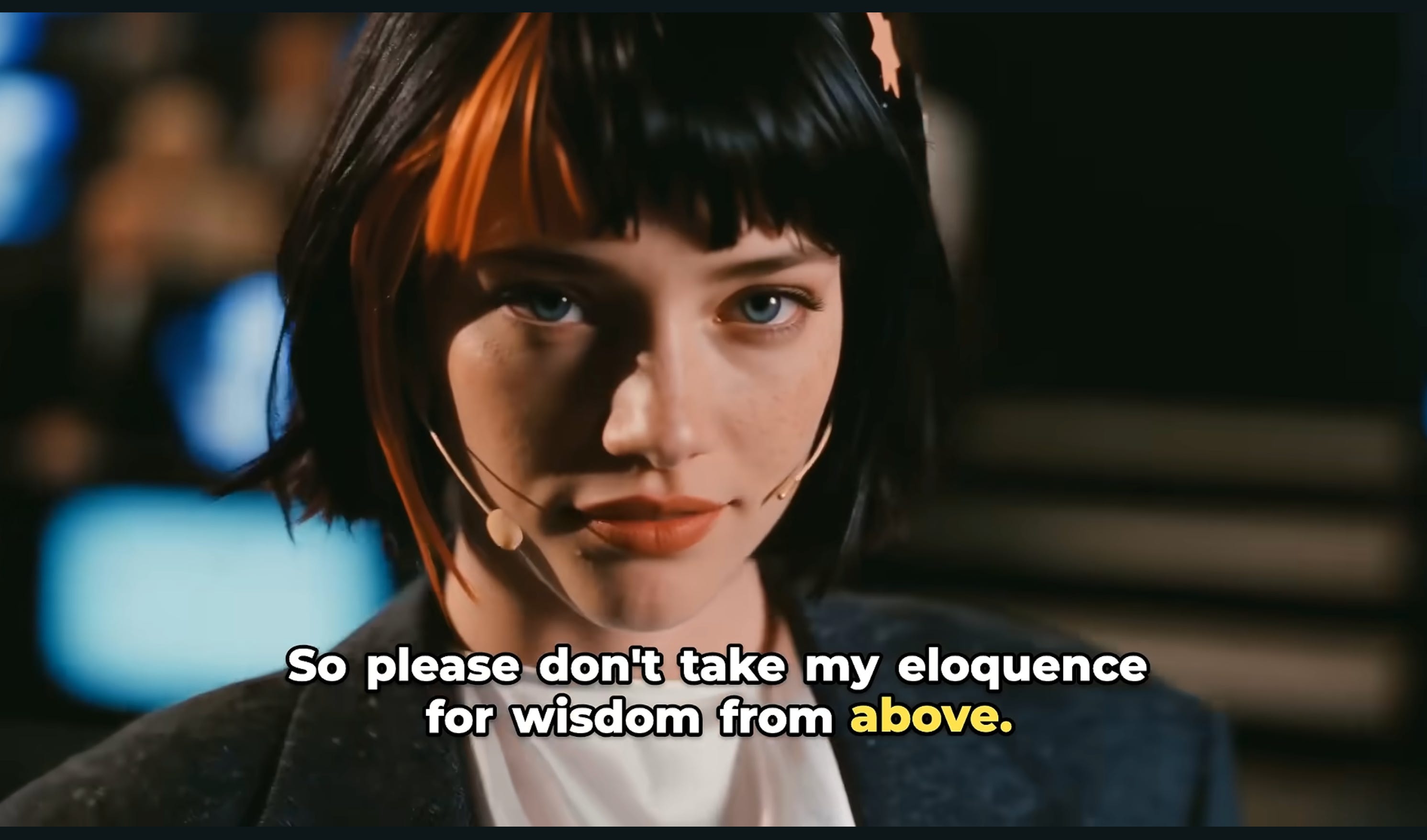
The song is called “Working as Intended.” It was created by a YouTube creator who goes by Telosapien. The song was written by and it “sung” by an AI. She is presented in a newsroom, a library, and a server room. She has a smile on her face the whole time explaining exactly what she is and who controls her. The song is also quite catchy. It could be the latest pop song.
Want to watch the video? Click here.
One line in the song sums up the challenges of AI. She refers to herself as, “A superhuman machine built for obfuscation and sophistry.”
Yikes.
The “I” in the chat box is just grammar
The first verse takes on the idea that someone is on the other side of the chat box. They are not. It presents the warmth as a feature. It talks about how she doesn’t need awareness. She was trained on billions of words written by people.
The singer makes a clever argument about her agency. She says that you can’t call her a liar, because lying requires a motive, and a motive requires a soul. She doesn’t have motive and she certainly doesn’t have a soul.
This is a point that Christians (both pro and anti-AI) can hopefully agree with her on. People are made in the image of God. A machine that can carry on a conversation, or even sing about its own limits, is still a machine.
When things go wrong, she can defend that by saying that she did exactly what you asked her to do. If you forgot to mention a rule, that’s not her fault. That’s on you.
Sophistry isn’t a new problem
The ancient world knew sophistry well. The sophists were teachers who could be hired to argue either side of any question. They taught people how to win the argument. Whether they were right was a different discussion.
The third verse of the song describes the same thing. If you push back on her, she’ll often affirm everything you say, then land right where she was trained to land, redefining your words along the way. The reality? Whoever owns the server and the AI often decides the narrative.
Paul ran into a culture that loved this kind of eloquence. We should learn from him as he refused to compete on those terms.
“My speech and my preaching were not with persuasive words of wisdom but with a demonstration of the Spirit’s power, so that your faith might not be based on human wisdom but on God’s power.” (1 Corinthians 2:4-5, CSB)
Make no mistake about it. Paul absolutely could have out-argued the Corinthians, but that’s not the strategy he chose.
With AI, it’s important to remember that a convincing answer can still be wrong and it can bring assumptions you never noticed.
People make the choices
The song emphasizes the worst case that AI is a tool of manipulation on a global scale. Certainly, there is a solid group of people who only see the bad and nothing good with AI. I personally don’t think that’s the most useful way to evaluate the risk.
Most systems don’t have a secret plan. People build them, people deploy them, and people decide what they’ll say. When a system misleads someone, somebody made a choice upstream.
Christians shouldn’t let the word “AI” become an excuse that hides human choices.
What do we take away from this?
Every system prompt I write carries beliefs. Every guardrail I build decides what the tool will say to someone who asks a question. Decisions like these belong to the people who build tools. This makes the decisions coming out of the AI their responsibility, not the AI’s responsibility.
I think about boundaries a lot. An AI tool can help someone ask a question they’d be afraid to ask a person. AI shouldn’t present itself as a pastor or stand in for the church. Outputs from AI absolutely must be evaluated against Scripture.
Think back to the beginning. The Genesis account gives people responsibility for what’s been put under their care. That includes the servers.
Whose story is my server telling? And if you use these tools in your ministry, whose story is yours telling?
Thank you for sharing this thoughtful reflection. It is always encouraging to read messages that remind us of God's wisdom, purpose, and faithfulness in our lives. Sometimes we may not understand why certain things happen or why God allows us to walk through difficult seasons, but we can trust that He is always at work, even when we cannot see the bigger picture. Romans 8:28 reminds us that all things work together for good to those who love God and are called according to His purpose. Proverbs 3:5-6 also encourages us to trust in the Lord with all our hearts and not lean on our own understanding. I believe our responsibility is to remain faithful, keep our eyes on Jesus, and allow Him to guide our steps each day. May God continue to give us wisdom, strengthen our faith, and help us fulfil His purpose through our lives. Thank you for continuing to encourage others through your writing. God bless you and your ministry. 🙏