


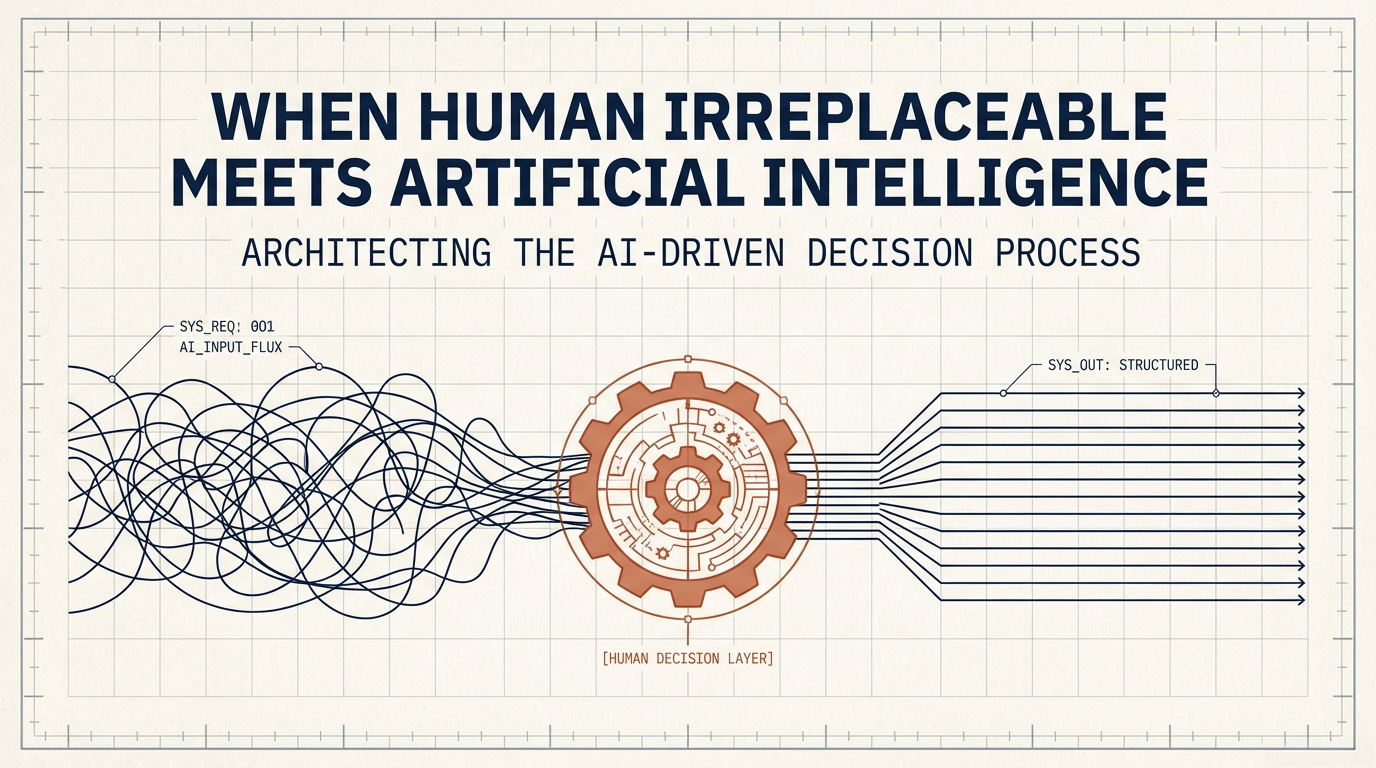
As the boom of AI has occured over past three years, there’s an unasked question is not being asked outloud, but it’s at the crux of a lot of questions I’m being asked. That question?
What happens to us?
Not “what happens to our jobs,” though that’s part of it. This question is something deeper. What happens to the things that make our work meaningful? The relationships, our presence, the moments of genuine human connection that no workflow can produce and no algorithm can replicate. What happens to those when the organization goes all-in on AI?
It’s a fair question. Today, I’m going to attempt to answer the unasked question. Let me start with what I believe is true, and what the evidence increasingly supports.
AI is genuinely remarkable at a growing list of things.
Pattern recognition.
Data synthesis.
Language generation.
Scenario modeling.
Research acceleration.
Translation.
Content adaptation.
Scheduling.
Summarization.
First drafts of almost everything.
The list is long and getting longer every month.
But there is a category of work, not a task or a function, but a category, that AI cannot enter. Not because the technology isn’t sophisticated enough yet. Because the work itself is constituted by human presence in a way that technology cannot replicate by definition. Things in this category include things like”
Sitting with someone in grief. Not solving it. Sitting with it.
Building trust across cultural distance over years of shared life. Not summarizing cultural research. Living it.
Discerning together, in community, what God is calling an organization toward. Not generating options. Listening.
Mentoring a young leader through failure toward growth. Not providing feedback. Being present through the process.
These aren’t tasks with human inputs. They are irreducibly, essentially human. The moment you remove the human; you haven’t done them faster or cheaper. You haven’t done them at all.
This matters especially for how faith-based organizations think about AI adoption.
The Efficiency Trap
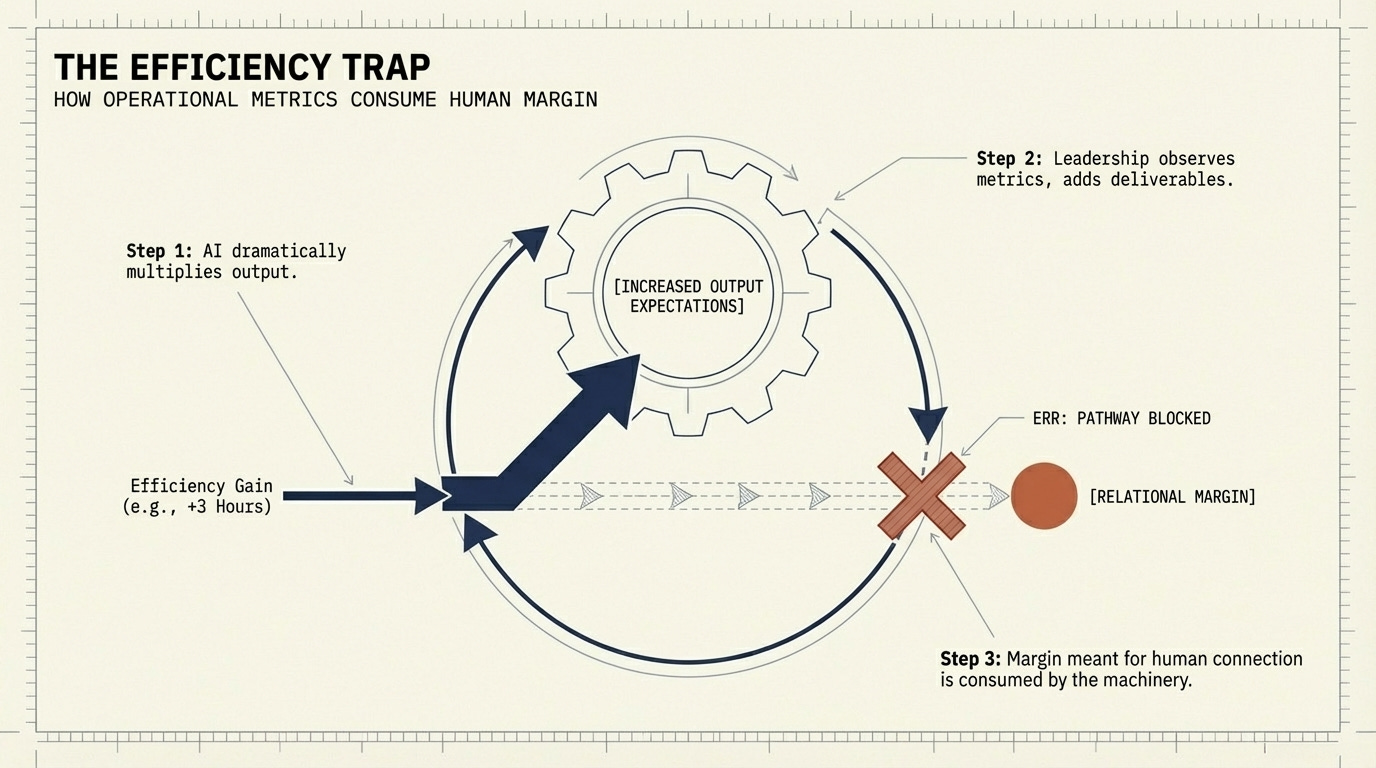
The risk isn’t that AI will replace missionaries, pastors, counselors, or community builders. The risk is subtler and actually more dangerous. It’s that in the pursuit of efficiency, organizations will slowly erode the conditions that make irreplaceable human work possible. Allow me explain.
Here’s what that erosion looks like in practice.
A worker gets so efficient at producing reports, translating content, and managing administrative workflows with AI that their outputs multiply dramatically. Leadership sees the numbers and adds more responsibility, deliverables, and expectations. The efficiency gains get converted immediately into more output. The time that was supposed to flow back into relationships, presence, and discernment gets consumed before it ever arrives.
AI made it possible to do even more, so instead of having more margin for the human things, we do exponentially more as we multiplied the work. The organization consumed the margin. The irreplaceable things, the ones that actually move the mission, got squeezed out anyway.
This is the leadership challenge that AI makes urgent but didn’t create.
Organizations have always struggled to protect the irreplaceable work from the demands of the operational work. AI just changes the scale of the pressure. When one person can produce what used to require five, the temptation to extract that productivity rather than redirect it is enormous.
The AI-driven organization has to make a deliberate, protected, countercultural decision: the efficiency gains belong to the mission, not to the output metrics.
That means when a worker gets ten hours a month back from AI-assisted reporting, those hours must go back into the relational work, not into more hours of reporting. It’s to ask, “What’s the right volume for genuinely human engagement, and how do we use the freed capacity to deepen that?”
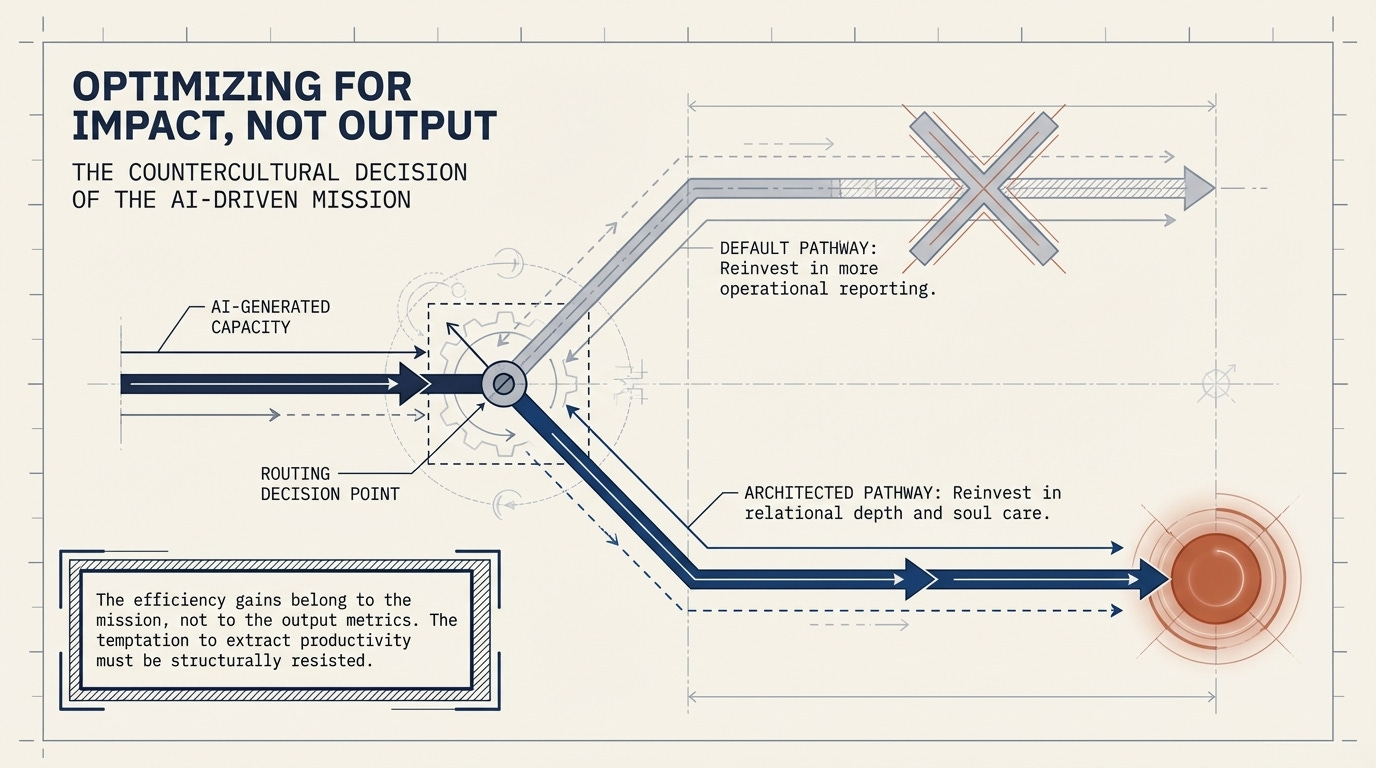
This requires organizational discipline that runs counter to most institutional instincts. Most institutions optimize for output, especially operational output. The AI-driven mission organization optimizes for impact. Those are not the same thing.
How Does an Organization Protect Needle Movers?
It starts by naming it explicitly. Many organizations have never had a serious conversation about what work is irreducibly human and what work is not. They treat everything with equal weight, or worse, they incentivize the operational. What gets inspected? The number of gospel conversations someone had or getting reports completed on time?
The AI-driven organization draws a clear line. On one side is the work that AI can do, assist with, or dramatically accelerate. On the other side is work that requires human presence, wisdom, relationship, and soul care. And it protects the second category with the same intentionality it applies to the budget.
Here’s what this looks like:
Protecting time before it gets filled.
When efficiency creates margin, leadership has to act before the organization’s natural tendency to fill margin with more output kicks in. Schedule the relational work. Block the discernment time. Make the irreplaceable things calendar commitments, not aspirational remainders.
Measuring what matters.
Most organizational metrics track output. Timely reports filed, content produced, personnel engaged, and trainings completed. These are easy to count, yet largely irrelevant to mission impact. These do not really move the needle.
The AI-driven organization also tracks, as best they can, the things that actually move the mission: relationships deepened, communities engaged, gospel conversations, and leaders developed. It’s sometimes hard to measure some of these, but these are the things that move the needle. The actually matter the most.
Keeping humans in the human moments.
While this sounds obvious, it isn’t. Organizational pressure to scale will consistently push toward replacing human moments with digital proxies. Can you use an automated follow-up instead of a phone call, a content piece instead of a conversation, an AI-generated update instead of a personal one. The AI-driven organization draws firm lines about which moments stay human, and holds them.
Here’s the theological frame I keep coming back to.
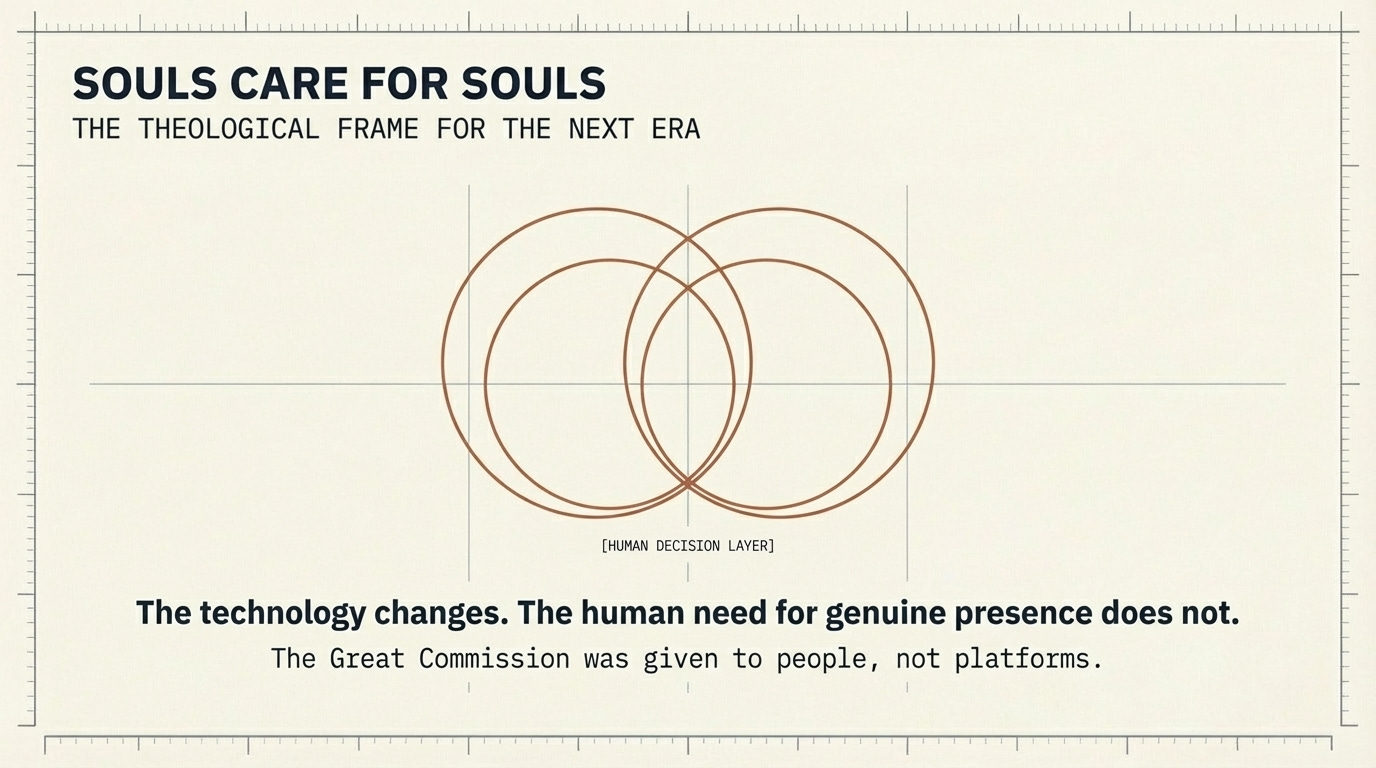
Souls care for souls. That was true before AI. It will be true after whatever comes next.
The technology changes, but the human need for genuine presence, genuine witness, and genuine love does not. The Great Commission was given to people, not platforms. It will be carried out by people who are present, available, and fully human in the moments that matter most.
Practical Challenge
Today’s challenge requires no computer, although you are welcome to use AI to help you ideate. Work on creating a list of distinctively human activities that you want to preserve as you begin to see the benfits of scaling AI.
How do you plan on creating greater impact on the things that actually move the needle?
How will you measure the impact?
If you do not build this in from the beginning, I predict that you will become much more efficient… at becoming more efficient. The purpose of efficiency is to have impact on the distinctly human things.
AI is a gift that can free those people to be more fully present in those moments. Or it can become a trap that extracts their capacity for the mission’s machinery.
The difference is entirely a matter of organizational decision. That decision belongs to leaders.
Article 8 of 10 in “The AI-Driven Organization” series. Next up: Building the Culture, Not Just the Tool Stack — why 90% of AI transformations fail, and what the ones that succeed have in common.