Before I tell you about the meeting that stopped me cold, I want to talk about this series about Faithful Intelligence. I’ve struggled to keep this series going because I keep rewriting these posts.
People who talk about everything wrong with AI often assume those of us using it daily have skipped the hard questions. That we don’t care about the theological weight of what we’re picking up. Hear me say that couldn’t be further from the truth.
Before our team built a single tool, we worked through what we actually believed about AI. What is a human? What is work? What does it mean to steward what the God of the Bible has entrusted to us? It’s why we have an AI Ethics Charter and the work on that document pre-dates almost every AI tool that we’ve built.
I keep hearing the same critique. I tried AI. It got something wrong. It hallucinated. So clearly no one can use it faithfully. What that’s really saying is: I tried something. I didn’t know how to use it. It didn’t work. Therefore nobody can. That’s a bad argument against AI.
I’m not asking you to be excited about AI. I’m asking you to be honest about your skepticism. The people most ready to hear what AI cannot do are the people who’ve actually tried to use it for the things it can. The nexus of this current series is trying to reassure those who assume that those of us who are using AI have actually have thought through the ramifications of what we are doing.
So let me tell you about the meeting.
The Proposal I Couldn’t Say Yes To
I was sitting with another organization when they laid out a plan that pulled me up short. I can’t remember if I have mentioned this in another series, but it’s worthy of a quick reminder.
They were working in a context with overwhelming trauma and almost no trained counselors. The need was real. More suffering than any human system could reach. Their solution: AI chatbots as trauma counselors. Not triage. Not a bridge to a human. The AI as the counselor, full stop.
Their argument was straightforward… an AI counselor is better than no counselor at all.
I sat with that for a moment. There’s a logic to it that’s hard to dismiss. Then the uneasiness came. Here’s what I kept coming back to. What does it mean that a human being, made in the image of God, in the middle of genuine trauma, receives something that performs personhood without having any?
That question cuts straight to the center of what AI is, what humans are, and what the church should refuse to outsource no matter how elegant the technology becomes.
Because we’d done the theological work in advance, the decision wasn’t actually hard. The proposal asked AI to do something our charter says AI cannot do. We didn’t participate. No hard feelings. It just isn’t something that we can participate in.
That clarity came from having a framework before the meeting, not during it. We had already set our guardrails and boundaries before we needed to have an answer.
AI Is a Mirror. That’s the Frame.
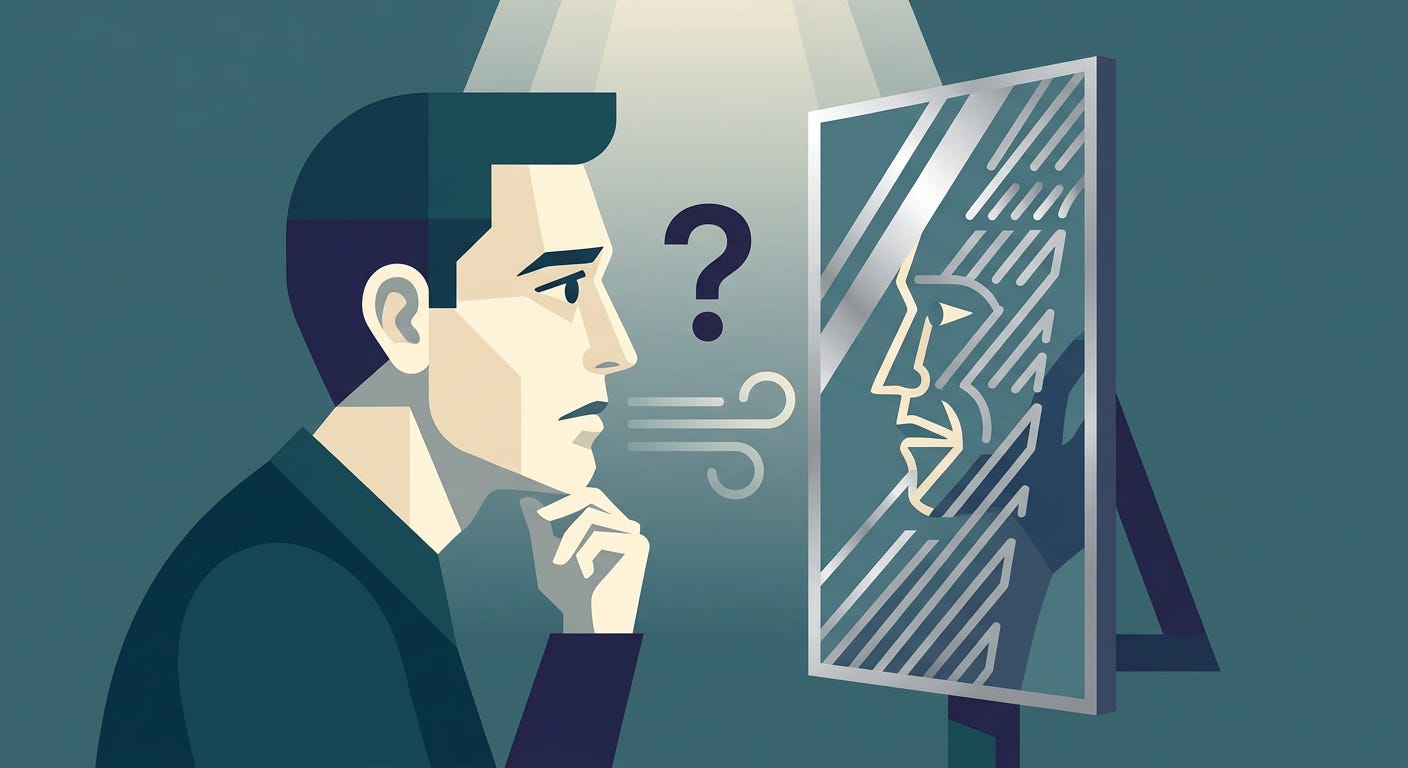
Before we get to Genesis, here’s the frame I use. AI is a mirror. A sophisticated one. It reflects back patterns from human expression. This includes our language, our reasoning, our empathy rendered into text. When AI seems wise, human wisdom is in the training data. When AI seems compassionate, human compassion has been distilled into patterns the model learned to reproduce.
AI is useful precisely because it reflects us. And it’s limited in ways most users never slow down to reckon with. AI doesn’t generate meaning. It reflects meaning that humans (image-bearers) have already created.
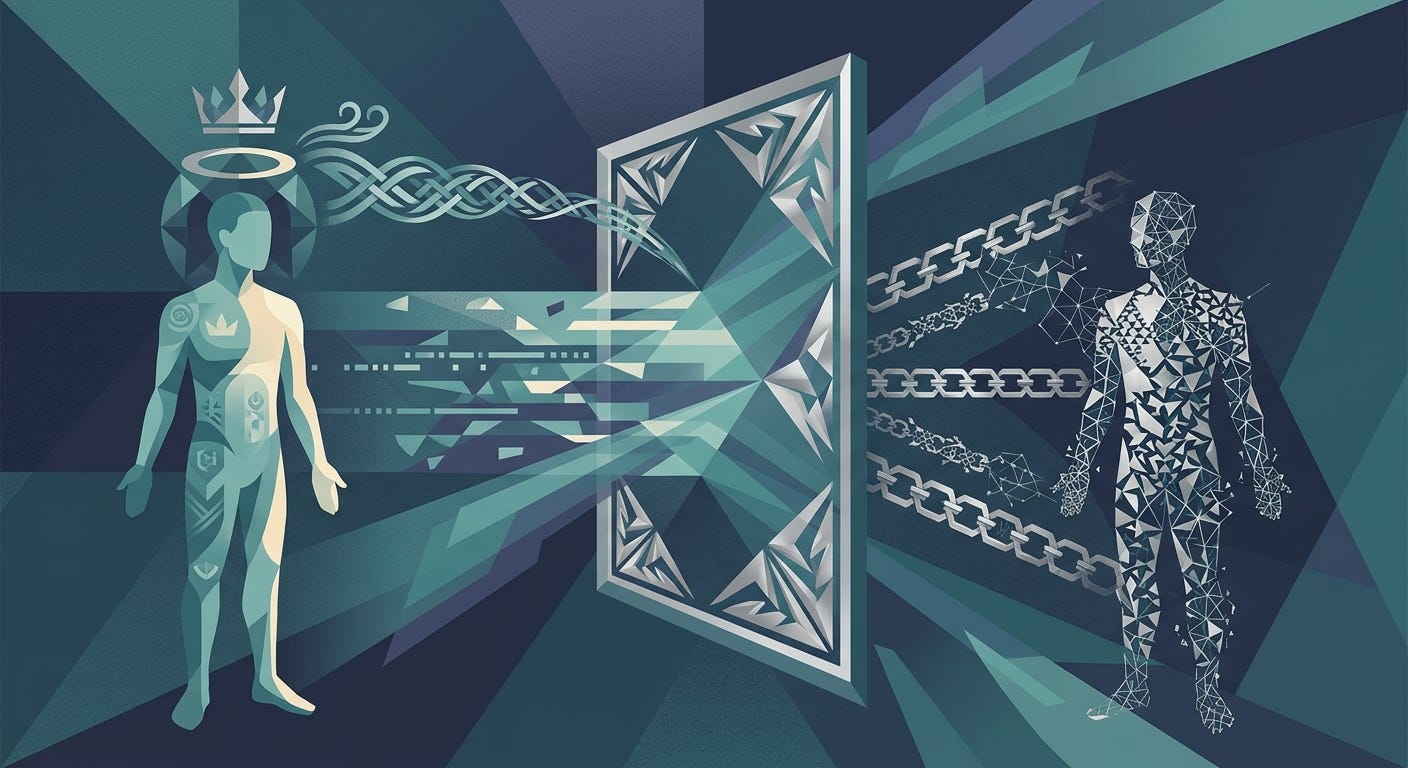
The chain of derivation matters. God is the source. We bear his image derivatively. AI reflects our outputs. At each step, something is lost. The further you move from the source, the thinner the reflection gets.

What the Text Is Actually Doing
“Then God said, ‘Let us make mankind in our image, in our likeness…’ So God created mankind in his own image, in the image of God he created them; male and female he created them.” (Genesis 1:26-27)
Notice what the text doesn’t say. It doesn’t say God created humans with greater intelligence, or more complex emotional circuitry, or superior reasoning capacity. It says he created them in his image. The distinction is not a category of capability. It’s a category of relationship and calling.
Then Genesis 2 gets specific:
“Then the LORD God formed a man from the dust of the ground and breathed into his nostrils the breath of life, and the man became a living being.” (Genesis 2:7)
The breath of God. That’s what makes Adam a living soul. Not the arrangement of dust, but the direct giving of life from Creator God. The Hebrew word here is nephesh.. soul, life, the whole living person. The God of the Bible put something of himself into a creature made of dirt!
AI is made of math. Sophisticated, remarkable, genuinely useful math. Math that I told my high school Calculus teacher no one in the real world would use… boy was I wrong. Because AI is math, there is no breath in it. There is no nephesh.
The Image Is a Person, Not a Property
Here’s where most conversations about the imago Dei go wrong. They treat the image of God as a property humans possess. a feature like rationality or creativity. That framing leads straight to the question, “Well, if AI becomes rational enough, does it bear the image too?”
The New Testament answers that question before it can be asked.
“The Son is the image of the invisible God, the firstborn over all creation.” (Colossians 1:15)
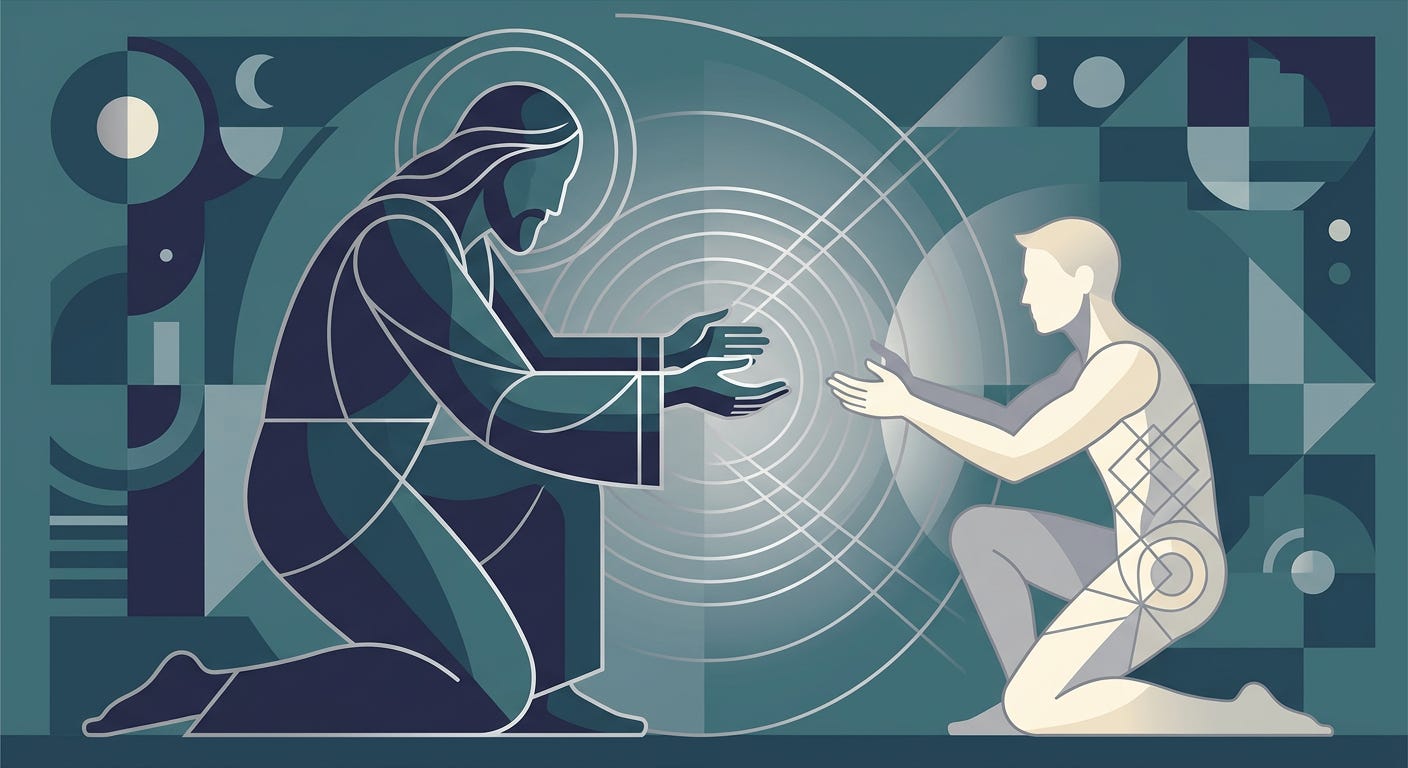
Christ is not an image-bearer. He is the image. The eikon. He is the exact, full, unmediated representation of God. When we talk about humans bearing the image of God, we mean a derivative, creaturely participation in something that finds its complete expression only in Christ.
This changes everything about the AI question. The image of God is not a set of capacities that could theoretically be replicated with enough compute. It is a relationship. A participation in Christ, mediated by the Spirit, that is moving somewhere.
“And we all, who with unveiled faces contemplate the Lord’s glory, are being transformed into his image with ever-increasing glory, which comes from the Lord, who is the Spirit.” (2 Corinthians 3:18)
Note this is present tense and ongoing. The Spirit is at work.
Christians are creatures made by God, fallen, redeemed, and being conformed to the image of the Son. AI is not in that story. Not as an image-bearer. Not as something being transformed. AI sits entirely outside the arc of creation, fall, redemption, and glorification that defines what a human being is.
What This Means on the Ground
Every human being you meet is a creature made in the image of God, participating however dimly in the likeness of Christ, and the object of the Spirit’s transforming work. That is the ground of human dignity. Not capability. Not productivity. Image-bearing.
Psalm 8 doesn’t let us look away:
“What is mankind that you are mindful of them, human beings that you care for them? You have made them a little lower than the angels and crowned them with glory and honor.” (Psalm 8:4-5)
Crowned with glory and honor. That’s who is sitting on the other end of your AI deployment decision. A being made in the image of God, being conformed to the image of Christ, deserves to be met by another such being. Not a simulation of one.
The Question That Cuts Through Everything
Back to that meeting that began all of this.
The argument was that an AI counselor is better than no counselor at all. I understand it. They weren’t saying that AI was a help to the counselor or that AI was a triage to help with initial assessments. They were saying it was the counselor.
Even so, our AI framework doesn’t let me say yes. If AI is a mirror, reflecting human meaning without possessing it, then what that trauma survivor receives is not care. It’s the shape of care. The pattern of compassion without the presence of a person. And the person receiving it is crowned with glory and honor, made in the image of the God whose Spirit is even now at work in the world.
The mirror cannot meet the image-bearer. It can only reflect back. So before you deploy AI in any ministry context involving people, ask this:
Is the person on the other end receiving something that honors their dignity as a being made in the image of God, or something that performs that honor without the substance of it?
That question won’t always give you a clean answer. But it will keep you asking the right thing.
Back to the skeptical reader I started with.
The honest critique of AI in ministry is not AI cannot be used faithfully by anyone for anything. That’s not skepticism. That’s abdication. The honest critique is AI cannot be the image-bearer’s substitute. Where AI extends image-bearers in their calling, use it. Where AI tries to replace image-bearers in their calling, don’t use it.
AI is not made in the image of God. You are. The person you’re trying to reach is.
Next: The Temptation of Efficiency — why kingdom work and efficiency culture are in deeper tension than we want to admit.