


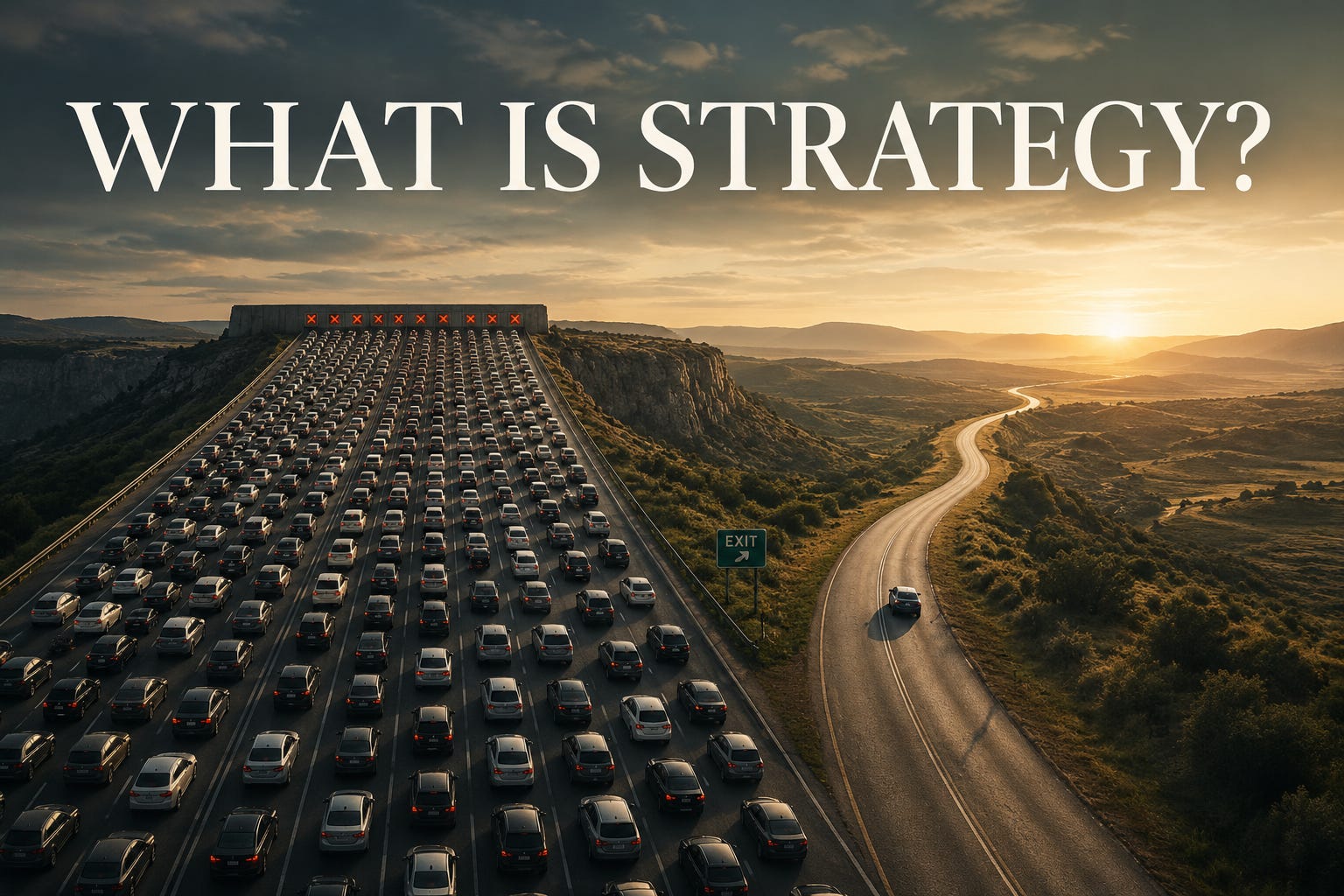
A friend mentioned Michael Porter’s 1996 HBR classic article What Is Strategy? this week. I have not read this in years and I had to track it down to read it again. Wow! It’s still relevant all of these years later.
Here’s a piece that’s nearly 30 years old and it describes with almost uncomfortable precision, what is happening in many organizations right now. The language is slightly dated, but the premise behind his article is still spot on.
Today, it seems that AI has everybody talking about optimizing. They want faster workflows, better processes, fewer redundancies, and most importantly… AI-assisted everything. Since I work in AI solutions, everyone thinks that I can just apply some AI magic and fix their problems. If only it was that easy.
Many people have confused operational effectiveness with strategy. Porter’s central argument is actually very simple
Doing things better is not the same as doing the right things.
Operational effectiveness means performing your activities better than other people or other organizations. Doing things faster, cheaper, and at higher quality. Strategy means performing different activities, or performing the same activities differently, in a way that creates a unique and valuable position that others can’t easily copy.
Here’s the problem. When every organization chases best practices, benchmarks against the same people, and outsources to the same vendors, everyone starts to look identical.
Porter called this competitive convergence. It’s a race to the bottom that no one can win. I’ve seen this in lots of organizations. Higher education has been experiencing this at scale for years.
When AI “magic” has been added to organizational workflows, the instinct is to use it to do what we’re already doing… only faster. Automate the reports, speed up the communications, and process more data.
This is totally the wrong approach. When we just keep doing what we have been doing, only faster and more efficiently, we’ve not really improved anything. We’ve just created a faster treadmill.
Strategy would ask this question. Why are we running on this treadmill at all?
Porter lays out three sources of genuine strategic positioning:
Variety-based
You do a subset of things exceptionally well (Jiffy Lube only does oil changes, and they destroy the full-service shops on speed and price for that one thing).Needs-based
You serve a particular group of customers in a comprehensive way. Concierge/Boutique Medicine means a doctor takes on a very limited number of patients and charges a premium to do so. In this case, the doctor to patient ratio is the strategy.Access-based
You reach customers in ways others structurally can’t (Carmike Cinemas operates only in cities under 200,000 people. They dominate because no one else bothers to design for that market.
The key word in all three is tailored. Not generic. Not best-practice. Not benchmarked. They have created a tailored strategy that differentiates them from others.
The activities have to fit together in a system that creates genuine trade-offs meaning competitors can’t just copy your best moves without blowing up their existing model.
That’s what makes a position sustainable.
Here’s the part Porter gets most right, and most people skip.
Trade-offs are the point.
We’ve been trained to believe trade-offs are signs of failure. We believe that a well-run organization should be able to do everything well. Porter says the opposite: if you don’t have trade-offs, you don’t have a strategy. You just have operations.
When Continental Airlines tried to imitate Southwest by keeping their full-service model while launching a low-cost brand, they bled money and made everyone angry. Not because the execution was bad. You can’t be both things without paying an enormous penalty.
The reluctance to say no is where strategy goes to die.
My Take
Porter ends with something that’s stuck with me since I reread it this week:
Strategy requires constant discipline and clear communication. Indeed, one of the most important functions of an explicit, communicated strategy is to guide others in making choices that arise because of trade-offs in their individual activities and in day-to-day decisions.
The leader’s job isn’t just to say yes to the right things. The leader’s job is to teach everyone else, explicitly, repeatedly, and with discipline what to say no to. That’s hard.
Most of us are avoiding it by staying very, very busy.
One question worth considering.
What is your organization uniquely designed to do and what are you currently doing that contradicts it?
Thanks for taking the time to write this article. I could not agree more with how we can look at what Michael Porter laid out and ask ourselves are we on the right track. Having come to NOBTS from a for profit company there are many areas I analyze and contemplate the Why and share thoughts. My favorite response at times is "We have always done it that way." Change is tough and in our broken world we need to find ways to change so we can witness the impact and build a stronger institution that will further grow God’s Kingcom.