
I’m frequently asked about the environmental impact of AI and Data Centers. It’s really hard to figure out the truth from fiction. There are a lot of special interest groups on both sides of that discussion and we’re early in the mass adoption of AI solutions. The environmental impact of 2026 will not be the impact in a year or two. The way AI works is changing. The future of compute is probably space where energy is free and tempretures are cold… but that’s the future. What about today and the next few years?
The question companies are currently throwing billions of dollars at is, “How do we build AI data centers faster?” It’s really crazy how fast these are being built because many are being built in anticipation of future needs. Nvidia is sold chips last year that haven’t even been put into production yet. Companies are buying the chips in anticipation of future needs.
Right now, it looks like what’s needed is bigger campuses, pre-fab construction, enormous buildings, modular substations, faster permitting, more power generation, new transmission lines, lobbying local leaders, and building in remote locations like rural North Dakota.
If you have been paying attention to the news lately, “how fast can we build” may not be the right question to be asking.
The most interesting AI infrastructure idea I’ve seen this year doesn’t try to answer that question at all. It takes a very complicated problem and proposes a completely different solution.
How might we deliver gigawatts of AI compute without building any new warehouses?
That single reframe, swapping “how do we build more” for “how might we deliver this differently,” is the move I want to talk about. It’s the innovators approach to solving big problems. The answer being proposed is genuinely novel. The thinking behind it is something every innovation team should be borrowing.
The Problem That Made Them Ask a Better Question
With a traditional approach to the data center problem, the answer became the constraint. The real problem isn’t can we build them faster. The real problem is how do we deliver compute faster. Who said that had to be in massive data centers?
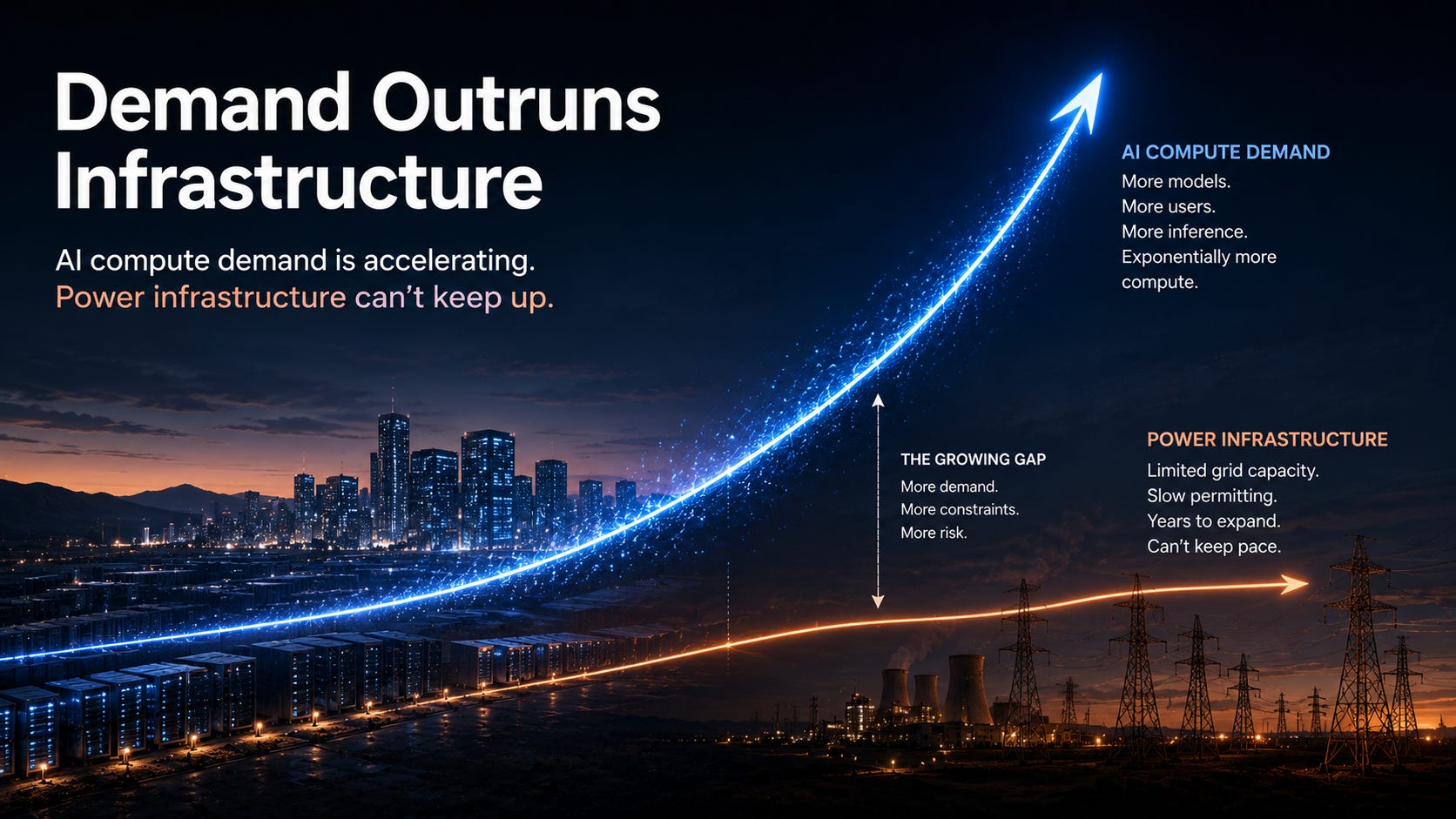
The U.S. generated 4,430 terawatt-hours of electricity in 2025. Demand is projected to grow 25 to 32 percent by 2030. Global data-center capacity demand is projected to grow roughly 3.5x in the same window. That’s an increase from 82 gigawatts today to about 219 gigawatts by 2030, with AI workloads driving most of the increase.
To keep up, the U.S. needs to bring online roughly 80 gigawatts of new generation per year. The problem? We’re currently only building 40 per year.
There’s also a long queue of generation projects waiting on grid interconnection. That amounts to over 2,600 gigawatts in line nationally. Most of those will never actually be built. But the queue itself tells us something important. The bottleneck right now isn’t AI ambition. It’s the speed of the electrical grid. It’s a real problem.
Span and NVIDIA have a phrase for the underlying tension. They call it the “hyperscaler paradox.” It means that compute demand is scaling quickly, but the power delivery infrastructure to feed that compute can only scale at utility build-out speed.
This is a serious constraint for AI growth. We’ve had constraints before. We’ve worked around them before. What’s interesting right now is how people are starting to work around this one because the workarounds are coming from directions nobody predicted three years ago.
A Genuinely Novel Answer
A company called Span, the folks who make smart electrical panels, just published a whitepaper for a product called XFRA. They call it a “distributed data center” and it is very exciting!
That phrase does not mean what you think it means. This is not an enormous data center or even a few large data centers connected. It’s way outside of the box thinking.
Here’s the actual idea.
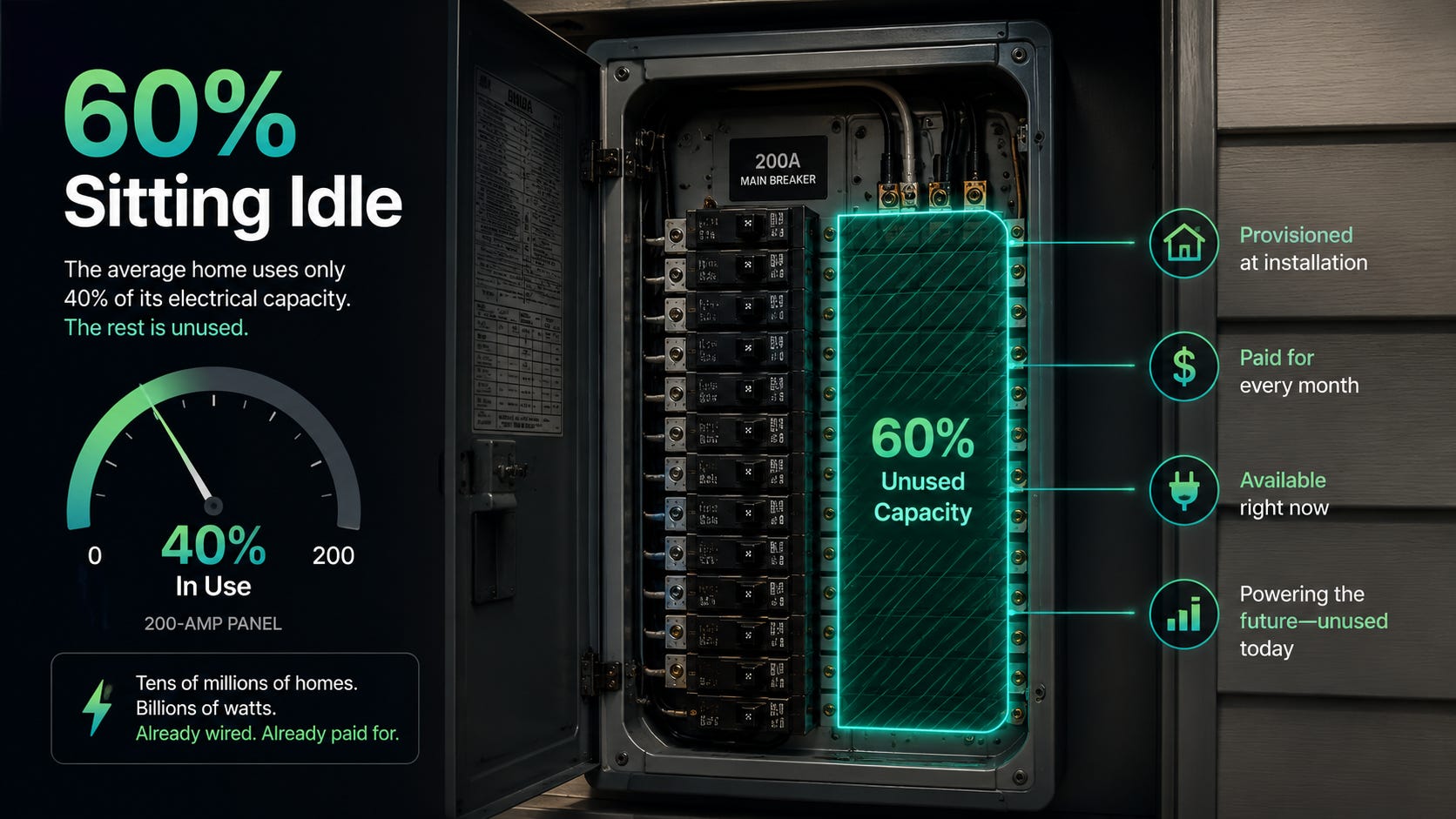
The average American home only uses about 40% of what its 200-amp electrical panel can deliver. The other 60% is provisioned, paid for, and sitting idle. Multiply that across tens of millions of homes and you have a staggering amount of unused electrical capacity already wired into the grid.
What if you put the data center there?
An XFRA Node is a weatherproof unit roughly the size of a backyard HVAC condenser. Inside that box? Sixteen liquid-cooled NVIDIA RTX PRO 6000 Blackwell GPUs, four AMD EPYC CPUs, three terabytes of memory, heat-pump cooling, and a 15-kWh whole-home battery. It’s wired into a SPAN smart panel certified to the highest safety standard for power control systems.
Span installs all of it at zero upfront cost. The homeowner gets a rental check that effectively subsidizes their electricity and Wi-Fi down to a fraction of normal, plus a premium electrical panel and battery backup they wouldn’t have bought on their own. In exchange, the unused headroom in their panel gets sold, second by second, to whoever needs AI inference right now. That’s genius!!!
Span partnered with NVIDIA, AMD, Dell, and PulteGroup, the third-largest homebuilder in the country. The first proof of concept goes live this fall in 100 homes in a build-to-rent community in the southwest. Beginning in 2027, they plan to scale to more than a gigawatt of annual capacity.
(SPAN + NVIDIA… if you’re reading and you’re looking for Virginia beta sites for the next phase, you know where to find me. Our electricity rates are quite reasonable. Just saying.)
No new warehouses. No new transmission lines. No four-year interconnection queue. Just headroom that already exists, monetized.

What “How Might We” Actually Looks Like
Here’s where innovators should take note. Notice the structure of what just happened. The industry was asking: How do we build data centers faster?
Span asked: How might we deliver compute without building any?
Same problem. Same constraint. Completely different question. And the different question opened up a solution space the original question literally could not see.
That’s the entire move.
“How Might We” (HMW) isn’t a brainstorming gimmick or a Post-It note exercise. When it’s used well, it’s a discipline. It’s a deliberate refusal to accept the framing the problem hands you. The default human move when something is too big or too slow or too expensive is to grind harder on the obvious answer. The HMW move is to put the obvious answer down and ask whether you’re even working on the right question.
Could XFRA fail? Of course it could. Homeowner churn. Regulatory pushback. Insurance liability. Latency that doesn’t deliver what the spec sheet promises. Real businesses get killed by boring problems all the time. And even if it works, it isn’t going to replace the training of the largest models still belongs in fortified compounds with their own substations.
That’s the wrong way to evaluate this kind of idea. The point isn’t whether XFRA wins. The point is the shape of the question that produced it.

Borrow the Move
It’s not uncommon to hear leaders ask questions like these.
How do we hire faster?
How do we raise more money?
How do we get approvals through faster?
How do we build more capacity?
Each one is the obvious version of a real problem or constraint they are facing. In each case, there’s usually a better “How might we” hiding behind the question being asked.
Not “how do we hire faster” — but how might we deliver this without hiring?
Not “how do we raise more money” — but how might we get this done with what we already have?
Not “how do we get approvals faster” — but how might we structure this so that approvals aren’t on the critical path?
Not “how do we build more data centers” — but how might we deliver AI compute without building data centers at all?
Same constraint, every time. Different question, every time. The different question reaches into a solution space the obvious question can’t see.
The Takeaway
Span may or may not turn out to be right about XFRA. Most novel ideas don’t make it. The proof of concept this fall could expose problems nobody has predicted. There could be a totally new solution that no one else has thought about.
The point of today’s post is about what they’ve modeled. They’re taking an enormous, expensive, slow-moving problem and refusing to accept the obvious framing. That’s the actual innovation work. The technology in the box is real, but it isn’t the lesson.
The lesson is the question they were willing to ask before they ever picked up a soldering iron. Most of us are answering the wrong question right now. We just haven’t noticed yet.
What’s the “how might we” your team is avoiding because the obvious answer feels too expensive, too slow, or too big to walk away from?
P.S. — Hey SPAN and NVIDIA… just a reminder, if you’re reading this and looking for Virginia beta sites for that next phase, you know where to find me. Our electricity rates are quite reasonable. 😉
To read more about this idea, see XFRA Whitepaper · Span / XFRA announcement