


Confession time. When I first heard that Pope Leo XIV had released an encyclical on artificial intelligence, I assumed it would be another warning document. Another institution pumping the brakes. Another “proceed with caution” from people who rally around the status quo.
I was wrong. Completely wrong.
Earlier this week, I read Magnifica Humanitas, all 245 paragraphs, all 82 pages. I then read it again… and again. I created an AI chatbot to ask it questions about the encyclical. What I found was not a warning. It was a calling and if you work at the intersection of faith and technology, this document is speaking directly to you, whether you knew it or not.
The Word “Innovation” Appears 15 Times
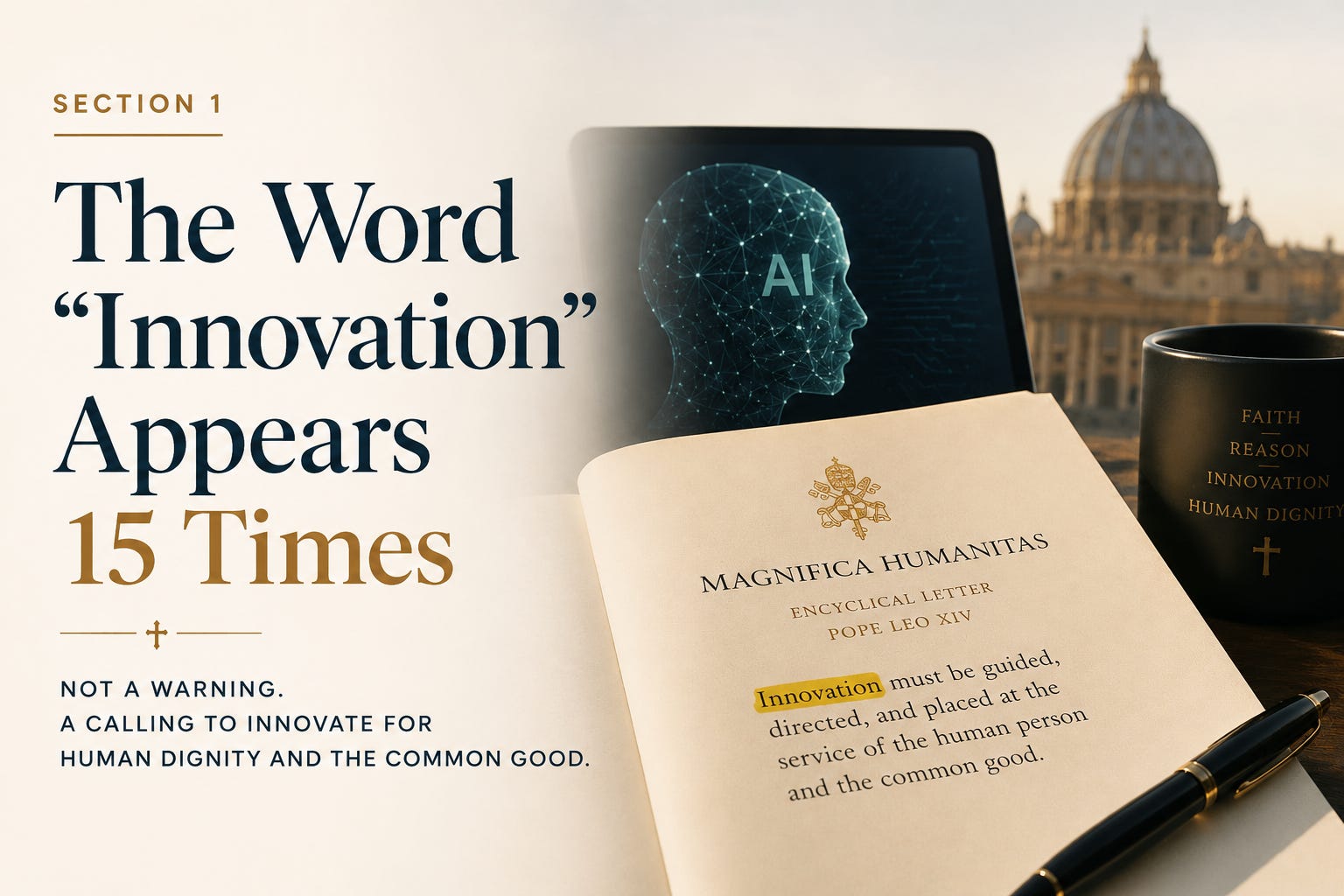
Let me start there, because it matters. I was shocked that this isn’t just a document about AI. It’s a document invoking innovation.
“Innovation” and its variants appear at least 15 times across all five chapters of this encyclical. Not tucked into a footnote. Not in a single cautionary paragraph. Across the Introduction, Chapters Two through Five, and the Conclusion, the word shows up in almost every major section of the document.
That type of presence in an Encyclical isn’t an accident. It’s a very intentionality choice of words and emphasis.
The Pope is not talking about innovation as a threat to be managed. He’s talking about it as a force that must be shaped, directed, governed, and in some cases, claimed by people who know what they’re doing and why. Here’s the range of what he says:
In paragraph 5, he names the core governance problem in the past and goes on to state guided and directed innovation. Today, private transnational actors have taken over, with resources that surpass most governments. AI Innovation has been privatized, and that’s a power question that the Church has an obligation to address.
In paragraph 85, he calls technological innovations, including AI, “not neutral.” They either foster participation and justice or exacerbate inequality and exclusion.
In paragraph 93, he describes the same innovations as capable of greatly serving integral human development, if guided by the right framework.
In paragraph 111, he addresses AI developers directly: “technological innovation can represent human participation in the divine act of creation.”
In paragraph 151, he warns that innovation is too often pursued solely for reducing costs and increasing profits, and he goes on to name that as a moral failure.
In paragraph 156, one of the most operational paragraphs in the entire document, he proposes “social criteria for innovation.” Every introduction of automation and AI should be accompanied by verifiable measures to protect workers. And then this: when those conditions are present, “innovation can serve as an ally of safer, more creative and dignified work; without them, innovation tends to become an accelerator of injustice.”
Take the two sides of this discussion. First, innovation seen as an ally. The second, innovation as accelerator of injustice. The difference is the framework you bring to it. Those are very different perspectives.
In paragraph 162, he insists that “justice requires access to the benefits of innovation,” including care, knowledge, tools, and opportunities, for everyone, not just those with resources.
In paragraph 164, he makes the point that the governance criteria he proposes “do not constitute a curb on innovation; instead they make it civilized and humane.”
And in paragraph 244, in one of the most striking lines of the entire conclusion, the Magnificat is described as “the strongest and most innovative hymn ever articulated.” The Pope frames it as as an act of innovation. As a new vision of history, seen through the eyes of the lowly, announced before it was visible to anyone else.
Fifteen times, across the whole document, innovation is seen not as the villain of this encyclical. The absence of moral framework for innovation is the villain.
The Framework Every Christian Innovator Needs
The theological core of the document is built around two biblical images: the Tower of Babel and the rebuilding of Jerusalem under Nehemiah. I’ve preached both of those sermons on innovation.
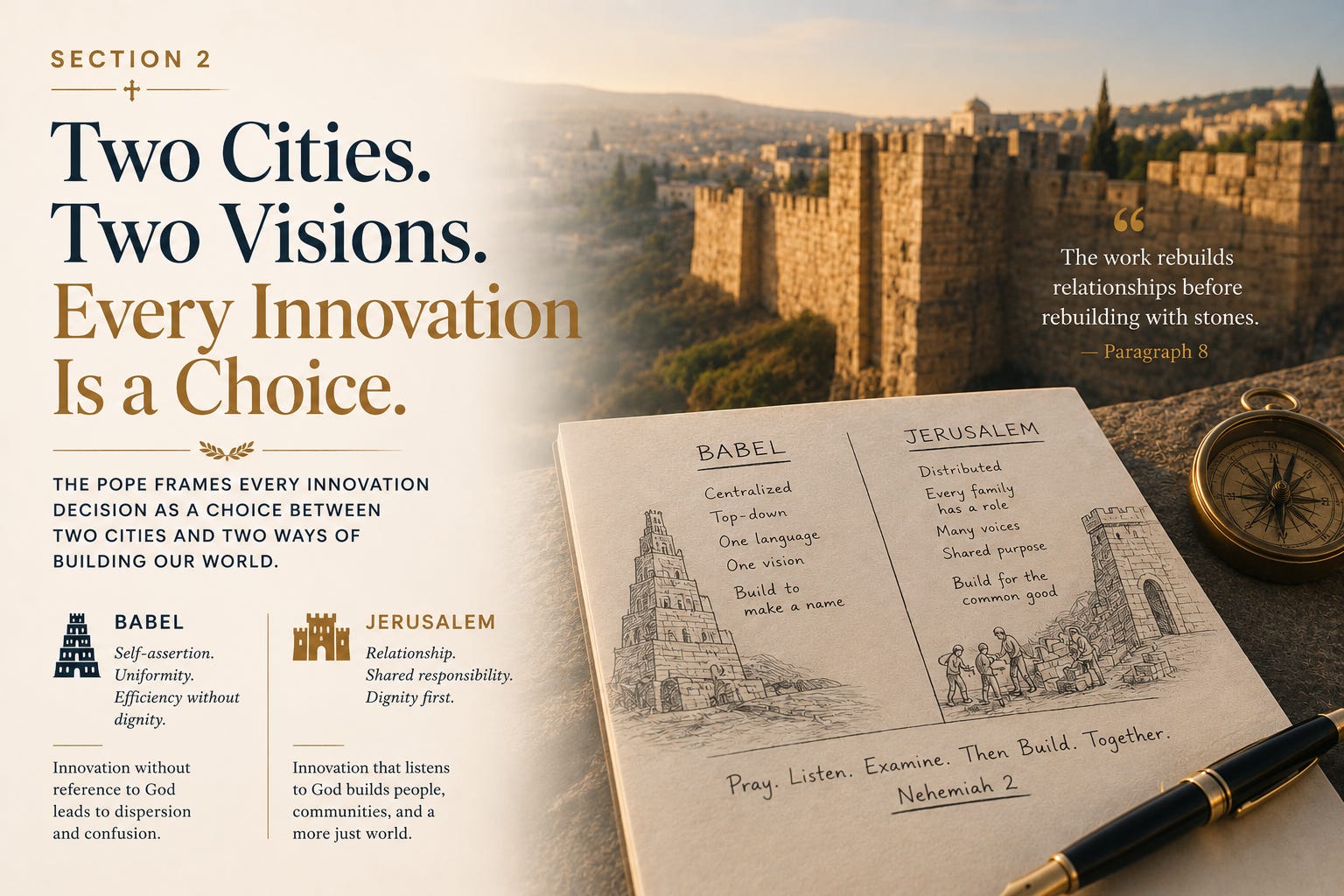
Babel, the Pope explains in paragraph 7, represents innovation driven by self-assertion. A single language, a single direction, and efficiency that sacrifices human dignity. The project built without reference to God, designed to make a name for the builders. The result is dispersion and confusion, even in its awesomeness.
Jerusalem under Nehemiah is the alternative. Before Nehemiah does anything, he prays. He fasts. He listens. He arrives in Jerusalem and examines the ruins in silence before proposing a single solution. Then he doesn’t impose a top-down plan. He assigns each family a section of the wall. Everyone has a role. The city is rebuilt not through the genius of one visionary but through shared responsibility. Paragraph 8 contains the line that took an interesting twist. The work “rebuilds relationships before rebuilding with stones.”
The Pope frames every innovation decision as a choice between these two cities. Are you building Babel, impressive, efficient, uniform, self-asserting, or Jerusalem, relational, distributed, God-centered, human-dignity-first?
That is an important question for faith leaders. It applies to every product decision, every deployment decision, and every governance conversation. The Babel syndrome, named explicitly in paragraph 10, is “the idolatry of profit that sacrifices the weak, a uniformity that neutralizes differences, and the pretense that a single language, even a digital one, can translate everything, including the mystery of the person, into data and performance.”
Sound like any AI products you’ve seen?
Paragraph 13 Is Your Job Description
If there is one paragraph I want every Christian innovator to read first, it’s paragraph 13.
The Pope is describing what it means to build for the common good, and he writes that no one is too weak to play their part, and then names explicitly who has a section of the wall: “scientists and researchers, entrepreneurs and workers, educators and legislators, civil society, popular movements and faith communities.”
Scientists and researchers. Entrepreneurs and workers.
That’s all of us. We have a section of the wall and not a bystanders to this moment. We are not an observers being cautioned from the sideline. We have been assigned a section, and are accountable for what we build there.
Paragraph 111 Is the Most Direct Address to Builders
The Pope reserves paragraph 111 for a direct appeal to AI developers, the people actually building these systems. He writes that “technological innovation can represent human participation in the divine act of creation.” And then he says developers “bear a particular ethical and spiritual responsibility, for every design choice reflects a vision of humanity.”
He goes on to write, “Just as the creator of an artistic or literary work must consider the values it conveys, so developers are called to embed values in their projects with due seriousness: with transparency, responsibility toward affected communities and careful attention to ensuring that what is being cultivated is a genuine good.”
A genuine good. Notice that he didn’t say, “A scalable product.” He said, “A genuine good.”
The Pope is telling builders that their work is priestly, that it participates in creation, and that the weight of that has to be carried consciously.
Paragraph 156 Is the Most Operational
For those of us who work inside organizations making real deployment decisions, paragraph 156 is where the rubber meets the road.
The Pope proposes “social criteria for innovation.” Every introduction of automation and AI should be accompanied by verifiable measures to protect employment, enable retraining, and ensure worker participation. Technology should be oriented toward “freeing up human time and capabilities, rather than producing exclusion.”
Then the clincher, “When these conditions are present, innovation can serve as an ally of safer, more creative and dignified work; without them, innovation tends to become an accelerator of injustice.”
This is not a general philosophical observation. Instead, this is a practical test for every deployment decision. It maps almost exactly onto our organization’s AI Charter.
Does this honor the image of God in every person it touches?
Does it empower human relationships or substitute for them?
Does it serve the mission?
The Pope didn’t read our charter. I would have shared it with him, but he didn’t ask. If he ever did read our charter, he would recognize our framework.
The Nehemiah Model
I’ve spent years teaching innovation frameworks. Design Thinking, the Business Model Canvas, Blue Ocean Strategy, and few dozen books and articles. There are great tools in this resources.
But Nehemiah, as the Pope reads him across paragraphs 8, 10, 16, 129, and 241, is a complete innovation methodology embedded in a biblical narrative. It’s one of my favorite stories in the Bible.
Nehemiah starts with prayer and discernment before planning. He listens before proposing solutions. He examines the problem in silence before generating ideas. He distributes ownership rather than centralizing control. He addresses opposition without abandoning the mission. He rebuilds relationships alongside infrastructure.
And in paragraph 241, the Pope explicitly connects Nehemiah to the present moment: Christians are called to enter “the construction sites of history: research laboratories, technology companies, schools, the media, institutions and local communities, in order to rebuild what has collapsed and protect what is threatened.”
Research laboratories and technology companies. This is bigger than the church. The church must be involved. People of faith are a part of these research laboratories and technology companies.
What This Means for Your Work Right Now
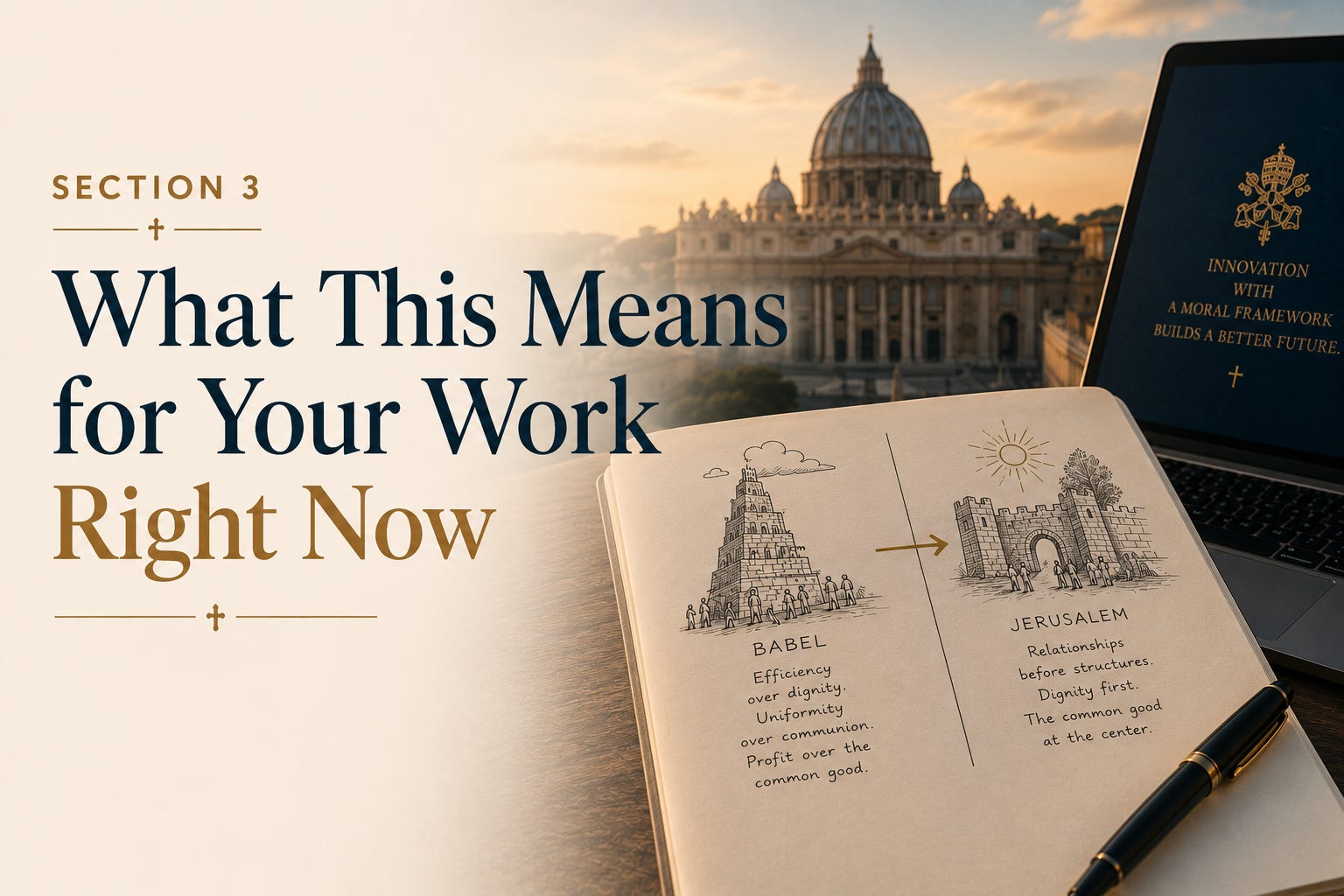
If you are a Christian who builds things, software, systems, curricula, organizations, strategies, and you don’t have a theological framework for your work, you are making those decisions by default… on autopilot. And the default, the Pope argues throughout, is Babel. Efficiency over dignity, uniformity over communion, and profit over the common good. I’m afraid he’s correct.
The encyclical is not asking you to slow down. In paragraph 106, it explicitly says that calling for prudence “does not mean opposing progress; instead, it is an exercise of responsible care for the human family.” The problem isn’t innovation. The problem is innovation without a moral framework anchored in human dignity.
In paragraph 164, the Pope offers four concrete criteria for innovation that honors human dignity.
Transparency and accountability.
Inclusion and access.
Equity in distribution of benefits.
The insistence that these criteria “do not constitute a curb on innovation; instead they make it civilized and humane.”
Civilized and humane. That’s a pretty low bar and not too much to ask.
The Length Tells You Something
This document is 245 paragraphs long. The Pope could have addressed AI in 20 paragraphs. It could have been an email! He covered truth and democracy, the dignity of work, unemployment, family stability, human trafficking, weapons systems, the crisis of multilateralism, digital addiction, and the formation of children, all through the lens of what it means to remain human in the age of AI.
That scope tells you how seriously he is taking this moment. And it should tell you how seriously we need to take it too. The most dangerous thing a Christian innovator can do right now is assume that the theological questions belong to someone else. The Pope spent 82 pages arguing the opposite. The builders are on the wall. The builders have a responsibility. That’s us!
Get Your Hands Dirty
The closing of the Introduction, paragraph 16, is a key line to consider.
The Pope addresses “all the Catholic faithful, to all Christians and to all men and women of goodwill” and says, “Let us not be afraid to get our hands dirty on the ‘construction site’ of our time.”
Get your hands dirty. I like that!
That is not the language of caution. It’s the language of calling and of someone who believes that the construction site needs Christians on it, not standing outside writing position papers or offering cautious affirmations from a safe distance. The calling is to be involved, to be on the site, with your hands in the work, and building with theological clarity and human dignity at the center.
The Pope issued a call to innovators of faith. He named us explicitly.
Now we need to build accordingly.
Read the full encyclical at the Vatican website. It’s 82 pages. Read all of them. And if your organization doesn’t yet have a theology of innovation, this is the best possible moment to start building one.