



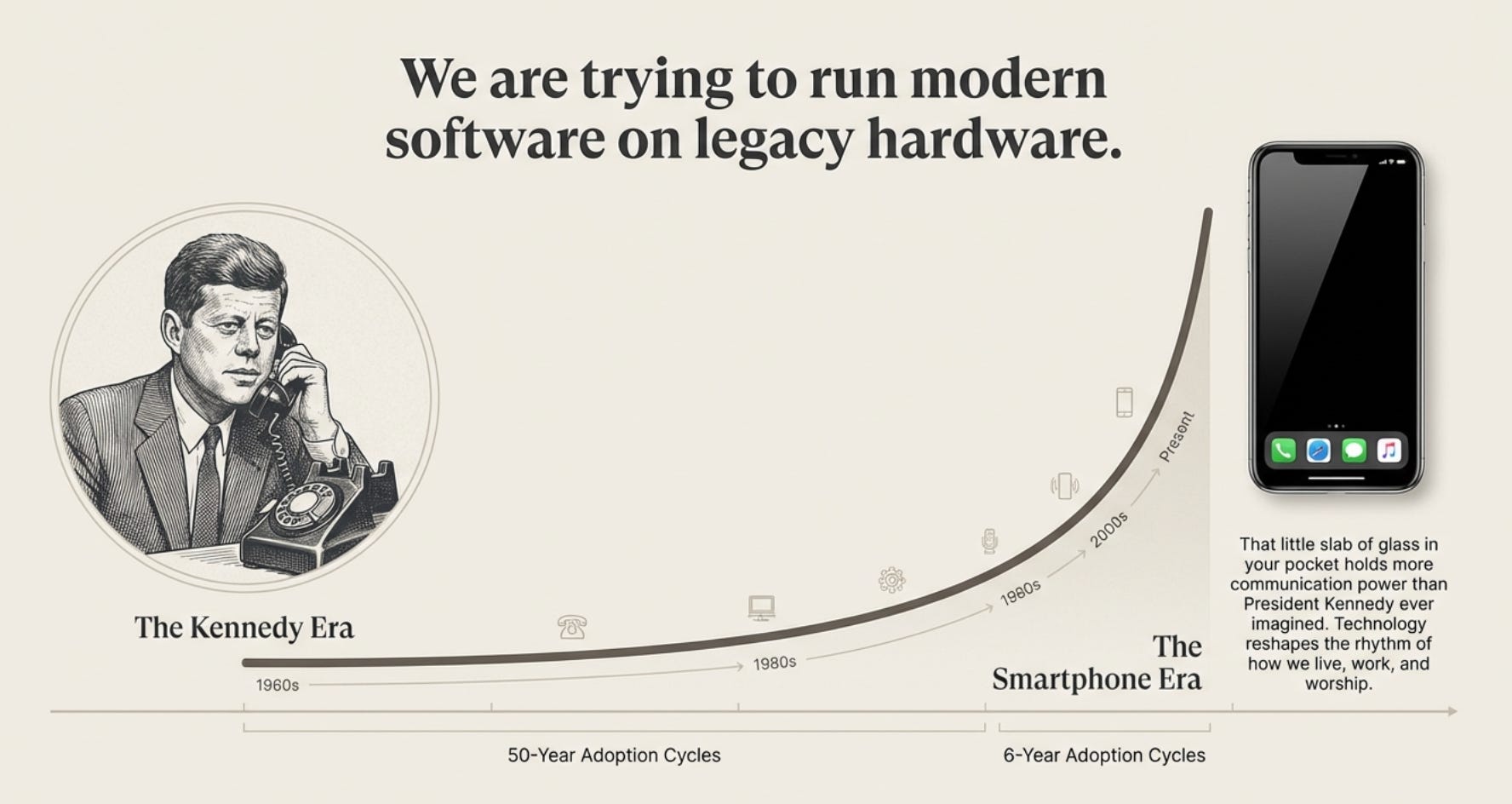
When I boarded a flight from Washington, D.C. to San Francisco in December, I stared out the window at the endless sky and thought about the tiny device in my hand. That little slab of glass and metal holds more communication power than President Kennedy ever imagined (and he dreamed big). It’s a reminder that technology is not just moving faster, but it’s reshaping the very rhythm of how we live, work, and even worship.
Prior to boarding this flight, a colleague texted me a simple question: “Can we build a game that teaches people about global missions based upon the Oregon Trail?” My first instinct was to ask, “How might we?” I didn’t have a polished plan, but over the next few hours, I went from idea to a working prototype by the time we landed. The point isn’t that the idea was brilliant. The point was that I was willing to try, to fail, and to iterate at 38,000 feet.
Innovation isn’t about a flash of brilliance. It’s about the people who are willing to turn that flash into a flame. In the corporate world, leaders love to tout “innovation” as a strategic priority. One study shows only a fifth actually put it on the agenda. The rest are caught in a paradox. They love the word innovation but fear the mess that comes with true change.
The corporate “immune system” is a perfect illustration. An accountant spent a decade balancing the books and one day his wife talked about a medical‑dosage app,. It got him thinking, “How do we know it’s trustworthy?” That question was the spark of a crazy idea. When he pitched the idea to his bosses, the corporate naysayers attacked. “We’re accountants, not app developers,” they said.
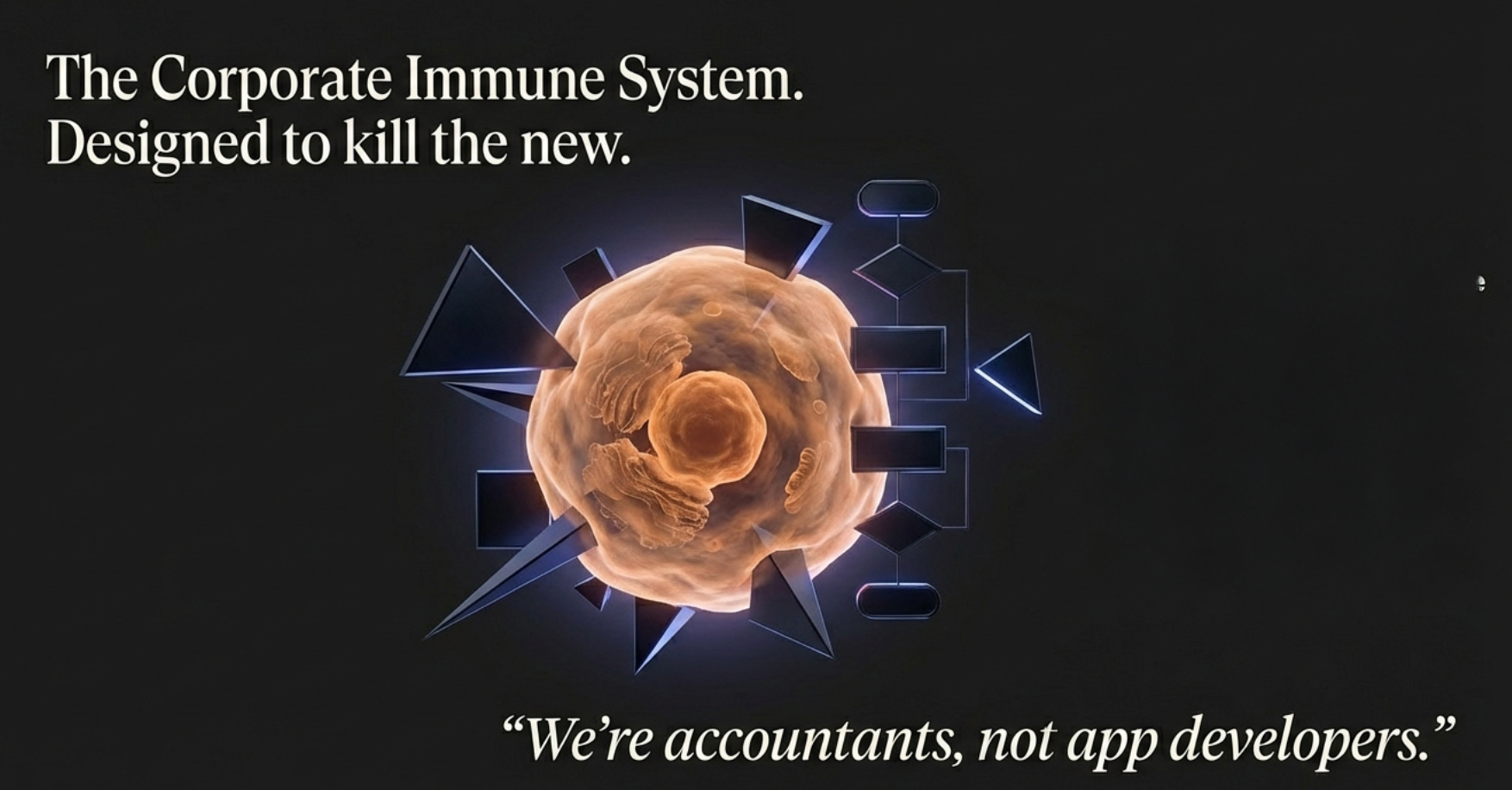
Instead of crushing Rob’s curiosity, that company’s innovation team gave him a seat at a new table. They didn’t hire him for his résumé, they hired him for his passion. Within a year, he was speaking at health conferences, leading a product team, and opening a market no one else even considered. The idea didn’t create this innovation, a person did.
As a Christian, I see a parallel in the body of Christ. Paul writes in 1 Corinthians 12 that we are many parts, each with its own function. The church’s “innovation” isn’t a new worship style or a slick app. The church’s innovation is it’s the ordinary people. Teachers, accountants, nurses, and retirees. People who feel God moving them to serve in unexpected ways. When we cling to the familiar, we build an immune system that attacks the new. When we give space for God‑gifts to flourish, we become a living examples of His grace.
So how do we cultivate an innovative environment?
Hire (or invite) for passion, not just skill. A résumé just shows us what has happened in the past, the passion God gives us points us forward.
Create safety. If people fear these corporate antibodies, they’ll never ask, “How might we?” Give people permission… actually, encouarge people to act on their dreams.
Allow failure. Let people try big things and fail openly. Innovative leaders take responsibility for the fallout when people were trying big things for the right reasons. Learning from things that don’t work help build upon the next big breakthrough.
Imagine a church that embraces big ideas. A pastor could test a new digital engagement platform without fearing change antibodies attacking. A church that embraces new ideas instead of preserving the past. The pastor is encouarged to take a calculated risk, knowing that if it flops, the leadership will stand with them and they will learn from the experience. The result? A community that moves at the speed of the smartphone, not the printing press.
The world is accelerating. Innovation and adoption cycles that once took half a century now shrink to a few years. Code that took a year to write is being written in a week. If we want gospel expansion to keep pace, we must stop worshipping bright ideas and start worshipping the people God places in our midst.
What’s the takeaway from all of this?
Look at your circle of influence. Who is holding a bright idea(s), and who is holding the courage to act on it? Invite them in, protect them, and give them the permission to fail. The next breakthrough may not be a product. The next breakthrough may be the person God has been shaping for this very moment.
If you are a leader who loves to talk about innovation, how often do you encouarge people to dream big dreams and ask, “How might we?” Create the space for innovation and celebrate it! Do you just talk about innovation or do you act on innovation?