


A small team of 4-5 engineers just beat companies with 100x more people to land DoorDash as a customer.
Not because they worked harder. Not because they were smarter. Because they work differently.
Watch this first. It’s 8 minutes and I believe that it will rewire how you think about teams and capacity.
This video introduces a concept called the 20x company. A startup so thoroughly automated internally that each employee carries the output of twenty. They’ve removed the friction. Not through burnout and more headcount, but through intelligence layered into every workflow, every process, every function.
Code. Support. Marketing. Design. Sales. Hiring. All of it with a fraction of the employees of other companies. Their leanness isn’t a limitation. It’s the strategy.
And here’s what hit me watching this, the church and missions world is sitting on the same opportunity. Almost no one is talking about it. Before you say what you are already thinking, let me say it for you. A startup company has a very different desired outcome than a religious institution. While this is true, I believe the church can learn from this not by automating human centric activities but cutting through things that distract us from our mission.
Many have been framing AI adoption in ministry as a question of ethics and caution. Should we use it? Is it authentic? What about the human element?
Those are real questions and concerns. Christians need to continue addressing these and not leave the ethics of AI to the tech companies, but those questions are the wrong starting point for us.
The better question is. “What becomes possible when a small team operates at 20x capacity?”
A church planting team of 3 people functioning like a team of 10, 20, or 60. A team with no communications support producing content in 5 languages in a fraction of the time and cost. A mission organization scaling discipleship tools without scaling headcount. A solo videographer tagging, renaming, organizing, and uploading hundreds of Vimeo videos overnight instead of hiring the work out or spending six weeks on the project.
These are not dreams. That’s what the startups in this video are already doing. It’s also what innovative and lean ministires are also doing.
What the 20x Framework Looks Like in Ministry
The video outlines three approaches that translate directly to our world.
The AI Teammate. GigaML built an internal agent called Atlas that works alongside a single human employee to manage dozens of Fortune 500 accounts. One human. Dozens of enterprise relationships.
Ministry parallel? Imagine one mobilization coordinator supported by an AI teammate that handles follow-up sequences, tracks engagement, drafts personalized responses, and surfaces the right information at the right moment for the right person. We’re not far from this. We’re already experimenting with it.
The Unified Source of Truth. Legion Health built a single interface where any care ops team member can instantly pull patient history, scheduling, insurance codes… everything. They grew 4x without adding a single new hire.
Ministry parallel? Over the past two years I have visited with dozens of ministries. It’s the same story over and over. Field workers drowning in disconnected systems. One tool for reports, another for prayer requests, another for contract reviews, another for expense reports, and nothing talking to each other. Enter a unified AI-powered dashboard to change everything. The information exists. The problem is retrieval and synthesis. AI solves that.
Custom Agents Per Person. Phase Shift literally asks employees to document what they do manually, then builds custom AI agents for those tasks. They’ve avoided hiring an entire design function because of it.
Ministry parallel? How do we replicable this in any ministry context? Ask your team, “What do you do every week that feels like it shouldn’t require a human?” Then build for that. Better, help them build that. The best person to build that system? The person who feels the friction.
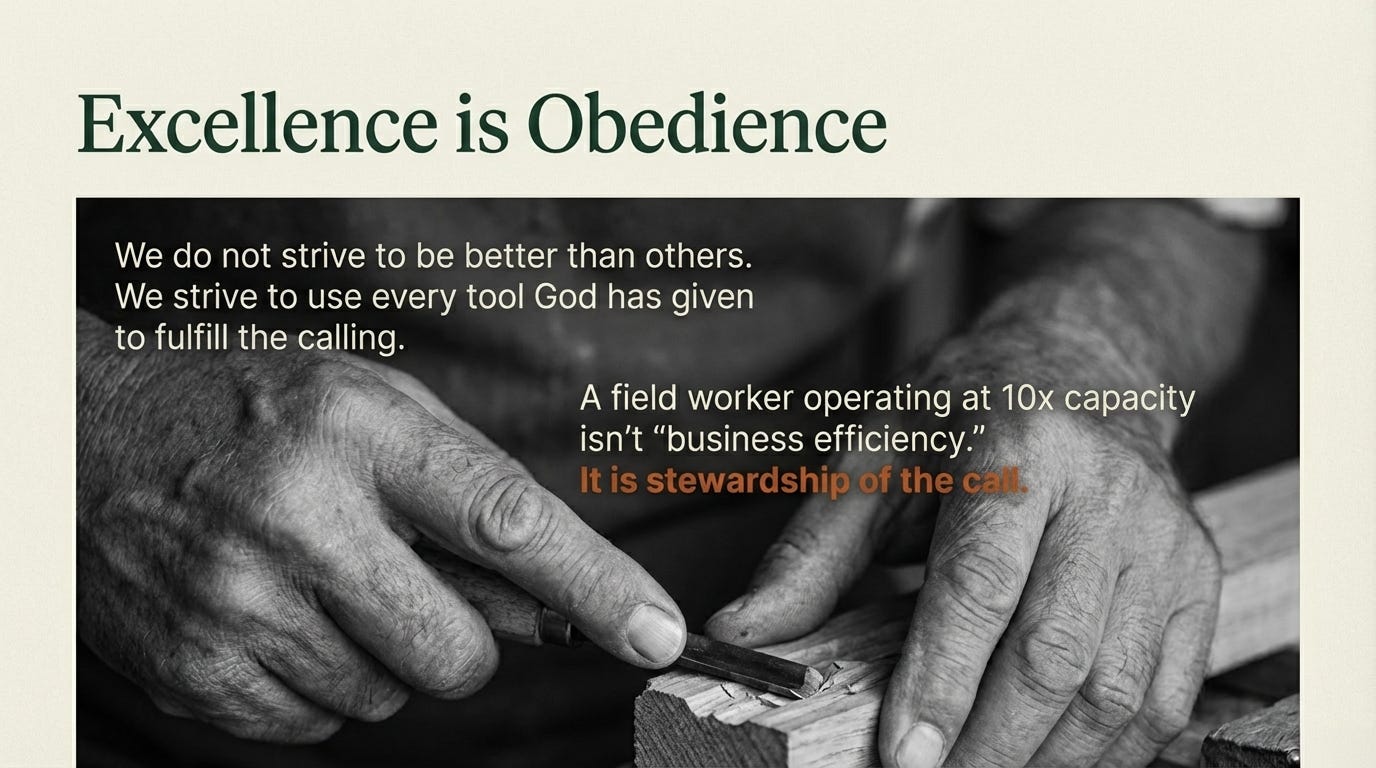
Missions Implications Are Staggering
Here’s what should be keeping ministry leaders up at night in the best possible way.
Ministries large and small are serving all around the worldwide. Most of them are doing work that has no administrative backup, no communications team, and no creative support. They’re gifted, called, and stretched thin. The answer is not redirecting critical frontline workers for administrative tasks.
What if every field worker was able to operate at 2x? 5x? 10x?
Not because they added staff, but because they added intelligence to their workflows.
Reports drafted faster, prayer updates edited for their supporting churches, language learning accelerated, cultural research available on demand, impact documentation that doesn’t take three hours to write, and metrics for evaluation available anywhere and at any time.
The Great Commission hasn’t changed, but the capacity of the people carrying it is about to.
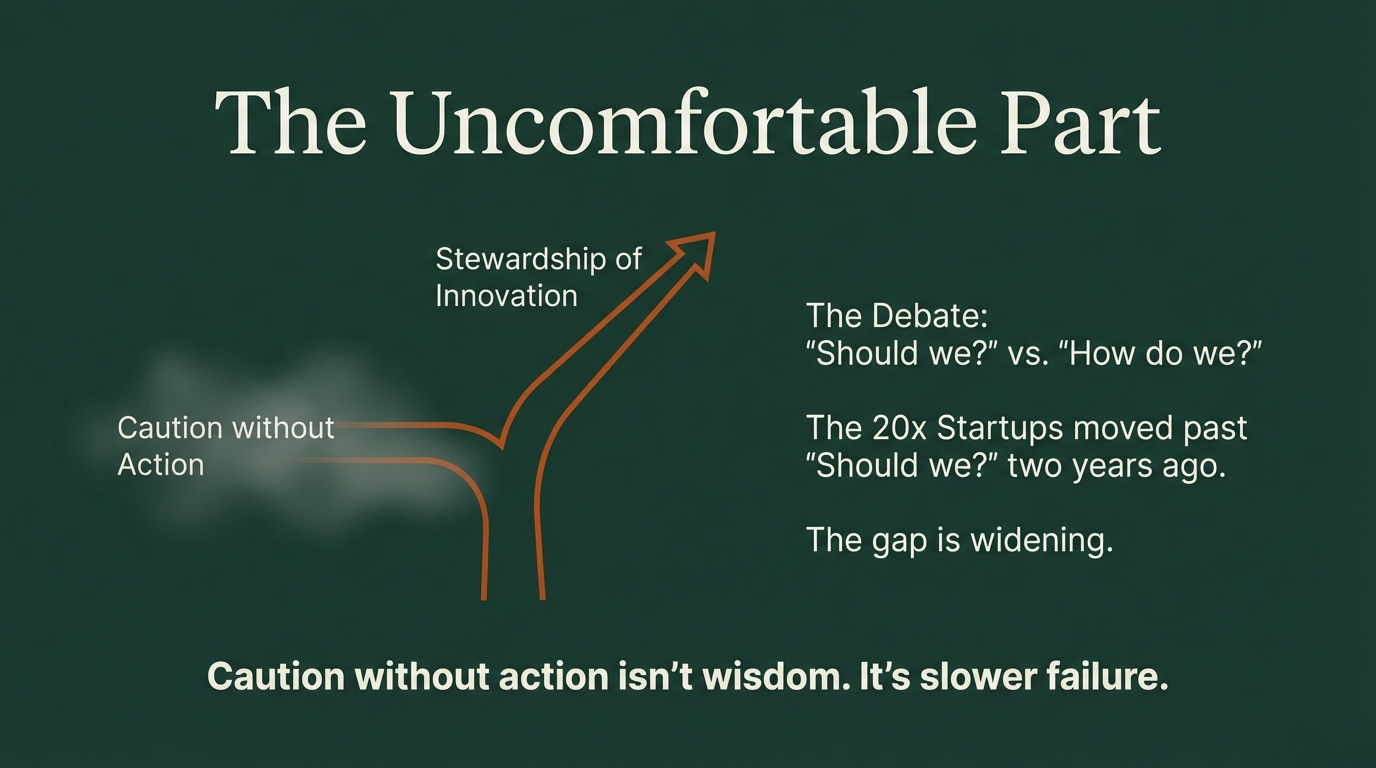
The Uncomfortable Part
Many ministry organizations are still asking, “Should we allow AI?”
The 20x startups already moved past that question two years ago. They’re not debating. They’re building. And the gap between them and the organizations still deliberating is widening every week.
I’m not saying throw caution away. Governance matters. Ethics matter. Data protection matters enormously. We must take all of those things seriously.
Here’s the rub for me.
Caution without action isn’t wisdom. It’s just slower failure.
The organizations that figure out the 20x ministry model first, lean teams, intelligent workflows, and leveraging embedded AI in every manual process, are going to have a reach and an impact that looks tremendously different than traditional structures. Our drive for excellence isn’t to be better than another group. Our drive is to use every tool God has given us at our disposal to be obedient to His divine calling on our lives.
And maybe that’s exactly the point. Jesus sent twelve. Not twelve thousand. The question was never about the size of the team.
Don, you've exactly articulated my frustrations over the past year. "Caution without action isn’t wisdom. It’s just slower failure."
Christendom has a discernment problem. Not because it wants to think and pray on things, but because it excuses inaction and analysis paralysis as spiritual discernment. By all means, take a day, a week, even a month to get the right people in the room. Think and pray on it. But if you haven't come to a conclusion in a year, that's not discernment. That's stalling, indecision, and poor leadership. It certainly isn't a virtue.
It's the servant that buried his talent in the ground and wants to be rewarded for making the "safe choice". What happened to boldly risking for the Kingdom? Stewardship is not always playing it safe. Stewardship is taking calculated risks and letting God work in amazing ways. The apostles risked it all for the gospel. All but 1 were martyred. We sit in comfy offices and "discern" about the ethics of AI for 3 years. God help us.
Wow! This article blew up today! Another one is coming out in the morning :)