


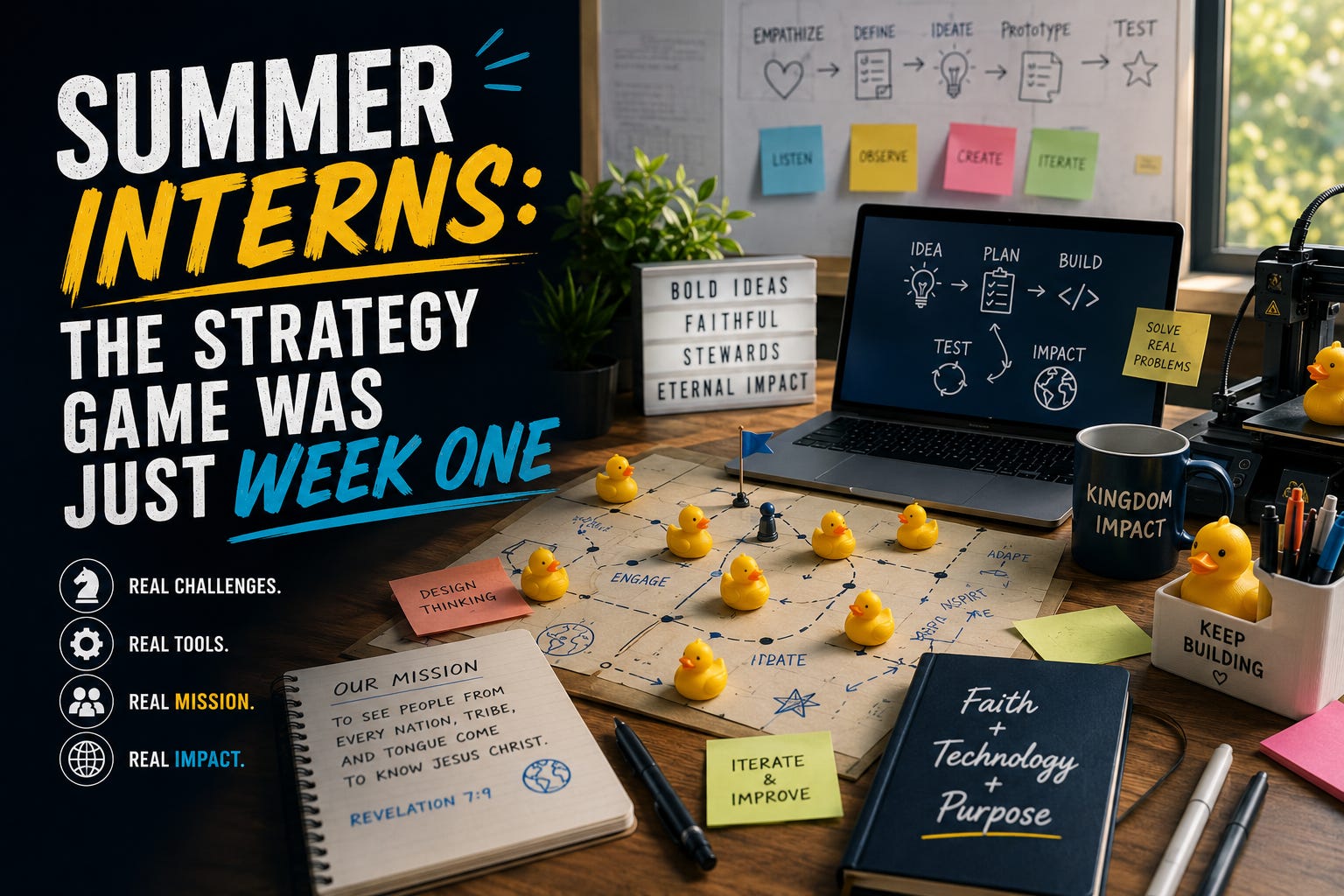
Most internships start the same way. Paperwork, passwords, a tour of the office, and maybe a welcome lunch if your organization is feeling generous. Then, somewhere around week two, you get assigned to something real. It’s usually something quasi-adjacent to what someone more senior doesn’t want to do.
Our innovation team didn’t do that.
Last week, our three summer interns arrived from Auburn University, the University of Florida, and the University of Virginia. Bright, capable, and genuinely eager. I love working with interns because they bring a renewed sense of curiosity and possibility to the room.
This year, once they finished their HR and technology onboarding, before I talked to them about any of their core summer work, before I assigned them to any project connected to AI or design thinking, I gave them one assignment.
Build a strategy game.
They were given a link to a website I created with the general guidelines. They are to build a game that runs all summer and secretly opens to everyone in the org. They need to use at least a hundred 3D-printed ducks, create a website where people compete, and keep people playing from June to August. This isn’t a research project about games. I want them to build one from scratch, as a team of three, with no template and no rubric.
Why a Game?
Here’s what that assignment is actually teaching them, even if they don’t fully see it yet. (And I know they’re reading this.)
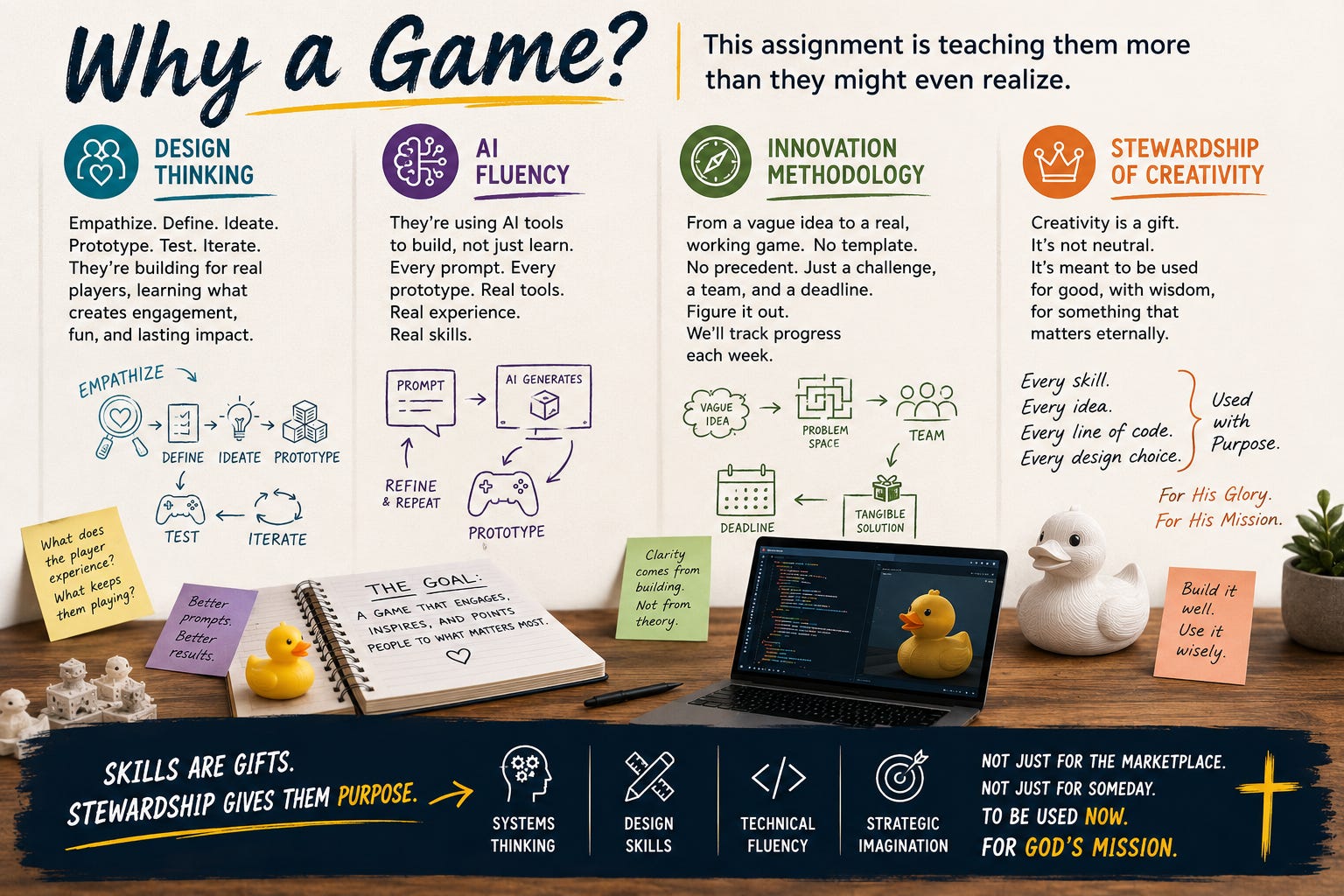
It’s teaching design thinking, because a game that doesn’t work from the player’s perspective isn’t a game, it’s a frustration. They have to empathize with someone who isn’t them. They have to test, iterate, fail, and rebuild. They have to ask questions like, “What does the player experience? What decision points matter? What makes someone want to keep playing?”
It’s teaching AI fluency, because they’re building the game with the help of AI, not learning about it in the abstract. Every tool they reach for, every prompt they write, every prototype they generate, that’s real experience. Not a case study. Not a simulation.
It’s teaching innovation methodology, because they have to go from a vague idea to something tangible with no precedent. Just a challenge, a problem space, a team, and a deadline. Figure it out. We’ll track progress each week.
And underneath all of that, it’s teaching something harder. It’s teaching them that creativity is a form of stewardship. That the skills God has given them, systems thinking, design skills, technical fluency, and strategic imagination, are not secular assets they happen to carry into some future ministry context. These are to be used now, even while building a game about 3D printed ducks.
Why We Actively Recruit Interns
We take as many interns as we reasonably can. We invest in them because we believe they are the future of missional innovation. We also gain the benefit of fresh eyes looking at our challenges from perspectives that are often not in the room.
The church desperately needs creative and innovative people. Most of those people have never been shown that there’s a place for them in ministry.
They go to school for design, engineering, computer science, or business strategy. They work hard, get good grades, and are good at what they do. They love God and somewhere along the way. through sermons, culture, and the implicit message of a thousand conversations, they absorb an idea that their skills are for the marketplace and their faith is for Sunday. Ministry is over here. Innovation is over there. Sacred calling is separate from the skills and gifts God has given them.
I want to blow that concept up.
Not with a lecture, but with an experience. With a summer where they build real things, work on real problems, use real tools, and do it all inside an organization whose entire reason for existing is to see people from every nation, tribe, and tongue come to know Jesus Christ. To see Revelation 7:9 lived out among the nations.
My goal for our three interns is simple, show them the intersection of faith and technology before they’ve had a chance to decide there isn’t one.
Formation, Not Just Training
We don’t just need smart young professionals who can execute tasks efficiently.
We need people who understand the mission deeply enough to innovate from within it. People who, when handed a novel tool or a strange new capability, don’t ask “what would the business world do with this?” but “what would faithful stewardship of this look like, given where we’re trying to go?”
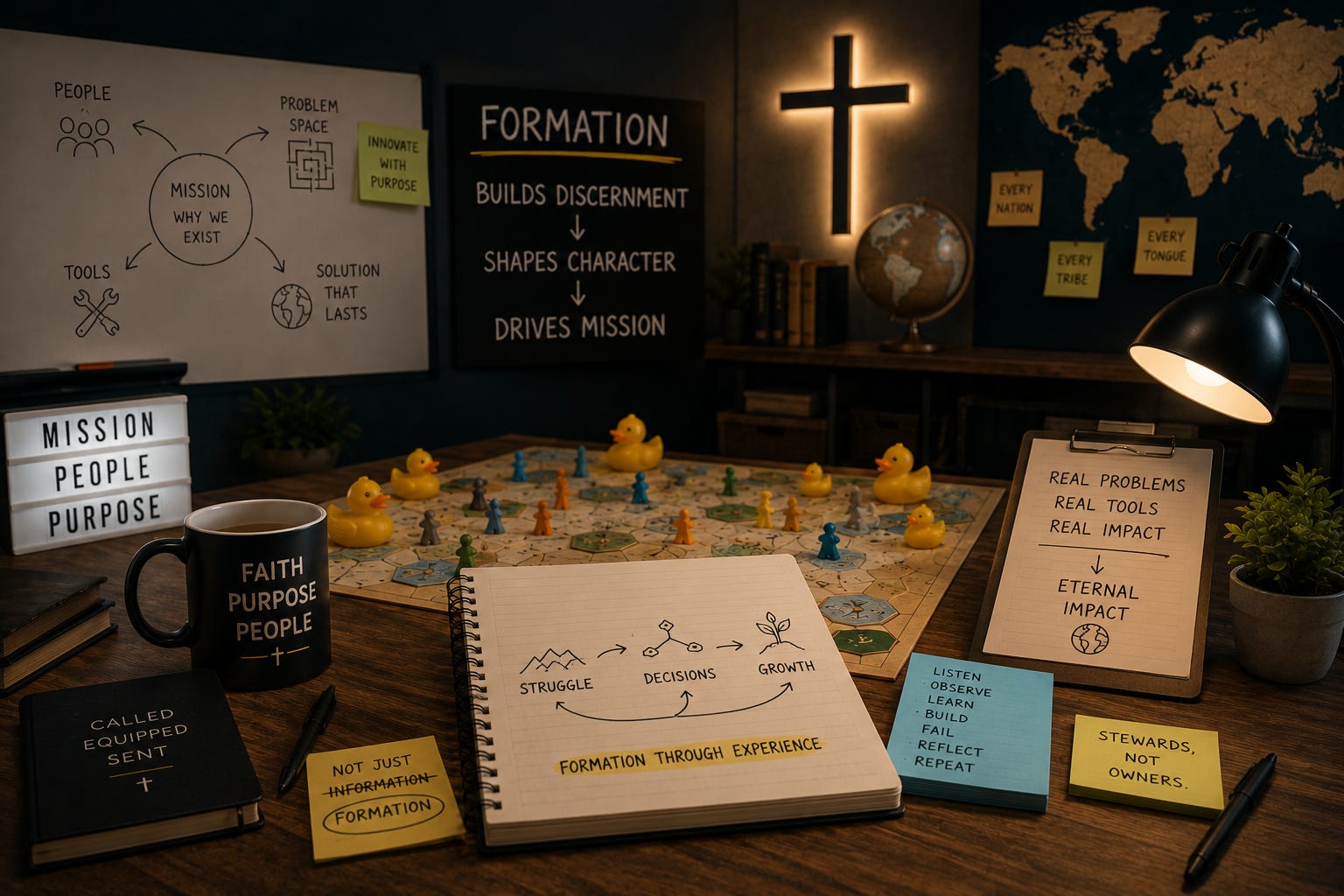
That takes formation… Formation is different from information.
Information you can deliver in a meeting. Formation happens through struggle. Through decision-making under pressure. Through the friction of trying to build something real and running into the places where your assumptions don’t hold. It happens when you’re three interns staring at a hundred rubber ducks, trying to figure out how to make an entire organization care about a game and you realize the answer requires you to actually understand people, systems, incentives, and design. All at once.
That’s the assignment. And it’s just week one!!!

The Longer Game
By the end of this summer, they will have worked on real innovation projects inside a global mission organization. They will have used AI tools not as a novelty but to build actual workflows. They will have practiced design thinking against real problems with real stakes. They will have seen that the people doing this work take theology and technology seriously in the same breath.
And maybe, just maybe, they will leave with a different picture of what their future could look like.
Not marketplace or ministry. Not secular skills or a sacred calling.
Both. Together. Integrated.
That’s the longer game. The strategy game of 3D ducks was just week one.
How might your organization build formation experiences like this for the next generation of innovators you’re developing? I’d love to hear what you’d build.