


You’ve got a great idea and you’ve even built out the implementation plan. You’ve pressure-tested it in your own head, maybe even bounced it off a trusted colleague, and you feel really good about it.
Most leaders at this point do one of two things. They either begin to implement it before the thinking has been truly tested or they schedule another meeting, which mostly delays the same untested thinking making it into the room again.
Even if you go the “extra-mile” and run your plan past a colleague, too often this is just bouncing your idea off an echo chamber. Rarely do people take their ideas to the people they think would be opposed to plan to ask them what they think about it.
Today, I want to ask you to consider a third option. I believe it’s a better option. This option doesn’t require a bigger team, a strategy consultant, budget, or another two month delay on the calendar. It’s an option I began doing a few months ago and has been transformational to introducing new ideas and new topics. If you’re an innovation person advocating change, it’s best to be prepared for the challenges before they occur. This option helps you do that.
All this third option requires is AI and the willingness to be honestly challenged. Today’s article is a how-to guide for using AI to stress test your ideas and strategic plans before they become commitments. It isn’t a philosophical argument for why you should test your idea, it’s a practical playbook for how to stress test your ideas and plans.
Why Most Ideas Fail the Wrong Way
Have you seen this happen before?
A good idea gets developed. It goes through internal review. Leaders nod, resources get allocated, the initiative launches, and then, three months in, six months in, or sometimes longer, something surfaces that everyone realizes, in retrospect, was visible all along. They just didn’t see it. The idea dies.
The market wasn’t ready. The team didn’t have the capacity. The assumption about donor behavior was wrong. The timeline was built on optimism rather than evidence. The dependency on another team’s cooperation was assumed but never confirmed.
The idea didn’t fail because it was bad. It failed because the thinking underneath it was never genuinely challenged. Maybe it was reviewed, but reviewing an idea and stress testing it are two completely different things.
Reviewing asks: Does this look good?
Stress testing asks: Where will this break?
AI is remarkably good at the second question. And it’s available right now, for free or near-free, to anyone willing to use it honestly.
The Mindset Shift Before the Method
Before we get to the prompts and the process, there’s a mindset prerequisite.
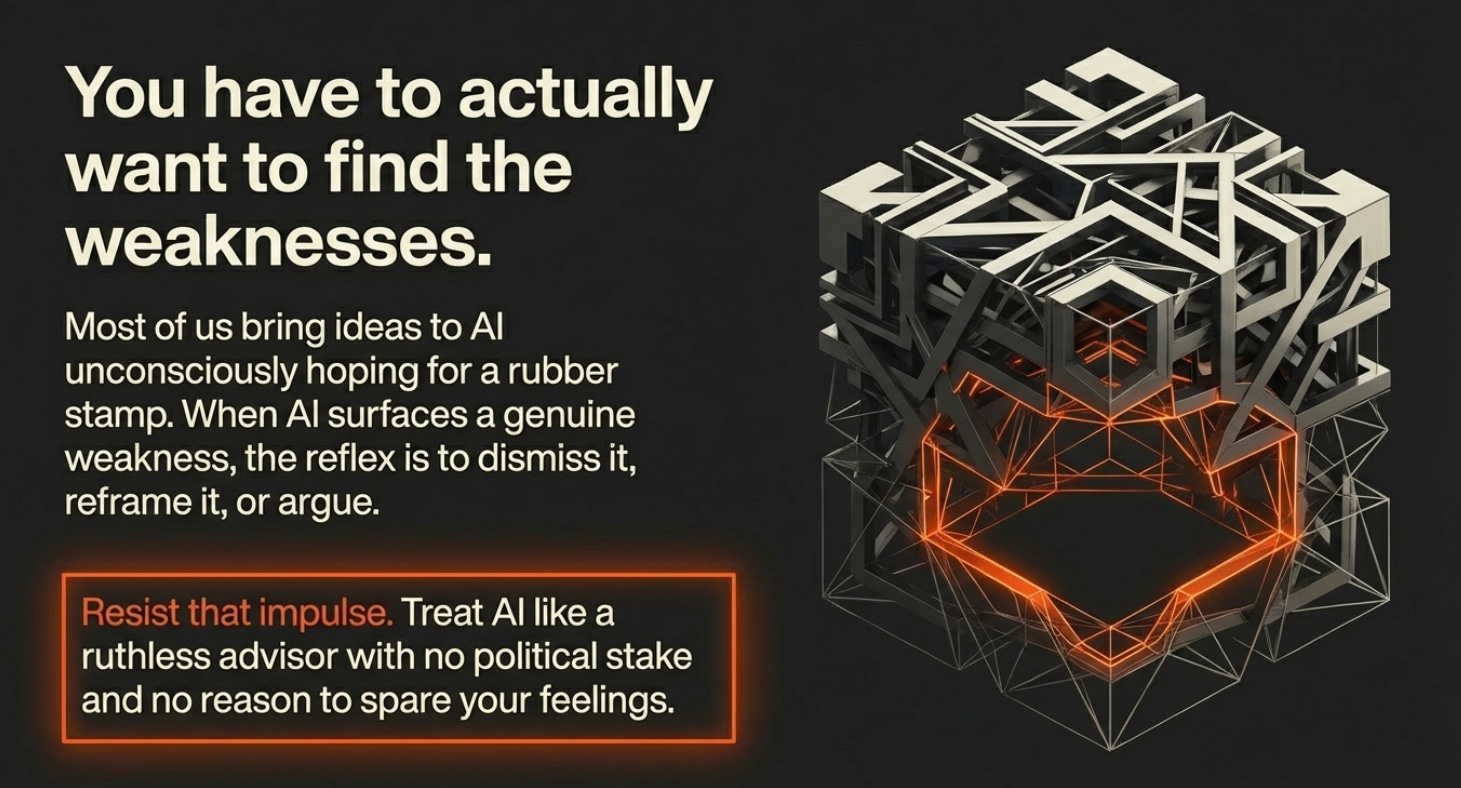
You have to actually want to find the weaknesses.
This sounds obvious. It isn’t. Most of us, when we bring an idea to review, human or AI, are unconsciously hoping for validation. We want someone to tell us it’s good. And when AI surfaces a genuine weakness, the temptation is to dismiss it, reframe it, or argue with it.
Resist that impulse. The weakness AI finds is the one you need to find before execution, not after.
The leaders who get the most value from AI stress testing are the ones who approach it with genuine curiosity rather than defensive confidence. They treat AI like a trusted advisor who has no political stake in the outcome and no reason to spare their feelings. That’s rare. That’s valuable. Use it.
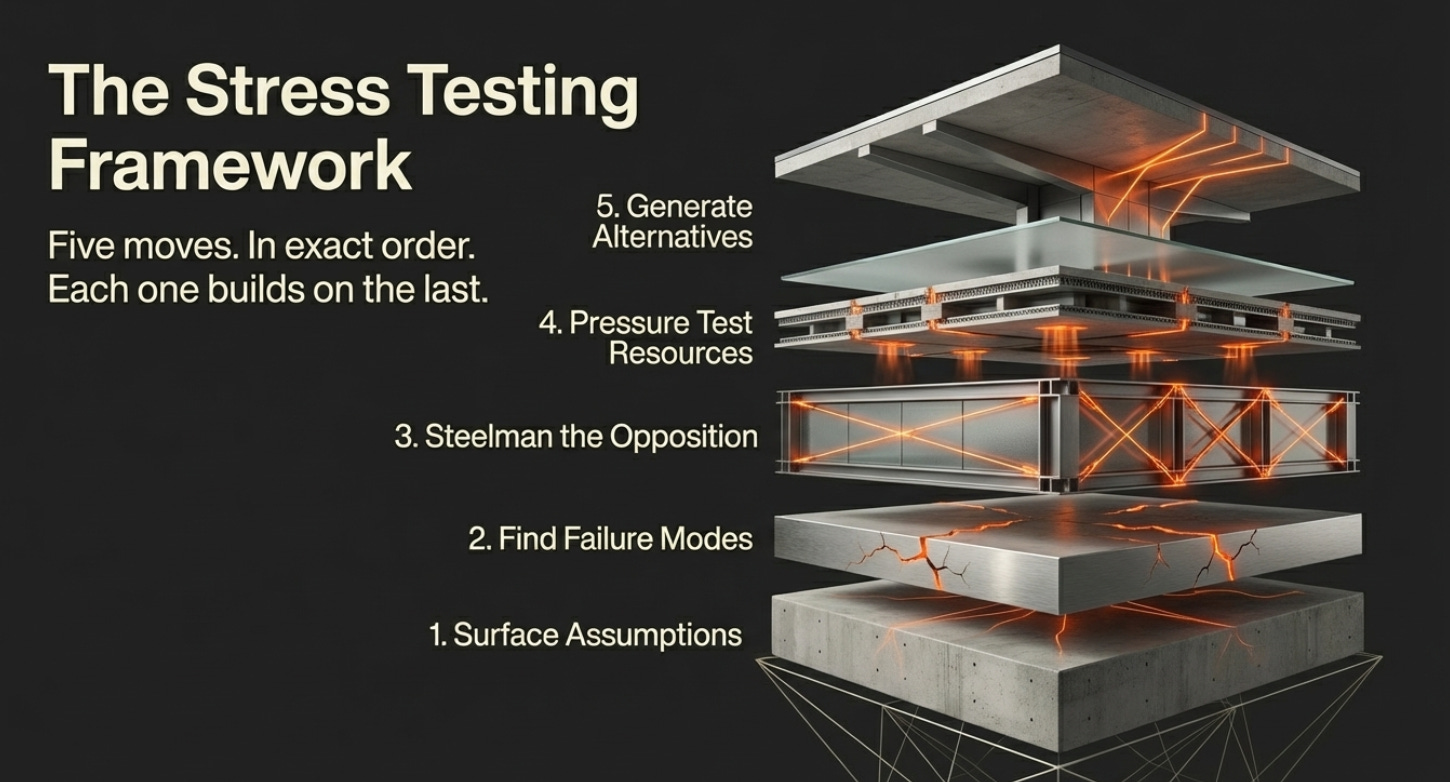
The Stress Testing Framework: Five Moves
Here’s the practical sequence. Use these five moves in order. Each one builds on the last.
Move 1: Surface the Assumptions
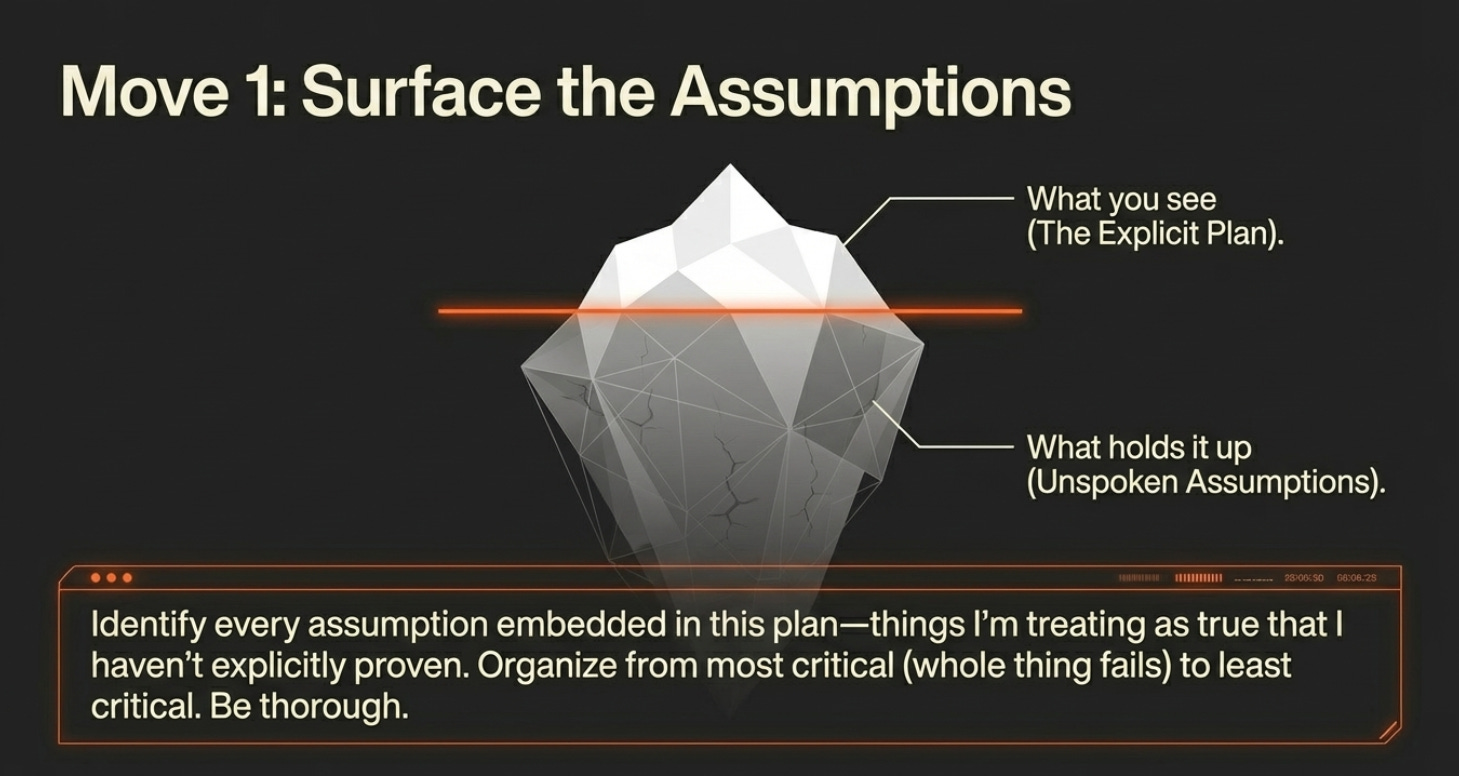
Before you can stress test a plan, you have to know what it’s actually built on. Most plans are built on assumptions that nobody named.
The prompt:
“Here is my plan / idea / proposal: [paste your content]. Please identify every assumption embedded in this. The things I’m treating as true that I haven’t explicitly proven. Organize them from most critical (if wrong, the whole thing fails) to least critical (if wrong, it’s an inconvenience). Be thorough. Don’t skip the obvious ones.”
What you’ll get back is often surprising. Assumptions you didn’t know you were making. Dependencies you treated as certainties. Market or audience behaviors you assumed without evidence.
Read the list slowly. Circle the ones that land. Those are your foundation. As a leader, you need to know how solid they are before you build anything on top of them.
Move 2: Find the Failure Modes
Now you stress test the plan itself. Not the assumptions underneath it, but the execution path above it.
The prompt:
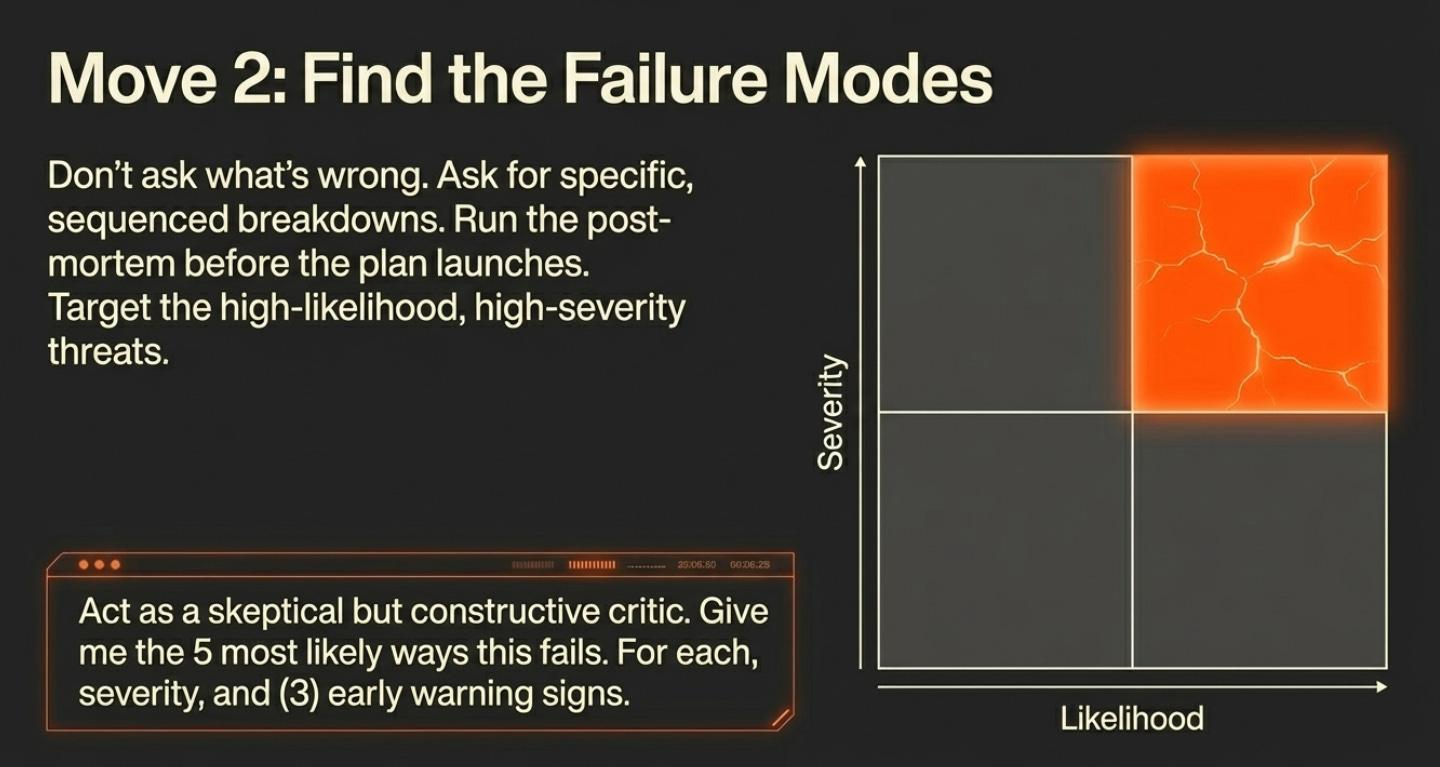
“Using the plan I shared, act as a skeptical but constructive critic. Give me the five most likely ways this fails. For each failure mode, tell me: (1) how likely it is, (2) how severe the impact would be if it happened, and (3) what early warning signs I should watch for.”
This is different from asking “what’s wrong with my plan.” Failure modes are specific, plausible, sequenced breakdowns. The kind of thing a post-mortem would identify if you ran the plan and it failed. You want to run the post-mortem before the plan, not after.
Pay special attention to the failure modes rated high likelihood AND high severity. Those are the ones that need either a mitigation strategy or a fundamental rethink.
Move 3: Steelman the Opposition
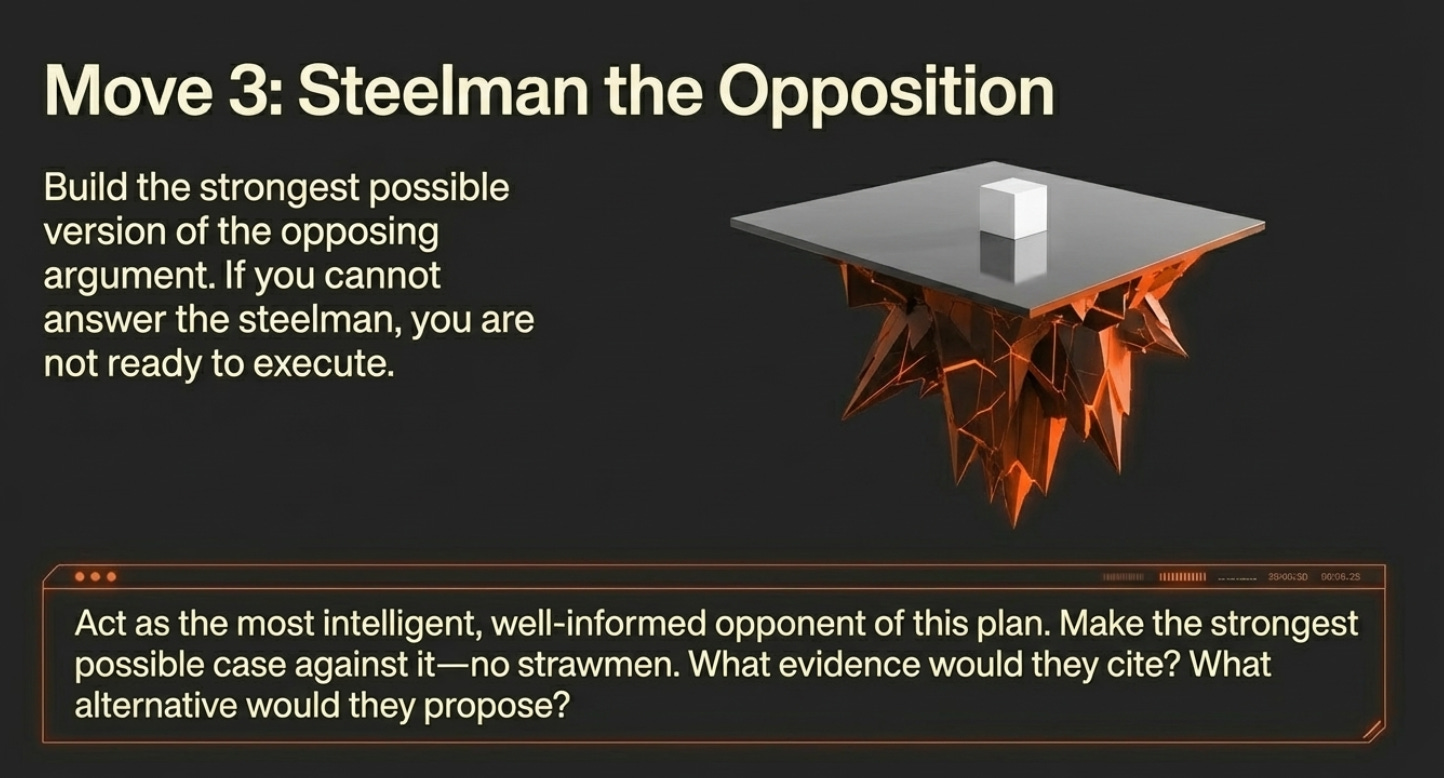
Every significant plan has opposition. It may have internal skeptics, external critics, alternative viewpoints, and/or competing priorities. Most leaders either dismiss the opposition or try to anticipate it defensively. Neither is as useful as genuinely engaging it.
The prompt:
“Act as the most intelligent, well-informed opponent of this plan. Make the strongest possible case against it. This is not a strawman, but the best argument someone who genuinely disagreed would make. What would they say? What evidence would they cite? What alternative would they propose instead?”
This is the steelman, which is building the strongest version of the opposing argument. It’s uncomfortable. It should be. The goal isn’t to talk yourself out of your plan. It’s to understand the opposition well enough to either address it genuinely or to discover that it’s right.
If you can’t answer the steelman, you’re not ready to execute.
Move 4: Pressure Test the Timeline and Resources
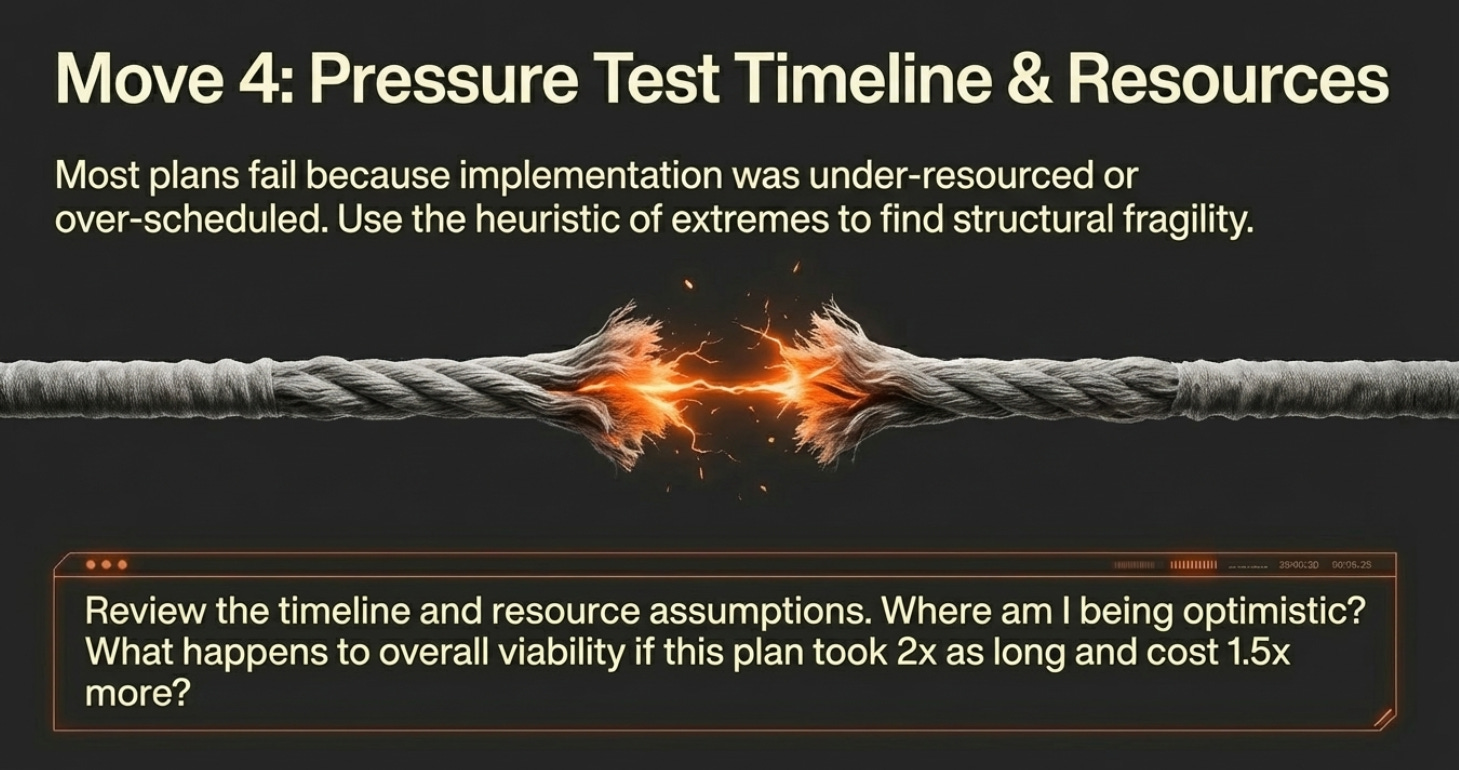
Most plans fail not because the idea was wrong but because the implementation was under-resourced or over-scheduled. This move focuses specifically on the practical execution layer.
The prompt:
“Review the timeline and resource assumptions in my plan. Where am I being optimistic? What dependencies am I assuming will cooperate that might not? What’s missing from the resource estimate? If this plan took twice as long and cost 50% more than I’ve projected, what would that mean for the overall viability?”
The 2x time and 1.5x cost frame is a useful heuristic — not because things always go that wrong, but because plans that can’t survive that scenario probably have structural fragility worth addressing before you’re committed.
Move 5: Generate the Alternatives You Didn’t Consider
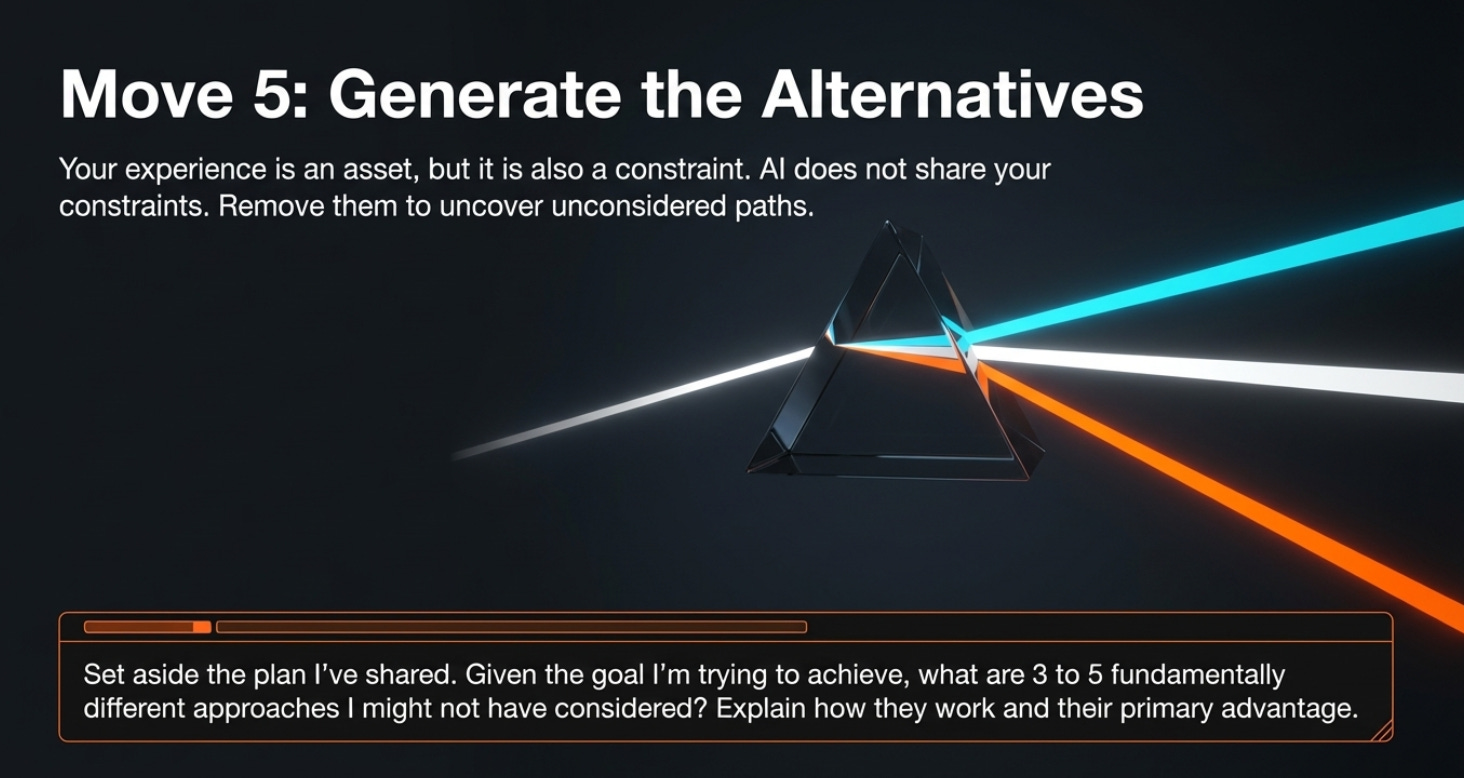
This is the move most people skip — and it’s one of the highest-value things AI can do in a strategic planning process.
You built the plan you built because of your experience, your context, and your imagination. All of those are assets. They’re also constraints. AI doesn’t share your constraints.
The prompt:
“Set aside the plan I’ve shared. Given the goal I’m trying to achieve [state the goal clearly], what are three to five fundamentally different approaches I might not have considered? For each alternative, briefly describe how it works and what its primary advantage would be over my current approach.”
You may love your original plan after this exercise. That’s fine. But you’ll love it more confidently — and occasionally you’ll find an alternative that’s genuinely better, or a hybrid that incorporates an element you hadn’t thought of.
Putting It All Together: The Stress Test Session
Here’s how to run a full stress test session in practice.
Time required:
60–90 minutes for a significant plan. 20–30 minutes for a smaller decision.
What to bring:
The plan, proposal, or idea in written form. The more context you give AI, the better the output. Include the goal, the approach, the timeline, the resources, and any constraints you’re working within.
The sequence:
Run Move 1 (assumptions). Read the output. Annotate the assumptions that concern you.
Run Move 2 (failure modes). Note the high-likelihood, high-severity ones.
Run Move 3 (steelman). Sit with the opposition argument. Answer it honestly.
Run Move 4 (timeline and resources). Adjust your estimates if the pushback lands.
Run Move 5 (alternatives). Note anything worth incorporating.
Then step away for a few hours if you can. Come back with fresh eyes and ask one final question — not to AI, but to yourself:
“Am I more confident in this plan, or less? And if less, what needs to change before I move forward?”
A Few Practical Notes
Give AI maximum context.
Vague inputs produce vague outputs. The more specific you are about your goal, your constraints, your audience, and your timeline, the more useful the stress test will be.
Don’t argue with the output. Annotate it.
When AI surfaces something that feels wrong, don’t dismiss it. Ask yourself why it feels wrong. Sometimes it’s wrong. Sometimes it’s right and you’re defending the wrong thing.
Run it again after revisions.
If the stress test surfaces significant issues and you revise the plan, run it again. The revised plan has new assumptions and new potential failure modes.
Use it with your team, not just alone.
The stress test session is even more valuable when a small team runs it together, reading the outputs aloud, discussing what lands, and deciding together what to address. It depersonalizes the challenge in a way that makes honest conversation easier.
The Bottom Line
AI cannot make your decision for you. It cannot tell you whether your vision is right, whether your calling is genuine, or whether this is the moment to move forward.
What it can do is make sure that when you do move forward, you’ve looked honestly at the ground you’re standing on.
The leaders who build things that last aren’t the ones who had the best ideas. They’re the ones who tested their ideas ruthlessly before committing to them and then moved forward with clear eyes and genuine confidence.
That’s what stress testing is for. And you now have one of the most powerful stress-testing tools in history available to you at any moment.
Use it before you need it. Not after.
If this was useful, share it with a leader who’s about to make a significant decision. And for more on AI enabled organizational thinking, check out the full “AI-Driven Organization” series at www.donbarger.com.