


Here’s what I’ve been chewing on lately.
I’ve spent many years trying to scale ideas for global impact. Take something we tested on a small scale and push it to a larger audience. I’ve tried to scale training, tools, and reach. These days, the team I’m a part of is working to scale workers, resources, and partnerships.
And here’s what I’ve been slow to learn. In scaling, “more” is not just a bigger version of what we were already doing. It’s something altogether different.
It took me several years to realize I was wrong about that.
---
More Is Different
In August of 1972, a physicist named Philip Anderson published a short essay in *Science* magazine. It landed like a grenade in the physics world, and it should land the same way for anyone thinking about missions.
The essay was called *”More Is Different.”*
Anderson’s argument was simple. The reductionist assumption (that if you understand the smallest pieces of something, you can predict the whole) is wrong. At each new level of complexity, something genuinely new appears. It’s not just more of the same. It’s something different.
He wrote:
“The whole becomes not merely more, but very different from the sum of its parts.”
I don’t usually read science magazines, but I saw this essay referenced in a book I was reading, so I tracked it down. It confirmed a hunch I’d been carrying about scale. Scale creates complexity. It isn’t always just a bigger version of the smaller pieces.
Let me put it in an analogy. You can know everything about a single water molecule and still not predict that at a certain temperature it becomes ice. Same with faith. You can understand one believer and still not predict what happens when several gather as a church. You can know everything about a single church and still not grasp the impact of multiple churches upon a region.
More isn’t just more. More is different.
The Reductionist Trap
We fall into this trap in ministry all the time. We reduce discipleship to a curriculum, church planting to a method, the missionary task to an assignment. It’s possible to track outputs and completely miss what’s emerging.
Anderson spent his career fighting a version of this in physics. The assumption that the “most fundamental” science was the one studying the smallest particles, and everything else was just an application of those laws. He pushed back hard. At every new level of complexity, entirely new laws appear. New behaviors emerge that couldn’t have been predicted from studying the individual pieces.
In the same way that psychology is not applied biology and biology is not applied chemistry, a multiplying church in a region is not just applied evangelism.
Something new breaks in. Something that couldn’t have been predicted from the first gospel conversation, the first disciple, or the first small gathering.
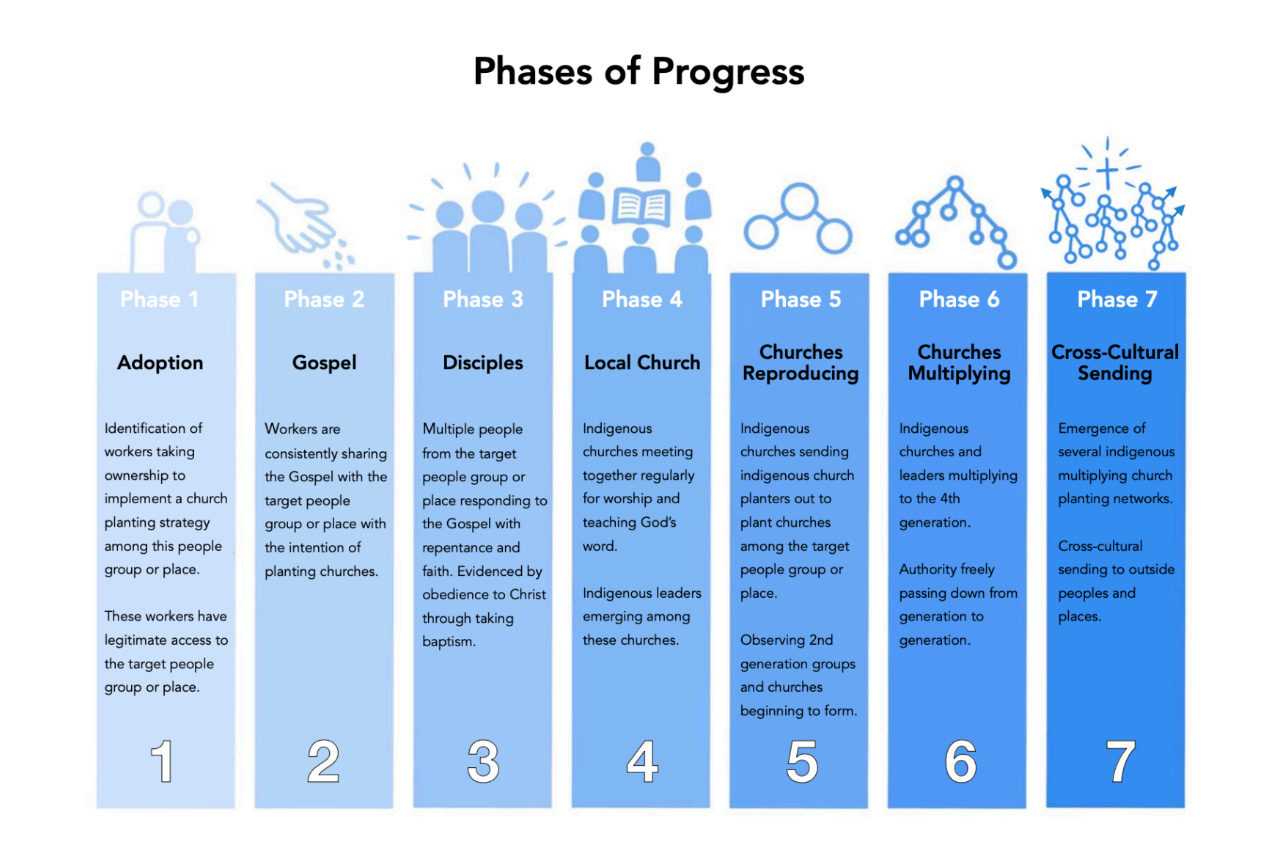
What Emerges When the Gospel Takes Root
I’ve been trying to wrap my head around a framework for understanding progress in a mission field. We use a seven-phase model to track gospel momentum, from Phase 0 (no activity) all the way to Phase 7 (indigenous cross-cultural sending).
Here’s what I suspect. Each phase transition isn’t just progress. It’s the emergence of something new.
Take Phase 2 to Phase 3. The moment disciples appear is not just more gospel proclamation. Something new has entered the field. There are now people who have crossed from death to life. A community of the redeemed exists where none did before.
Phase 3 to Phase 4. The moment a church forms is not just more disciples meeting together. A new organism has come into being: the body of Christ in that place. Categorically different from a small group.
Phase 4 to Phase 5. A church that begins to reproduce is Anderson’s whole argument in missiological form. A church that plants churches is not a bigger church. It’s a different kind of church. It has crossed a threshold.
And Phase 7? The moment that indigenous, multiplying network begins sending cross-culturally, the mission field itself becomes something different. Not just more. Different.
Binary Is Killing Us
Here’s where Anderson’s essay gets uncomfortably practical.
For decades, the missions community has operated with a binary classification system: engaged or unengaged. A people group either has a gospel witness or it doesn’t.
That’s reductionism, and it has the same flaw Anderson identified.
A binary label can’t track emergence, see momentum, or detect when work has stalled or regressed. A people group technically “engaged” that has had no active workers for years, no disciples, no forward movement, keeps the label even though the reality has changed.
A people group with one worker and no believers gets the same designation as one with fifty reproducing churches. The label says they’re both “engaged.”
Anderson would say you’ve collapsed a dynamic, living system into a single bit of data. The binary is a snapshot. The mission field is a film. A snapshot taken at first engagement tells us almost nothing about what happened a year, two, or ten years later.
What This Means for You
Maybe you’re a pastor. Maybe you’re a missions leader, a sender, a supporter, or a missionary. Here’s the question Anderson’s essay forces on us.
Are we managing emergence, or are we trying to control it?
A church that becomes a sending church is not a bigger local church. It has crossed a threshold. New identity. New responsibility. If you manage it like a program, like more of what it was before, you’ll miss what it actually is.
A believer who moves from consumer to disciple-maker hasn’t just leveled up. Something new has emerged. Don’t treat them like a slightly better version of who they were.
And a field that goes from first worker to indigenous sending movement is not just more missions activity. It’s the answer to the prayer of Matthew 9:38.
“Ask the Lord of the harvest to send out workers into his harvest field.”
The Lord didn’t just send more workers from the West. He raised them up from the field itself.
That’s emergence. That’s what happens when the gospel takes root.
The Mustard Seed Knew
Jesus never pictured God’s work as a pile getting bigger.
He used a seed becoming a tree. He used yeast disappearing into dough, invisible and silent, changing everything.
That’s emergence. Not addition. Transformation.
Philip Anderson spent his career studying this in physics labs. He never knew he was describing something Jesus taught two thousand years before him.
The mission field is not just more people. It’s a different world. And maybe the invitation is to stop managing the harvest like it’s the same field it used to be.
What’s one place in your life (a relationship, a church, a community) where you’ve been managing for “more” when God might be doing something categorically different? I’d love to hear from you.