


Time to be honest.
I’m just going to start with the one that I am failing at—daily.
In ministry, we wear our exhaustion like a badge of honor. “Busy” isn’t just a schedule status—it’s a spiritual credential. If you’re not overwhelmed, are you even doing Kingdom work? But Scripture warns against pride and self-reliance (Galatians 6:3; James 4:6).
It also warns against confusing busyness with faithfulness. Martha was “distracted with much serving,” while Mary chose to sit at Jesus’ feet and listen to His teaching. Jesus told her, “Martha, Martha, you are anxious and troubled about many things, but one thing is necessary” (Luke 10:41-42).
For the past few months, I have been burning the candle at both ends, the middle, and the middles between the middle and the ends. It has been nonstop.
And don’t get me wrong—we’re doing some incredible things.
But innovation is suffering
(So is sleep.)
We’ve baptized busy.
And it’s killing us.
Not necessarily in the “burnout” sense—though for sure, that’s always a risk. I’m talking about the quieter death: the slow suffocation of creativity, vision, and faithful innovation because we’re buried under a mountain of urgent but non-transformational work.
Ouch.
You Can’t Innovate in a Crisis Loop
When you’re constantly putting out fires, you don’t have time to start anything new.
Creativity needs margin. Strategic thinking needs breathing room. Innovation needs boredom—yes, boredom. It needs mental whitespace where new ideas can stretch their legs and wander around a bit before anyone shoots them down.
But in many Christian organizations, we’ve built systems that reward reactivity, not reflection. Leaders too often spend their best hours answering emails, building reports no one reads, sitting in meetings that should’ve been a Teams chat, and responding to fire after fire after fire.
And then we wonder why no one’s creating.
Not all activity is fruitful. Ministry is not measured by motion—It’s measured by obedience and abiding in Christ (John 15:4-5).
Am I saying we shouldn’t do email, participate in meetings, and give an account (reports)? Of course not.
Those are a part of our work.
Administration is a spiritual gift. It should be embraced. But the challenge is when administration becomes the work—leaving no time for ministry and no margin for innovation.
Maybe you have achieve that perfect balance. If so, a few of us would like to buy your book teaching us how! We’ll read it… between fires.
When Everything is Important, Nothing Is
I have heard this said a hundred times. I have probably said it a hundred times—just this month.
The urgent convinces us it’s important. But mission drift doesn’t usually happen in big decisions. It happens in the small compromises we make when we stop creating and just start coping.
We delay trying something new.
We shelve that crazy new idea.
We cancel the dream session—squeezed out by the urgent.
We tell the creative thinker, “Not right now.”
We shrink.
We do what we have always done..
The tyranny of the urgent tricks us into thinking ministry means action and motion. But Jesus was never in a hurry and He seemed to do just fine.
The Gospels show Jesus as purposeful, never rushed by the demands of others. He often withdrew to pray (Mark 1:35; Luke 5:16), took time to be with individuals (John 4:7-26), and was not pressured by urgent requests (John 11:6—He delayed going to Lazarus).
That wasn’t laziness. Jesus was not idle.
He was always about His Father’s business (John 5:17).
He finished the work He was given (John 17:4).
He did so in God’s timing, not man’s.
Sometimes urgency is holy. But we have to learn to tell the difference between God’s priorities and the world’s pressures.
What’s at Stake?
When we fail to prioritize margin and creative space, we lose:
Breakthrough solutions to recurring and big problems
Contextualized ministry (instead of copy-paste programming)
Joy in the work, because we were made to be creative, not just administrate (Administration is also need—and Biblical, but creativity offer suffers and administration wins the day)
Momentum—because the organization gets stagnant.
And eventually… we start to lose people too.
The dreamers. The sideways thinkers. The 10x multipliers. They get quietly crushed under reports, meetings, and one more budget review.
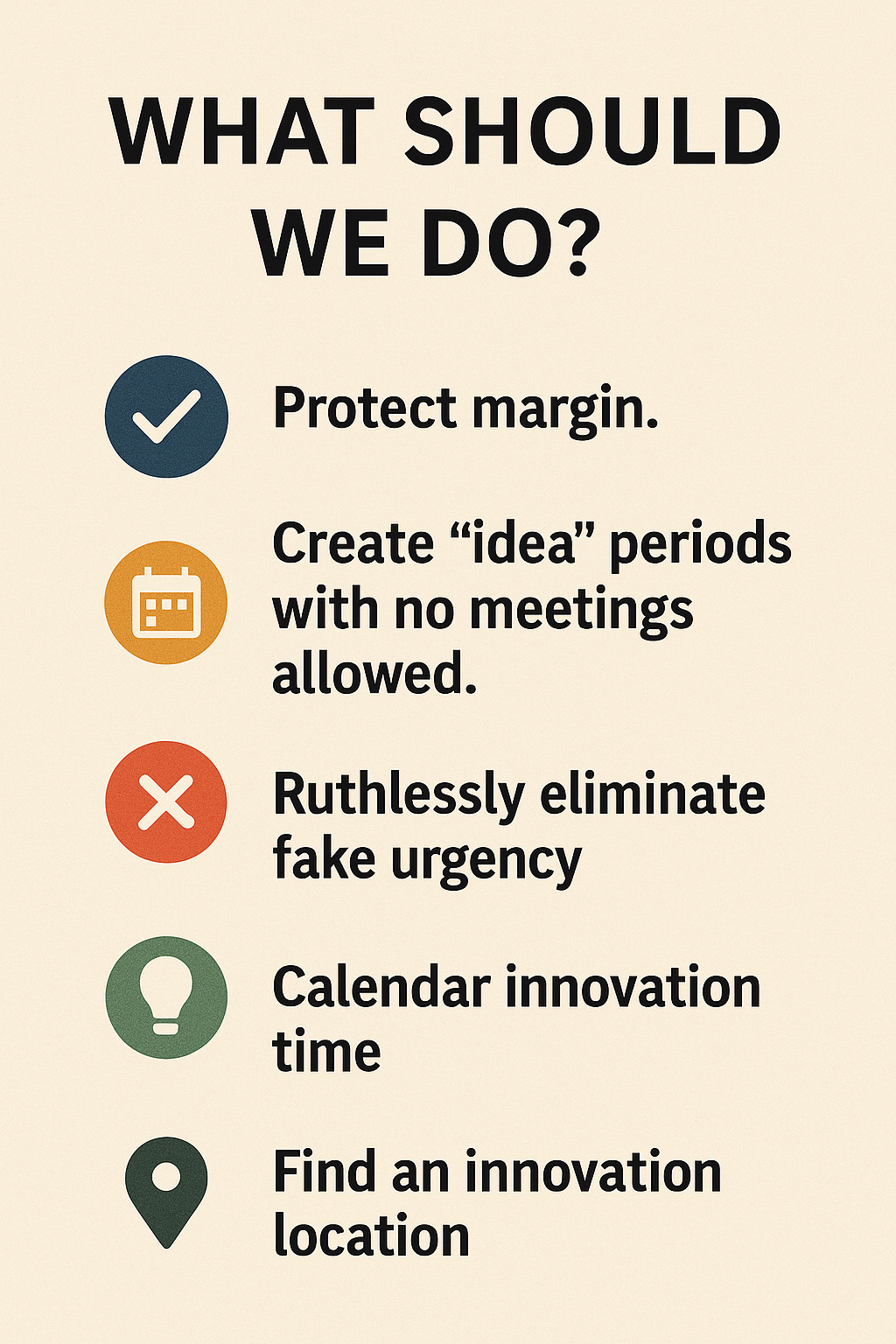
So, What should We I Do?
We don’t need more time. That’s what I just told myself… then I argued with myself… and kind of lost the argument.
What I need—what we need— is different priorities.
We need to protect margin.
We need to schedule creativity (idea periods) where no meetings are allowed - some people call this time blocking. I do that daily, but what I am lousy at is blocking entire days for this.
We need to ruthlessly eliminate fake urgency—the kind that makes us feel productive but produces nothing.
And we need to put innovation on the calendar, not just the crisis.
Find a place where you can get away and be creative. As crazy as it may sound, I go to Panera. Seriously, I joined their sip club so I can drink all the bad coffee I want, camp out at a table, and create.
No interuptions. No Teams. No Outlook. Just margin.
You can’t microwave vision.
You also can’t outsource creativity.
You can’t expect innovation if your team is always reacting.
A Closing Thought
Jesus wasn’t reactive.
He wasn’t rushed.
He wasn’t driven by the fear of missing an email or the pressure to produce reports.
He made time to go off into the wilderness. To pray. To think. To listen.
That wasn’t wasted time. It was Kingdom strategy.
NOTE: I am not saying that we shouldn’t work hard!
Ministry—especially cross-cultural ministry—is far more than a 40-hour work week. Some don’t work hard enough. Others work too hard for too long.
My concern is that we often confuse “busy” with “fruitful.” I don’t want you to use this post as an excuse to disengage or to be lazy. I want you to se it as a call to be intentional.
Carve out time to think. To process. To dream.
Like me, you probably won’t accidentally find yourself sipping bad coffee at Paneray. You’ve got to choose to show up—to make space for what’s missiong.
If we want to build something new, we’ve got to slow down long enough to ask:
What if?