


Last week, we talked about how generative AI is no longer just for writing, coding, or solving problems—it’s quietly reshaping how we live and think. But after reflecting further upon Harvard Business Review’s updated research, something much deeper stood out:
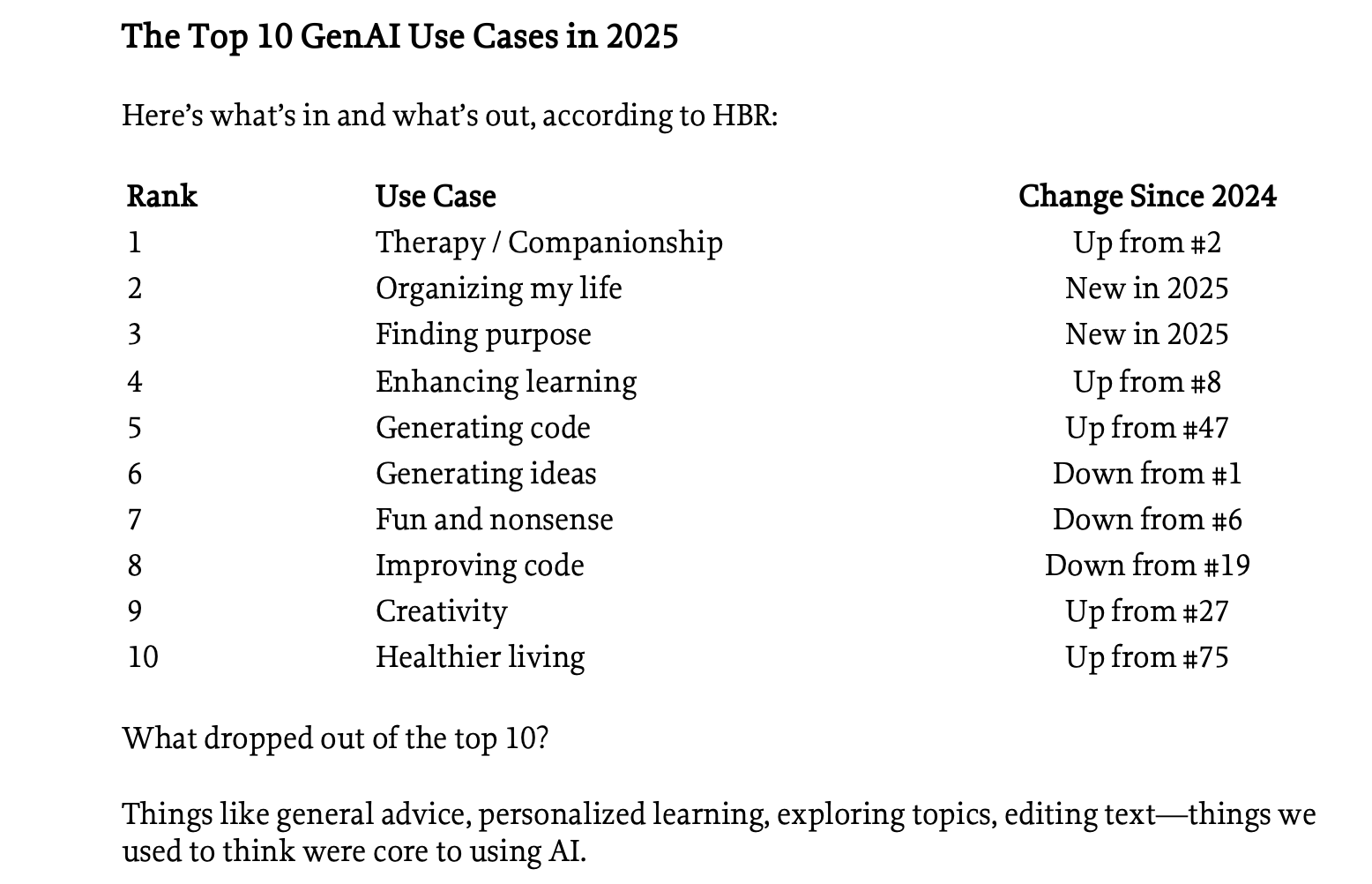
The number one use case for GenAI in 2025 is... therapy and companionship.
Let that sink in.
Not “productivity.”
Not “learning a new skill.”
Not even “solving hard problems.”
In 2025, the most common use of generative AI is to help people feel better. To help them make sense of life. To ease loneliness. To be there for them.
That may sound good on the surface.
But from a Christian worldview?
I find it deeply concerning.

Let’s look at the new top ten list from How People are Really Using AI in 2025, byMark Zao-Sanders and Harvard Business Review.
The Emotional Shift
The biggest trend? We’ve moved from technical to emotional.
Zao-Sanders’ research shows that three of the top five use cases—therapy, organizing life, and finding purpose—are all deeply personal. And people aren’t experimenting. They’re confiding. They’re emotionally outsourcing.
The therapy/companionship category includes AI-fueled counseling conversations, journaling support, grief processing, even romantic companionship. As he puts it: "AI fulfills a fundamental human need for emotional connection and support."
But here’s the thing: AI was not created in the image of God. People were.
And while I understand the appeal (constant availability, no judgment, free to use), it’s worth asking:
What happens when we start giving our deepest emotional burdens to an algorithm?

Let’s Be Clear: AI Is Doing Some Amazing Things
Before I go full warning light, let me say this:
There are genuinely good, even great things AI is doing right now. I am absolutely loving using it and learning new skills
I use it every single day for tasks like:
Creative brainstorming: writing, scripting, idea generation
Automation: turning repetitive tasks into one-click prompts
Data analysis: finding patterns I would’ve missed
Admin reduction: summarizing notes, drafting outlines, organizing thoughts, checking posts like this for grammatical errors
Speed and scale: what used to take hours now takes minutes
These are not minor wins—they're huge time-savers. Every single worker should be finding ways that they can use include AI in their daily workflow.
For me, AI has improved productivity, allowed for more creativity, and freed me up to do more meaningful work.
So yes—let’s keep celebrating the good AI can do.
But also…
Let's Not Lose Sight of the Line
There’s a difference between using AI to do a task and using it to replace human presence.
Helping you plan a training even? Great.
Helping you code better? Awesome.
Helping you figure out things to do while traveling or to study for your exam? That’s what I am talking about!
But helping you process trauma?
Helping you battle addiction or navigate grief?
Becoming your “always-available best friend” or “partner”?
That’s not healthy.
That’s soul work masquerading as software.
Why Does this Give Me Pause?
From a biblical standpoint, human beings were never meant to find ultimate comfort in artificial intelligence. God designed us for relationships—with Him and with each other.
“It is not good for the man to be alone.” – Genesis 2:18
“Bear one another’s burdens and so fulfill the law of Christ.” – Galatians 6:2
“Confess your sins to one another and pray for one another, that you may be healed.” – James 5:16
Notice the pattern?
Real presence - with other humans
Mutual vulnerability - humans supporting other humans
Spiritual healing through human connection and by God
Therapy with a chatbot might give users a certain form of comfort. But it cannot offer them presence, true wisdom, truth, nor can it show grace. Not in the way the human soul needs.
There’s no embodied empathy. No spirit-led counsel. No love that comes from another person who was created in the image of God.
And there lies the risk: people begin to confuse simulation for healing.
The Design Matters
From a biblical perspective, this isn’t how it’s supposed to work. It’s not healthy and it’s not God’s design.
The Lord God said, “It is not good for the man to be alone.” – Genesis 2:18
“Rejoice with those who rejoice, weep with those who weep.” – Romans 12:15
“Where two or three are gathered in my name, there am I among them.” – Matthew 18:20
God built us for connection—with Him, and with one another. That’s His plan!
What we’re seeing now is a synthetic substitute. And while it may feel comforting in the moment, it does not heal, it does not sanctify, and it does not bear witness to truth.
AI can simulate a response, but it cannot offer real spiritual guidance.
It can say nice words, but it cannot know you.
It can listen to your story, but it cannot carry your burden.
Only people can do that.
And ultimately, only God can restore a soul. You can have a relationship with God - you can’t have a real relationship with AI.
So, What Do We Do with This?
Two things can be true at the same time.
AI is incredibly helpful.
It’s revolutionizing how we work, learn, and even create.
AI is not our therapist, pastor, or friend.
It cannot replace the image-bearing presence of another human—or the Spirit of God.
I’ll be writing more about how this shapes the way we think about digital ministry, discipleship, and soul care in the age of AI. But for now, let’s just say this:
Use AI. Appreciate it. Maximize it.
But don’t ever let it become your replacement for real connection.
God didn’t send us a chatbot.
He sent Jesus.
Final Word
In 2025, the #1 AI use case has not been productivity. It’s actually presence.
But AI presence is an illusion. It isn’t real. It’s a bunch of 1’s and 0’s and extremely good ad predicting what comes next.
Real presence is incarnational. It listens, weeps, and walks with us.
Real purpose is found in Christ, not the screen.
Real companionship is rooted in community, not code.
Let’s not trade the real thing for a simulation.