


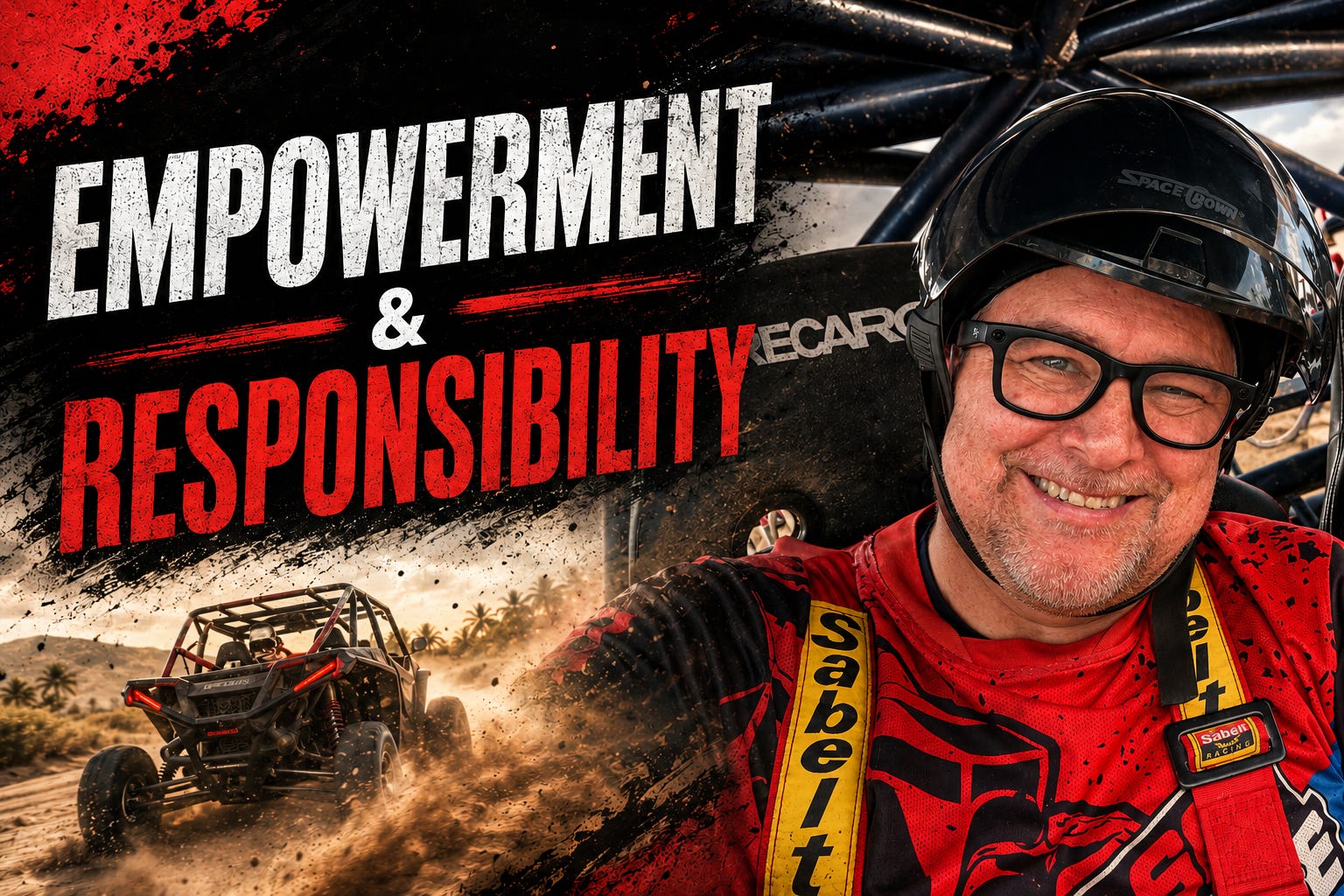
Recently, I spent half a day doing something completely unproductive. It involved a rented a dune buggy and driving it as fast as the dune buggy company would allow. It was a blast.
But something happened before I ever hit the throttle and it came up with a friend of mine as we were debriefing the experience.
The company handed me the keys to a dune buggy simply because I was over 16 years old. That’s it. That’s the whole qualification to drive one? Are you old enough? There wasn’t a test drive or a background check on my off-road experience. They asked me how old I was and essentially said, “We trust you to handle this machine.”
That’s empowerment!
But… I still wasn’t able to hop in and take off. There was an extensive safety briefing. They had rules… lots of rules.
No passing anyone… ever!
Single file line, no exceptions.
Follow at a distance of 15-20 feet. Not too close and no hanging back too far.
Wearing your helmet is required.
Wearing your seatbelt is required.
If there is an accident, stop, stay put, don’t touch the throttle.
After going through all the rules. They talked through the legal responsibilities. Injuries to me? Covered. They have liability insurance that will cover any injuries I might sustain. Damage to the buggy? Mine to pay for, dollar for dollar. All on me.
Then came the part I wasn’t expecting. They played a five-minute video. Real crash after real crash on their course with their buggies. Real people not paying attention, not following the rules, doing exactly what they felt like doing in the moment, and then the aftermath. Bent frames. Twisted metal. Buggies upside down. X-rays of broken bones.
Yikes… that was the accountability.
The company gave me real trust and real limits at the same time, and neither one canceled out the other. The trust made the fun possible. The limits made the trust safe.
What Most People Want
I was talking with someone who put words to this.
“Empowerment without accountability usually leaves a wake of frustration and problems.”
Think about that statement.
Most of us want the keys. We want the trust, the autonomy, the “go figure it out” mandate. We want to be the person who doesn’t need to be micromanaged. We want to set out 100 mph in the dune buggy without anyone telling us how to drive.
What we don’t want is the video of the crashes. We don’t want the lane restrictions. We don’t want someone telling us we’re responsible for the damage we cause.
We want empowerment without the seatbelt.
When leaders hand out empowerment without any accountability attached, here’s what actually happens. Not freedom. Not innovation. A wake. People colliding into each other. Damage nobody wants to own. Trust that erodes because nobody has clarity on what happens when something breaks.
Caution without action isn’t wisdom. It’s just slower failure. But action without accountability isn’t courage either. It’s just chaos.
Three Things the Buggy Company Understood
Allow me to unpack why that briefing worked so well for me, and I think it comes down to three things most organizations get wrong.
They defined the lane, not just the destination.
They didn’t just say “have fun out there.” They told me exactly where the edges were. Single file. No passing. Consistent spacing. I still had freedom to drive the way I wanted inside those lines, but the lines were non-negotiable.
Most of us do the opposite. We hand someone a vague mandate, tell them to “own it,” and then get frustrated when they drive somewhere we never wanted them to go. If you empower someone without defining the lane, don’t be surprised when they end up off the road.They named the cost before it happened.
Nobody had to guess what would happen if they wrecked the buggy. It was said out loud (and you signed a document), before the keys ever left the counter. Your injuries, we’ve got you. The damage you cause, that’s on you.Most teams never do this. We hand someone authority and quietly hope nothing goes wrong, and then when it does, we scramble to figure out after the fact who’s responsible for the wreckage. Naming the cost upfront builds respect. It tells people you believe they can handle the truth before they need it.
They showed the video.
This is the part that was a little of a shock (and that was the purpose). They didn’t just tell us the rules. They showed us, in graphic detail, what happens when the rules get ignored. Not to scare us out of driving. To make sure we drove with our eyes open. When I was tempted to gun it and pass someone, the video came back to me.
I’ve sat in lots of meetings where leaders hand someone real responsibility, and it’s the first time that person has ever seen what failure actually costs. Nobody showed them the video. We assume people understand the stakes. Usually they don’t, not until they’ve lived it themselves, and by then the damage is already done.
Application
I’ll own my part in this. I’ve handed people freedom and skipped the briefing. I’ve said “you’ve got this“ without ever naming what “this“ actually costs if it goes sideways. I’ve assumed people could read my mind about where the lane ended. That’s not real empowerment.
Here’s the big takeaway from this article. If you read nothing else, read this.
Empowerment without responsibility → recklessness, inconsistency, entitlement, blame shifting.
Responsibility without empowerment → resentment, burnout, learned helplessness, bureaucracy.
Empowerment + responsibility together → ownership.
The Question to Ask
If you’re a leader, the dune buggy company already figured out what most of us are still fumbling through. Trust and boundaries aren’t opposites. They’re part of a package deal. You can’t hand someone real authority and skip the conversation about what happens when it’s misused, and you can’t hover over every decision and call it stewardship.
So here’s the question worth taking into your next team meeting:
Where have I handed out keys without ever showing the responsibility video?
Great analogy for responsibility and accountability. I hope we all watch the video.