


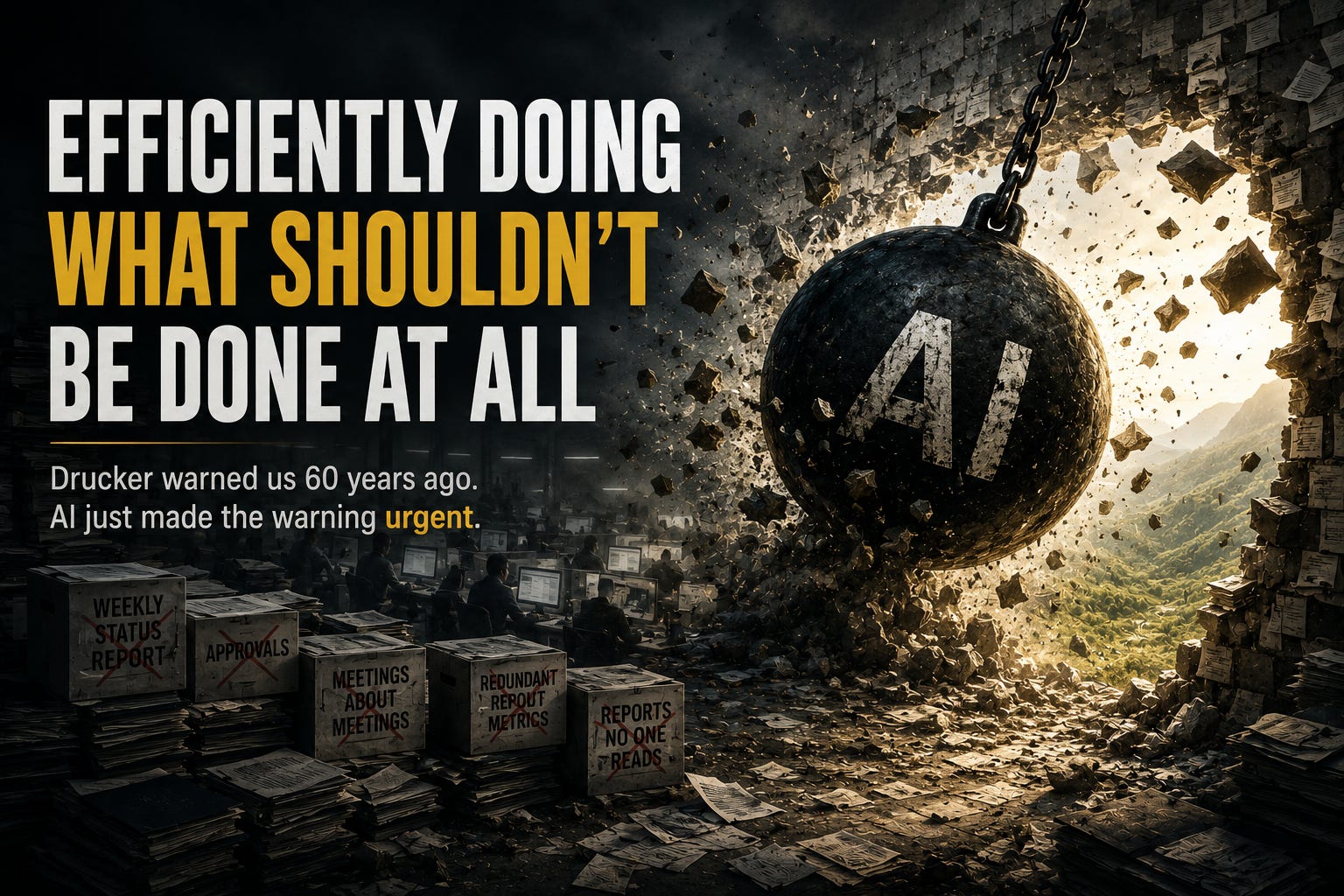
I was first introduced to Peter Drucker in my undergrad classes more than 35 years ago. At the time, I had no idea how revolutionary his thinking actually was. It was just another class… something to memorize for the exam. I definitely wasn’t thinking about organizational change. I was a college kid. Bureaucracy was not my problem.
It took a couple decades of real work for his ideas to stop being theory and start being uncomfortably accurate for me. Here’s one phrase that Drucker said that really resonates with me.
There is nothing so useless as doing efficiently
what should not be done at all.
For most of business history, inefficiency has hidden in plain sight. Everybody felt it. The redundant report. The approval that took four signatures. The meeting that summarized the other meeting. We knew it was not helpful, but we tolerated it because killing it seemed like a Herculean effort. Inefficiencies just continued, year after year.
AI showed up and suddenly inefficiencies became more and more obvious.
The floodlight
Here’s something that I was discussing with a friend last week. AI doesn’t just automate work. It exposes work.
When intelligence gets embedded into the tools we already use, it’s like putting a floodlight on every task we’ve been pretending was necessary. You ask an AI to “help with the weekly status report,” and within thirty seconds you realize the report itself is the problem. Nobody reads it. Nobody acts on it. It exists because someone created it in 2017 and nobody’s been brave enough to stop.
This isn’t just a corporate problem. Sit in any ministry long enough and you’ll find our own version. The monthly field report that gets compiled, sent up the chain, and filed unread. The activity metrics we gather because we’ve always gathered them. Numbers that count what happened without ever asking if it mattered. Ministries have spent years measuring motion and calling it fruit. AI shines a light on that too, and the light is not always comfortable.
That’s the gift hiding inside this moment. The work we’d learned to tolerate suddenly becomes impossible to ignore.
“We’ve always done it this way”
When the floodlight comes on, the first thing it usually finds isn’t laziness. It’s inertia. Work that survives not because it matters, but because it’s always been there.
These are the tasks that don’t move the needle on anything that actually counts, yet we keep doing them anyway. The process got approved in a meeting nobody remembers and outlived everyone who was in the room. “We’ve always done it this way” quietly became the only reason we still do it.
That’s the most dangerous kind of waste, because it’s invisible. Nobody defends it. Nobody attacks it. It just persists, soaking up hours and attention while contributing nothing to the mission it supposedly serves. Compounded, this waste adds up.
So before we talk about doing anything faster, we have to back all the way up and ask a question that feels almost too obvious to say out loud, “Why are we doing this at all?”
Notice that the question isn’t, how do we improve it or how do we automate it. The question is, why does this even exist? If the answer is “because we always have,” that’s not a good enough reason.
The temptation is to automate the dumb thing
Most leaders, when handed the AI floodlight, do something strange. They use it to find the busywork, and then they begin to try to automate the busywork.
We see the useless report, and instead of killing it, we build a workflow or automation that generates it faster. We see the four-signature approval, and instead of asking why four humans need to touch it, we route it through an agent so it clears in minutes. We take something that should not be done at all, and we do it brilliantly. Efficiently. At scale.
Drucker would’ve had a field day with this. We’ve invented the most powerful tool for eliminating waste in the history of mankind, and our first instinct is to use it to preserve waste in a more polished form.
This is the automate-reflex, and it’s everywhere right now. Something feels slow, so we reach for the tool. The tool is so good, and so fast, that we never stop to ask the harder question sitting underneath it. Why are we doing this to begin with?
The wrong first question
Organizations are at a pivot point. The AI dividend is real, and almost everything is getting automated, enhanced, or rethought because of it. That creates enormous pressure to move, and pressure has a way of skipping steps.
So the question I hear most often goes something like this: “How can we do this more effectively?” Or the newer version, “How can AI help us do this better?”
I understand the instinct. But that’s the wrong first question. The first question is never how. It’s always why. Why are we even doing this? Why are we running this report? Why does this to-do exist on someone’s plate at all?
The first question is never how. It’s always why.
Only after you can honestly show that the task moves the needle on what matters have you earned the right to ask the next question. How might we make this better? Notice something about that second question. It works the same whether the answer involves AI or not. Efficiency is always the second question. The tool you reach for to achieve it is the third.
We’ve been starting at question three. AI just made question three so easy and so tempting that we’ve nearly forgotten the first two exist.
Why “efficient” became a trap
Part of the blame goes to a culture that treats efficiency like a virtue all by itself. Somewhere along the way, fast became good. Optimized became righteous. We started measuring leaders by how smoothly the machine runs, not by whether the machine should be running at all. Speed and activity feel like progress even when you’re sprinting in the wrong direction.
Efficiency is morally neutral. It’s a multiplier. Point it at meaningful work and it’s a blessing. Point it at meaningless work and you’ve just built a faster way to waste everyone’s time. The output looks impressive. The dashboards turn green. And underneath it all, you’re still doing the thing that should not be done.
Efficiency culture loves the green dashboard. I just wish the dashboard people would start by asking what does the dashboard measure?
Now what?
Here’s the problem, the window for fixing this is closing.
When inefficiency was clunky and manual, at least it announced itself. The pain was the signal. People complained about the report because filling it out hurt. That friction was honest. It told you something was broken and we had an admin overload problem.
Once you automate the bad process, the pain disappears. The report still gets made, only now no human feels the cost of making it. The friction that used to flag the problem is gone. The waste doesn’t stop. It simply goes quiet.
That’s the trap of embedding AI everywhere without discernment. You don’t eliminate the bad work. You bury it. You make it invisible, automatic, and permanent. A year from now nobody will even remember the task was optional, because it’s been humming along in the background, doing the wrong thing flawlessly, asking nothing of anyone.
Before you automate, ask questions
Here’s my take on AI and automation. The most important skill in an AI-ready organization isn’t prompting. It isn’t tooling. Instead, it’s the discipline to stop and ask whether the work in front of you deserves to exist before you make it faster.
How might we resist the reflex? A few questions worth asking before you automate anything:
If this task disappeared tomorrow, who would actually notice, and what would they lose?
Are we automating this because it matters, or because automating it is easy?
Once this runs invisibly, will we ever revisit whether it should run at all?
Notice that none of those are efficiency questions. They’re discernment questions. Discernment has always been the thing automation can’t do for you.
Stewardship
For me this goes a layer deeper than productivity.
Jesus told a story about three servants and the wealth their master left in their care. The one who got judged wasn’t reckless or lazy in the way we’d expect. He was careful. He took what he’d been given and buried it. He kept it safe and out of sight. The master’s verdict was severe, because the question was never whether the servant had been efficient with what he held. It was whether he’d done anything that mattered with it at all.
I think about that every time we talk about burying bad work inside an automation or processes. When we take a task that shouldn’t be done and quietly bury it in a workflow where no one feels its cost, we haven’t stewarded anything. We’ve just hidden it well.
Time is one of the few things we’re each given a fixed amount of. We don’t manufacture more of it. We only spend it. So when I automate the wrong thing well, I’m not just being inefficient in a business sense. I’m taking a finite gift and pouring it, smoothly and efficiently, into something that was never worth doing. Done is not the same as faithful. A polished waste of time is still a waste of time.
Drucker was making a management point, but the deeper truth has teeth. Doing the wrong thing well isn’t progress.
Kill the task first
For those of us in faith work, the stakes aren’t abstract. Every hour an organization pours into work that should not be done is an hour stolen from the work we actually exist to do. The waste isn’t just expensive. It’s distracting us from the work we’ve been called to do.
The leaders who lead their organizations to make the greatest impact won’t be the ones who automate the most. They’ll be the ones who eliminate the most before they automate anything.
Kill the unnecessary tasks first. Then, and only then, make what’s left run beautifully.