


Every New Beginning
“Every new beginning comes from some other beginning’s end.” — Semisonic, “Closing Time”
A couple of weeks ago, I was driving to Waco and the song “Closing Time” came on the radio. It immediately brought back lots of memories of growing up in Birmingham and listening to the Paul Finebaum show. (This song ended his show each day as I drove home from college). For some reason, this time I got curious as to the meaning of this song. At my next gas station stop, I actually looked up what the song was about.
Here’s what I found. Dan Wilson wrote it while his wife was pregnant with their first child. While he was writing this new song, the lyrics turned into a metaphor for birth. A kid leaving the womb. A person showing up in the world for the first time. “Time for you to go out to the places you will be from” is the child arriving (not the bar patron getting kicked out at 2am like everyone assumes).
Birth ends one kind of existence to start another. As I got back on I-35 South, I realized the song had basically been narrating my last three years back to me.
From Version 1 to Version 83
Here’s an example of what I mean. About two years ago, I built a piece of software called Table. It was a local setup running on my home computer. Two agents, a Researcher and a Classifier, both calling a LLM locally on the machine, coordinating my research.
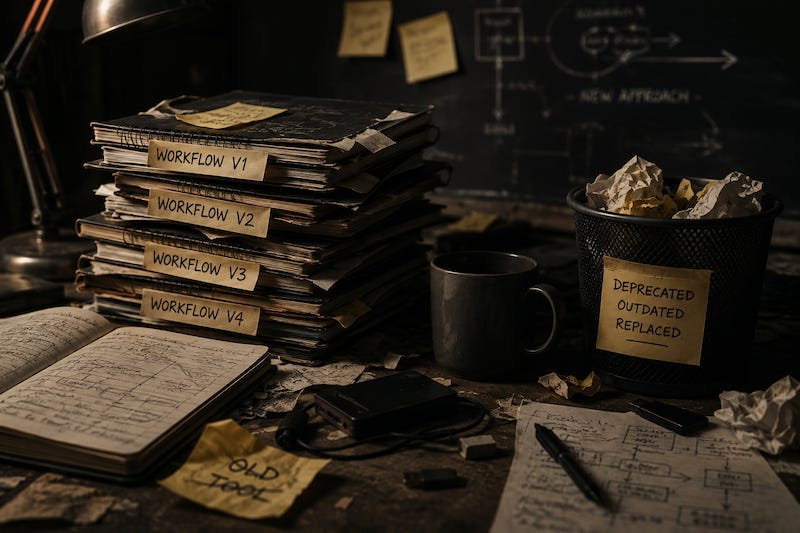
I spent an embarrassing number of hours setting it up and debugging the tool. I lost count at the number of versions I went through. Eventually, the tool worked great and was genuinely saving me time and effort. The problem? A few months later, other tools did what I had built much better and with less friction. Almost none of what I did with this software survives today.
I could focus on the software being killed, but instead I focus on all that I learned through the process of building the software and how much of that learning continues in new projects today.
Starting Over isn’t the Failure. Starting over is the work.
The song’s line isn’t a eulogy for what ended. The song is a way of saying the ending was already the beginning of the next thing. Every version of “Table” I tore apart taught me something that showed up in the next build. The graveyard of old approaches isn’t wasted effort. This graveyard of old attempts is actually what learning looks like. This is obvious when you can see it laid out chronologically instead of pretending it happened all at once.
I want to be careful here, because there’s a version of this idea that becomes an excuse to never finish anything. “We’re always iterating” can be a badge of honor. Those are different postures.

The Tension
Part of my job is scanning the horizon and testing what’s possible hopefully before anyone asks me to do so. I’m fine with my personal tech stack looking like a laboratory. I’m even fine with the instability this brings because I’m the only one who has to live inside it.
That said, you can’t run an enterprise system that way. When we push a change that thousands of colleagues depend on, we’re not swapping out software, we’re asking real people to relearn part of their job. Do this too often and you get change fatigue, and eventually a workforce that’s learned not to fully invest in whatever this latest version is, because they’ve watched three of them evaporate already.
The team that I work on runs at two different speeds. We move fast so the organization doesn’t have to. We absorb the churn, filter out most of what we try, and only bring forward what’s shown enough staying power to be worth the cost of asking people to change how they work. For us that threshold has settled around six months. A year is too slow for how fast this moves, but six weeks is too fast for people who don’t want to be early adopters. Many people just want a tool that works. Keeping both sides happy is hard.
It’s important to realize that the person exploring and the organization adopting are not doing the same job. We have to be careful to keep exploring but not change too fast. Run both at the same speed and you’ll wear people out. Most people in the org will never see all of the iterations or things that were silently killed before production.
Maybe none of this is really new. Maybe competence has always been provisional and we’re just now seeing it clearly. I’ve been in global missions long enough to watch entire strategic frameworks rise, dominate a few years, and then get replaced. New solutions changed as the world changed around us. Strategies that were cutting-edge at launch and gone within a few years, because none of us build in a vacuum.
Being responsive to a changing world isn’t being disruptive just to be disruptive. It’s actually being faithful in our methods and processes to address the needs of an ever changing world. What’s different now is the speed and how visible the entire process has become.
But the underlying reality? We’ve been here before, but we just didn’t have the language for it.

Every new beginning comes from some other beginning’s end.
Unfortunately, there’s no dust settling on the horizon. There’s no stability on the way. It’s probably going to be just the opposite. Learning to function inside this ambiguity is an important skill we all need to develop. You don’t develop this skill by waiting on the ground to stop moving.
At the same time, you also can’t chase every signal that shows up. The discipline isn’t finding more to pay attention to. Instead, the discipline we need to work on is knowing what deserves attention and what doesn’t deserve attention.
When something does end, whether it’s a tool or a strategy, or a version of how you used to work, it’s worth taking some time to ask what it taught you before you let it go and move on to the next thing.
We’re going to move on either way. The only real question is whether we bring anything with us when we do.
What have you had to let go of in the last three years that actually made you better?
Wardley’s “pioneers, settlers, town planners“ model applies here when thinking about the different speeds and appetites for change within an organization.
Your team probably landlands squarely in the pioneers camp, but looks ahead to what kind of structure and repeatability is needed for the settlers and, eventually, town planners who will follow.