


For the past three years I’ve pushed back on a comforting half-truth that I hear repeatedly. “AI isn’t coming for your job, people who know how to use AI are coming for your job.”
That soundbit comes across as empowering, but it’s actually misleading and it’s not true. AI isn’t only coming for the jobs of people who don’t learn how to use it. AI is coming a lot of jobs of people who know how to use AI.
If you are in a faith-based organization, it’s tempting to assume this is a “Big Tech issue.” That it’s, “not going to effect me.” But what’s happening in tech right now is a preview of what will roll through the rest of the economy. This will especially be true when budgets are tight and expectations are high (which is basically the world we live in).
The signal from Big Tech is that the on-ramp for entry level workers is disappearing. They reportedly went from new grads making up over 50% of new hires pre‑pandemic, to 25% in 2023, to roughly 7% today. At the same time, entry-level hiring across tech fell 73% in the past year (per Ravio’s data)!
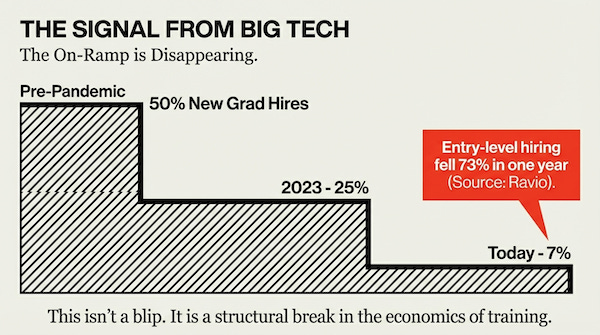
It’s beginning to look like this is not a blip on the radar. Companies are reducing the entry-level pipeline because the economics of training new people are changing. People keep excusing this as overhiring post COVID. I think this is a sign of the things to come.
Why this matters to faith leaders
Because the dynamic isn’t “tech jobs are changing.” The dynamic is that AI is collapsing the value of certain kinds of junior work. Work that used to be a person’s first step into competence is being absorbed by tools.
In tech, that junior work looked like scaffolding: boilerplate, first drafts, quality assurance, and basic implementation.
In faith based organizations, the equivalent shows up everywhere:
• admin work like first-draft communications
• basic graphic and slide creation
• summarizing reports and meeting notes
• translation and localization drafts
• donor research and first-pass briefings
• policy drafts and handbook updates
• data cleaning, reconciliation, simple analytics
• training materials and curriculum drafts
• intake triage and FAQ support
While much of this work won’t disappear entirely, the amount of human time required to do it is dropping fast. If it isn’t dropping, we should be asking why it’s not. Eventually, people will be asking, “Why are we staffed the way we were in 2019?”
That logic may sound cold, but it’s the logic we’ll soon face.
Managers in the private sector are already saying the quiet part out loud:
37% say they’d rather use AI than hire a new grad
89% say they actively avoid hiring recent graduates
• Reasons include lack of real-world experience (60%), poor teamwork (55%), and high training costs (53%)
Translate that into nonprofit reality and it sounds like:
“We can’t afford ramp time.”
“We don’t have a training bench.”
“We need people who can produce immediately.”
“We can’t carry roles that exist mainly to become something later.”
In other words: margin pressure (or in our world, funding pressure) will eliminate roles that don’t have clear near-term output.
The deeper shift that’s happening:
One strong performer + AI replaces a small team
Here’s what actually changed. AI tools collapsed the productivity gap.
A single experienced worker, augmented by AI, can now produce what used to require multiple junior (or senior) contributors doing first drafts, compilation, formatting, and coordination overhead.
This makes experienced judgment and organizational trust far more valuable than ever before. It makes organizations ask, “Do we need more people or do we need fewer people with higher leverage?” What’s the right mix? At what levels do we pull the people, process, and technology levers?
The ethical layer we can’t ignore
Faith leaders are not just about optimizing spreadsheets. We are accountable for how we treat people made in God’s image. We are also called to be excellent stewards of the resources with which we have been entrusted.
So we have to hold two truths at once:
Stewardship is real. We can’t pretend budgets are infinite or inefficiency is holy.
Ministry is real. We can’t outsource formation, training, and vocational development of missionaries to “the market” and then complain about the outcome.
BUT not everything we do is related to soul care. If technology can help with the other things, it actually frees up Christians to do more things that only humans can do.
What faith leaders should do next
Redesign roles around judgment + relationships + accountability
AI can draft, but it can’t bear responsibility. Roles should increasingly center on: decision-making, trust, pastoral intelligence, partnership management, contextual understanding, and ethical oversight.
Build new leaders purposefully
If “entry roles” become economically unviable or unnecessary with the use of AI, we must create apprenticeship tracks with clear outputs and mentorship baked in. This isn’t optional. We can’t just stop developing people or we will not have a leadership pipeline.
Require “proof of work,” not just “proof of credential”
Degrees are still very important in many contexts, but they’ve never been, nor will they be, an indicator for readiness. Demonstrated competence is a must for many roles.
Continue to encourage an AI usage standard that leverages technology and process before adding headcount
Faith based organizations should ruthlessly evaluate new headcount and periodically look at the distribution of headcount. It could be that some departments are overstaffed and others woefully understaffed. As AI continues to provide value, investment must be made in the AI deployment and onboarding of “AI agents” as well as employees.
Get ahead of the anxiety with honesty and hope
If people sense leaders are minimizing the change, trust erodes. Name reality plainly. Do not hide from the fact that some work will change, some roles will shrink, but we will continue to invest in equipping people, not just checking boxes.
The bottom line
Big Tech didn’t just change hiring. It’s revealing a new economic reality. The training pipeline that created “entry roles” is breaking because AI is absorbing a huge amount of entry-level output.
Faith based organizations will feel this, too. This will occur through funding expectations, staffing models, and the rising bar for “ready on day one.”
We can respond fearfully, or we can respond intentionally. Intentionality means redesigning roles, rebuilding (or creating) apprenticeships, setting clear ethical guardrails, and forming people for high-judgment work in a high-automation world.
AI is coming for many jobs.
The question for faith leaders is whether we’ll lead with denial or with courage and formation.