


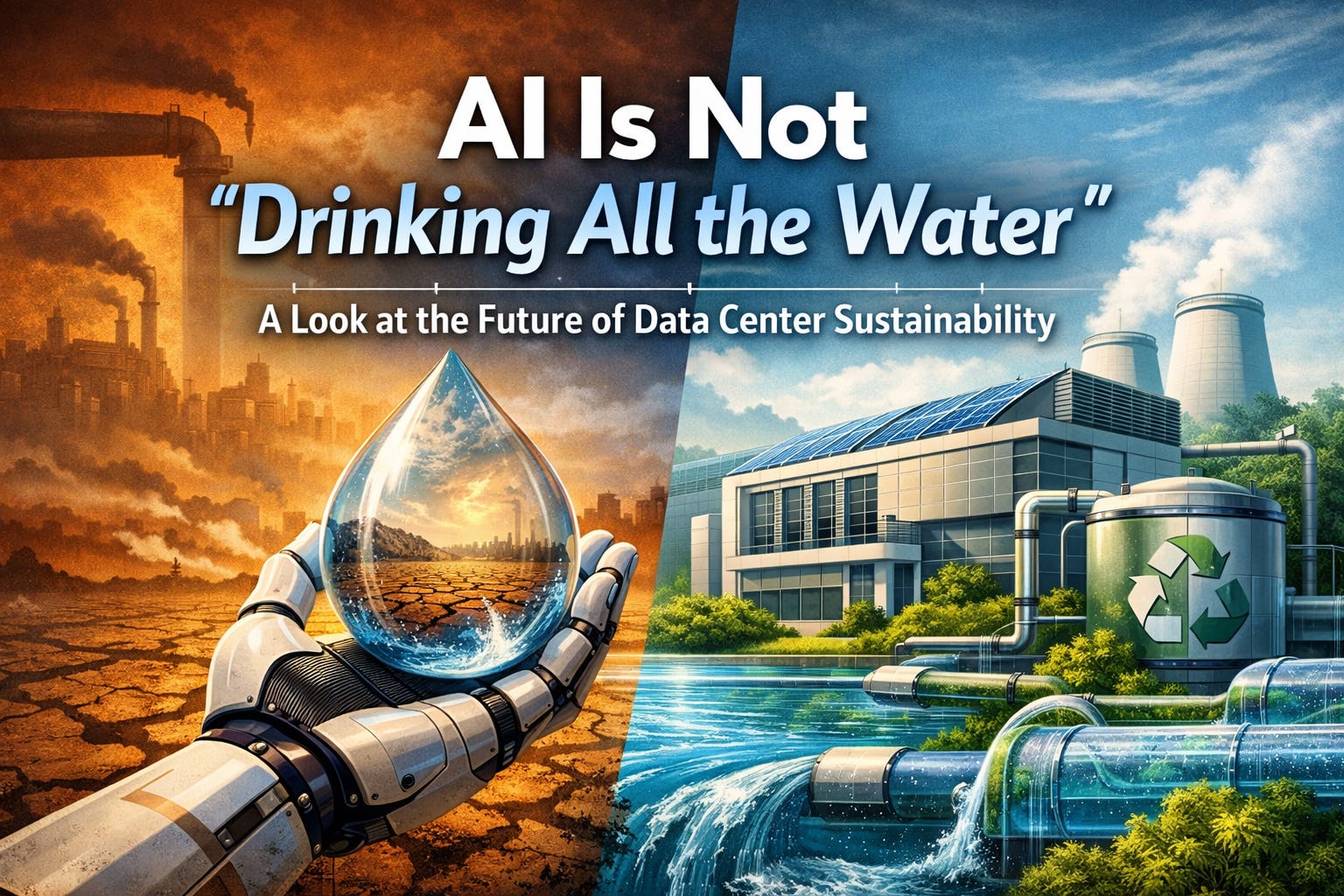
I spend a lot of time speaking at events about the future and the intersection of AI, Innovation, and Faith. The audiences vary. Church leaders, educators, nonprofit leaders, technologists, and students. The questions about AI I receive are increasingly the same.
I want to deal with one of those questions in this post. One concern comes up again and again. AI and water.
Sometimes it is framed as a sincere question. More often, it comes across as a confident statement. Sometimes it’s sort of a gotcha question from someone who is already sort of anti-AI. It usually goes something like this, “AI is consuming vast amounts of water.” or “AI is environmentally reckless.” Sometimes people say that even simple interactions like saying please and thank you to an AI system are framed as having devastating environmental consequences.
I want to be clear from the start. There are legitimate environmental concerns related to AI. Energy demand matters. Power generation matters. Infrastructure siting matters. These are real issues that deserve serious discussion.
What concerns me is how often those legitimate issues get wrapped in narratives that are not grounded in how modern systems actually work. Complex infrastructure gets reduced to viral talking points and tweets. Big numbers are repeated without explanation. Fear travels much faster than context.
At times, what I encounter feels less like education and more like propaganda.
Water is the clearest example.
The mistake we keep making
Most headlines about AI and water rely on two shortcuts.
First, they cite gross water throughput rather than net water loss.
Second, they assume older cooling models rather than the systems now being built.
This distinction matters. Saying that water moves through a system is not the same as saying it is consumed. We make this distinction everywhere else, but often ignore it when AI enters the conversation.
Think about your car. Coolant circulates through the engine every time you drive. Heat is transferred. The same fluid is reused over and over. We do not say your car is “using water constantly,” even though liquid cooling is essential to its operation. If you had to refill your radiator every day, you would know something was wrong.
More and more, many modern AI data centers are being built on the same principle.
Closed-loop cooling systems circulate water continuously. Heat is transferred through heat exchangers. Losses are minimal and typically limited to evaporation or maintenance. In some cases, water is recycled on site or reclaimed from municipal wastewater systems rather than drawn from potable supplies.
This is a fundamentally different model from the one many people still have in mind and certainly not what you hear in anti-AI talking points.
A look at where things are actually headed
One of the most visible examples of this shift is the AI infrastructure being built in Memphis by xAI.
Early reporting focused on large numbers. Millions of gallons per day circulated widely, often without explanation. That framing triggered understandable concern, but it also missed the most important part of the story.
The Memphis project includes plans for industrial-scale wastewater recycling designed to support cooling without relying primarily on fresh potable water. Instead of pulling water from local aquifers and discarding it after use, the system is designed to treat and reuse municipal wastewater repeatedly.
In other words, the water moves through the system, but it does not simply disappear from it.
This approach is not accidental. It reflects the direction large-scale AI infrastructure is moving as costs rise, regulations tighten, and communities demand better stewardship. Water is not cheap. Poor design does not scale. At this level of investment, efficiency is not optional. In other words, even if companies are not motivated by environmental concerns, economic factors will push them to make scalable choices.
That does not mean there are no risks. It does mean the simplified story many people are repeating no longer reflects how modern facilities are being designed.
Why raw comparisons mislead us
When someone says “a data center uses millions of gallons of water,” it sounds alarming until you ask a follow-up question. How much of that water is actually consumed?
We rarely ask that question elsewhere.
Laundromats use thousands of gallons of water every day. Once used, that water is gone into wastewater treatment plants. Fast food restaurants use thousands more. Elementary schools with a few hundred students can easily move tens of thousands of gallons daily. Hospitals can consume hundreds of thousands of gallons every single day for sanitation, sterilization, laundry, and cooling. Again, once this is used, this water is consumed and not part of a closed loop system.
We don’t object to these uses because we understand their purpose and because we recognize that infrastructure always involves tradeoffs.
The mistake is treating AI as if it exists outside that same framework, as if it must justify itself in a way no other system is asked to.
Modern AI data centers often circulate large volumes of water while consuming far less than the raw numbers suggest. When water is reclaimed, reused, or kept in closed loops, the impact on freshwater supplies is very different from what the headlines imply.
The future looks less like waste and more like reuse
The trajectory is clear.
Closed-loop liquid cooling, non-potable water sources, onsite wastewater treatment, and heat reuse are all part of the discussion for future AI data center deployments.
These aren’t public relations talking points. I’m not getting an AI kickback. These are points that I learned when I set out to research the actual consumption of water in data centers. If I were to talk about something concerning, that would be electrical consumption… but that’s another topic. Even for that, there are solutions.
In many cases, AI infrastructure is becoming one of the few places where advanced water stewardship is economically viable at scale. Most cities will never build wastewater reclamation systems this sophisticated. Large AI facilities already are because of economics.
That does not make AI immune from criticism. It does mean the caricature of AI as an environmental villain, uniquely irresponsible compared to every other system we tolerate, does not hold up.
A more honest way to talk about water and AI
It is fair to ask hard questions about where facilities are built and how communities are affected. Transparency matters. Accountability matters. Poor implementations should be challenged.
But the water argument, as it is usually presented, is not about stewardship. It is about fear driven by incomplete information that fits a narrative.
If we applied the same logic consistently, we would have to shut down hospitals, schools, and agriculture long before we ever touched AI. We also would stop using washing machines, dish washers, and clothes dryers. We don’t do that because we understand tradeoffs and because we value outcomes.
The real question is not whether AI uses resources. Everything that matters does.
The real question is whether we are willing to evaluate new systems honestly, based on where they are going rather than where the worst examples have been. AI infrastructure is evolving quickly, and in many cases, toward less consumption and more reuse than the systems we already accept without complaint.
If we want a serious conversation about water, let’s have one that is comparative, forward-looking, and grounded in how these systems actually work.
Anything else is just noise.
A closing reflection on faith and stewardship
As people of faith, we should care deeply about stewardship of God’s creation. Truth and integrity in how we speak about the world matters.
But stewardship is not fueled by fear. It is guided by wisdom. Scripture consistently calls us to discernment, to honest weights and measures, and to refusing false testimony even when it supports a cause we care about.
Threse principles apply here.
If we are going to critique AI, we should do so truthfully. If we are going to raise environmental concerns, we should ground them in how systems actually function, not how we assume they do or how a headline frames them. Exaggeration does not honor creation. It distorts it.
Faith should make us slower to panic and quicker to seek understanding. It should make us careful with our words and rigorous with our facts. And it should push us toward conversations that are thoughtful, comparative, and rooted in reality rather than outrage.
AI, like every powerful tool, deserves scrutiny. It also deserves honesty. Where there is concern, we should voice those concerns, but we should do all we can to fully understand before we give into fear. The big AI companies have much to account for and it’s good to hold them accountable, but we must do so based upon facts and research. If they abuse their environmental footprint, we should call them out on this. The US has largely left the industry unregulated while much of the world is putting it under much more scrutiny. We should encourage scrutiny based upon verifiable research.
This is a good reminder that stewardship is not rejecting innovation out of fear. Stewardship is telling the truth about the world the God of the Bible entrusted to us, even when that truth is more complex than a viral talking point.
Regarding the topic of the article, you've hit on a really crucial point about the narrative around AI's environmental impact. How do we, as educators and informed individuals, best combat these viral talking points and bridge the gap between complex infrastructure and public understanding? Your insight into 'fear travels faster then context' is spot on.
I was recently posed this same question and TBH hadn't researched environmental impacts. On the spot, I took it an entirely different direction:
When assessing environmental impact, we have to ask ourselves what the alternative is. It's not just "AI vs nothing." If AI is a more efficient way to achieve a goal, then its environmental impact should be weighed against the alternative way of achieving that goal. If AI makes me 50% more efficient at writing an article, then I write it for less time and my computer consumes less energy in doing so.
Or, if the alternative to generating an image with AI is hiring a photographer and models and traveling to a remote location for a photo shoot, isn't this AI use case actually saving quite a bit of energy? This reasoning of course is case-by-case, but the point remains: people can't just point to the downside w/o considering the alternative. And when they do, they may find their argument nullified or even goes the opposite direction.
I would therefore posit that the use of AI, if used wisely, can actually *decrease* overall energy consumption for the same output. Or, if we so choose, increase overall output with that additional time.