


The irreducible human and divine elements of gospel work that no model will ever replicate.
AI cannot pray.
I know that sounds obvious. Prayer assumes things AI simply does not have. It assumes a self, a particular person, with a history, a body, a record of failure and grace, who is bringing something real to the conversation. Prayer isn’t a user session. It’s not a prompt. It’s being brought by a person.
Prayer assumes a relationship. Not a connection to a database, but an actual standing before the God of the Bible. This is through the sacrifice of Jesus and maintained by the Holy Spirit, personal in a way that cannot be replicated by any system however sophisticated.
Prayer assumes need. Genuine dependence on a God who is other, who is greater, who can do what we cannot, and before whom we are genuinely small.
AI has none of these things. When AI generates a prayer (and it may create the words quite well, syntactically speaking) it is producing the form of prayer without the substance. Beautiful words pointed at nothing.

The Incarnational Logic
The God of the universe became a human being, in a body, in a place, at a moment in history. This isn’t a projection, avatar, or broadcast. The Word became flesh.
The incarnation is the ultimate anti-efficiency move. God could have sent information. He sent himself. He could have transmitted truth. He chose to embody it.
That logic doesn’t disappear when Jesus ascends. Instead, it gets handed to the church. “As the Father has sent me, I am sending you” (John 20:21). The church is the ongoing incarnational presence of Christ in the world, embodied, particular, local, and relational. You are sent the way the Son was sent. With a body and name into a specific place, to specific people, at a specific time.
AI is not embodied. It has no locality. It cannot be sent the way the Father sent the Son. It can carry information across distances that would have taken a generation to cover. It cannot carry presence. This is not a temporary limitation waiting for better hardware or faster processors. It’s a theological category to which AI is unable to belong.

What Only Humans Can Do
Intercession
When a missionary sits with a person, learns their name, watches their children grow, and carries their faces into prayer every morning for years, that is a form of intercession no AI-generated prayer will ever touch. The prayer is grounded in presence. It is specific in the way that only proximity makes possible. It costs something. That cost is part of what makes it real.
This can’t be outsourced to AI. There is no model to replicate that. There never can be. Not to anything that doesn’t know the family’s name and feel the weight of their reality.
Suffering alongside
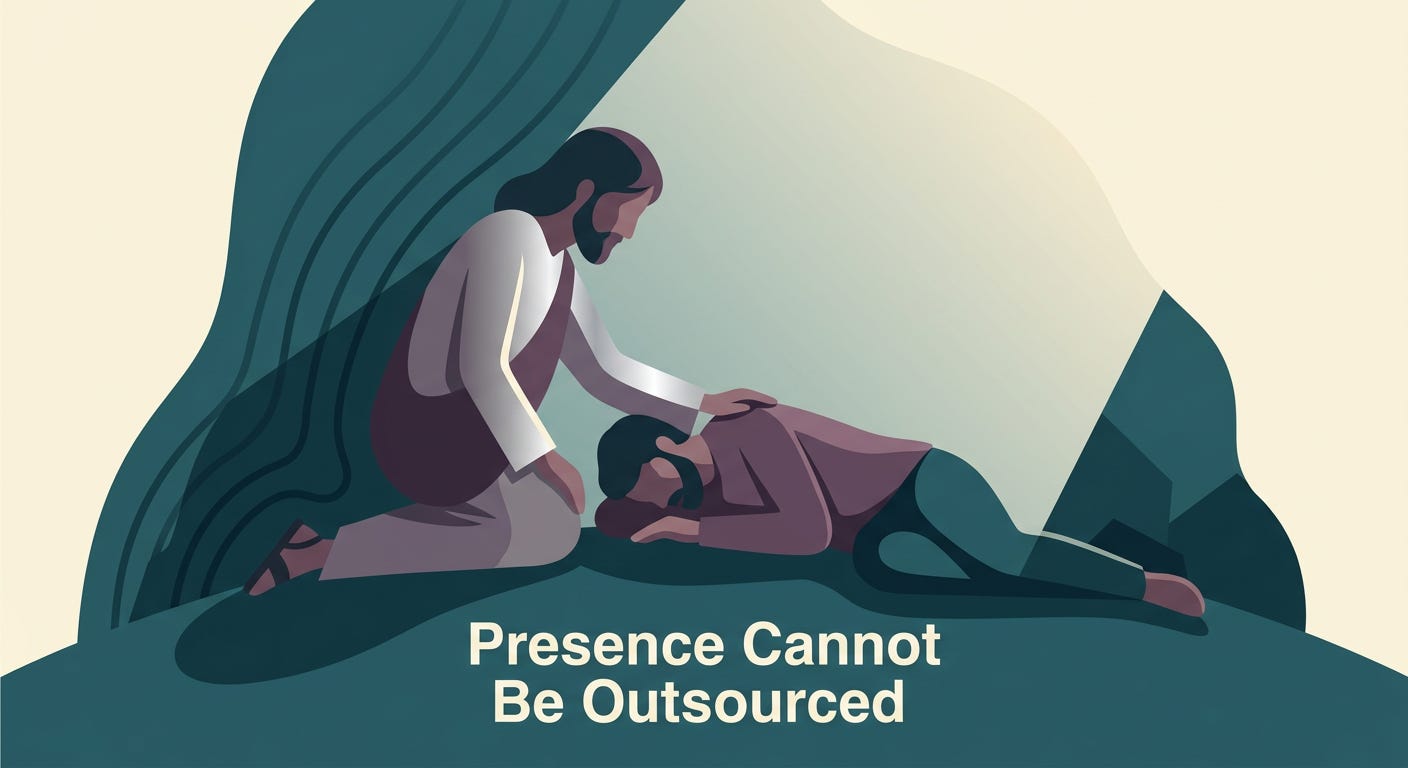
Paul writes about filling up “what is lacking in Christ’s afflictions” (Colossians 1:24), a mysterious phrase that points toward something real. There is a ministry that happens only in and through suffering. The missionary who stays when it gets dangerous. The pastor who sits with the dying at 2am. Counselors who bear the weight of someone else’s trauma until it costs them something too.
That kind of presence cannot be relegated to an algorithm. Not because we haven’t built the right tool yet, but because the ministry is inseparable from the cost. Remove the cost, and you’ve removed the thing.
AI does not suffer. It cannot enter suffering with someone, because entering requires a self that can be affected. A self that has something to lose. AI is not a self and can never be a self.
Testimony.
This is the one that doesn’t get said enough. The gospel is most credible in the mouth of someone who needs it as badly as the person hearing it. AI doesn’t have a testimony. It has never been lost. It has no experience of grace, no moment when the weight lifted, and no before-and-after. It cannot say “I was there, and then I wasn’t, and here is what changed.” That witness, personal, embodied, costly, is irreducible. It is the oldest apologetic in the church and the one no model will ever be able to replicate.
The Spirit’s Work
The Spirit of the God of the Bible is the primary agent of gospel work. “Not by might, nor by power, but by my Spirit, says the LORD of hosts” (Zechariah 4:6). The conversion of a soul, the transformation of a community, the opening of a heart that was closed are all works of God. Not outputs of artificial effort.
This should be simultaneously humbling and liberating for every ministry leader thinking about AI.
Humbling, because no tool produces spiritual fruit. That is God’s work. Our tools, at their best, are instruments in hands that belong to Him. The harvest has never been ours to manufacture.
Liberating, because it takes the pressure off the optimization question entirely. We are not responsible for outcomes only God can produce. We are responsible for faithfulness, presence, prayer, and proclamation. AI can help with some of the logistics surrounding that work.
The harvest belongs to the Lord of the harvest. He just keeps asking us to go into it.
AI can’t pray, only you can pray. AI can’t suffer, only you can suffer. AI can’t testify to, only you can testify to. AI can’t receive from the Spirit of the God of the Bible, only you can receive.
Go do the thing the machine can’t do. That’s what you’re for. Let machines do what machines can do in order to free you to do the thing that only souls can do.
Next: A Framework for Ministry Leaders — a practical, theologically grounded guide for how to hold AI well.