


This week, I was on a LONG flight and began wondering, what am I going to build today? Since December, I intentionally use flights as a time to build solutions to problems. Over Christmas, I went down the Claude Code rabbit hole. Since then, I have looked for scalable tools using AI to build AI (another post on my setup soon).
Once we reached 10,000 feet, I began to build I decided to build a tool to draft Bible studies and devotions based upon sermons. You either drop in the text of the sermon or a link to a YouTube video. Humans in the loop are essential to this process, but most people struggle getting started. This tool will help you get started and allow you to build off the AI draft. This is going to be a real time saver.
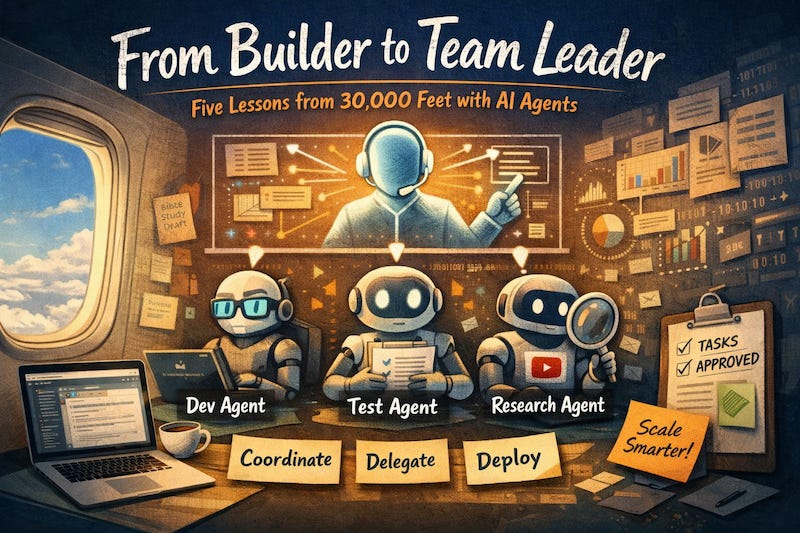
As I set up my environment, AI deployed a team of agents to help me create the tool I wanted to build. They all worked together to build what I wanted. Each agent took a part of the build and worked with each other to deliver. Within no time, the model spun up a team lead, assigned three sub‑agents, and started churning out pull‑requests while I settled into seat 32J.
I defined the problem, I set out the framework, and the agents began to work. This was a difference from seeing the AI as an assistant, to the new reality of one of those AI agents becoming a manger of assistants. This was a big shift. Now, we are seeing the AI manager lead and orchestrate the work of other agents. The shift wasn’t just technical, it was cultural. If you can offload coordination, planning, and even some quality‑control to an “AI‑driven” team, the bottlenecks that have kept people from scaling start to melt away. Here are 5 takeways that made the difference for me, and that could change the way you approach any multi‑step project. Note - this isn’t just for coding! It can help with any project!
Five Key Takeaways From Claude’s Agent‑Team Feature
A Team Lead Emerges From Plain English
You no longer need to write YAML files or spin up Docker containers. A single natural‑language command creates a *team lead* agent that owns the workflow. It parses your request, decides how many sub‑agents are needed, and then delegates tasks. Think of it as an invisible project manager who never sleeps, never gets sick, and never asks for a raise.
Sub‑Agents Operate Asynchronously in Their Own Contexts
Each “teammate” gets its own sandboxed environment and a dedicated token window. They can read, write, and even browse the web without stepping on each other’s toes. The result? This actually feels like having developers, a tester, and a designer all working side‑by‑side.
Built‑In Communication Keeps Everyone on Task
The framework includes a lightweight “mail system” that lets the team lead ping sub‑agents for status updates or extra data. You can also intervene manually if a plan looks off. Forgive me if my terminology is off, but I think you get the picture. An agent is supervising other agents.
Automatic Shutdown Prevents Orphaned Processes
Opus 4.6’s team lead automatically shuts down its teammates once the job is done, and it even offers a clean‑up command you can fire manually. My experience with this was a cost savings.
You Can Mix and Match Model Variants Per Agent
The system lets you specify which underlying model each sub‑agent should use. You don’t need to throw the most expensive models for many of your tasks. You can pick the best model for the best use case. This will significantly help you reduce costs.
Here’s the deal… while I’m more techie than the average user, I’m far from what I would call a coder. Historically. what have I brought to the table? I know context, use cases, and the needs of end users. Traditionally, I have “translated” between end-users and programmers. These new AI tools allow people like me actually become builders. I’m blown away at how fast I can prototype working solutions. Once prototyped, I can get tools to other people (humans) on our innovation team who look at security and approve my design.
Let’s build!!!
Tomorrow, pick a low‑stakes task that usually takes forever. Maybe cleaning up a README, gathering recent blog mentions, or something else. Write a single prompt like, *“Create a team of two agents: one to summarize the latest three blog posts about xyz, and another to draft a one‑page report with key metrics.”
Let the AI handle the delegation, execution, and cleanup. Observe the time saved, note any issues, and iterate. Be prepared to iterate! Within a few experiments you’ll have a reusable pattern for turning any multi‑step job into an “AI‑managed sprint.” This should free you up to focus on the human tasks.
I’ve been down the Claude Code rabbit hole recently as well. Claude has blown me away!
Wow. Just wow.