


Continuing in my What is Blockchain? series, today, let’s look at the history of Blockchain. Before we get into how blockchain works in practice, it helps to understand where it came from. Blockchain didn’t appear out of nowhere—and it definitely didn’t start with NFTs or crypto hype. As with other posts in this series, this is a general overview with links to videos and articles—if you want to go down the rabbit hole of blockchain, you will have plenty of options to learn!
Blockchain is a story that begins with broken trust, a mysterious figure/group, and a radical idea about how the internet could work differently. — I LOVE IT! Talk about disruptive technology!!!
The Problem: Trust Doesn’t Scale
Let’s head back to the early days of the internet. It was built to share information—not value. You could send an email or upload a blog post.
I still remember the first email I ever sent—it was on a BBS and it took a few days to get to my friend. After that, I remember the first corporate email that I sent out of my organization. I sent an email from the House of Representatives email account (I was a Congressional Aide) to my friend who worked at a Charter Communications.
Sending email? Doing research? Sharing files? That’s what the internet was for me. Sending money? Are you kidding me? Banks couldn’t even operate across state lines back then—my how times have changed.
Owning something digital? Not without a third party like a bank, credit card processor, or platform in the middle. That model with all of those middle men works very well... until it doesn’t.
Fees.
Delays.
Fraud.
Centralized control.
Privacy issues.
Data leaks.
And don’t get me started with why are stores still paying 3-4% for credit card transactions? (Be cause the credit card companies get away with charging it)
By the late 2000s, people were starting to ask a new question:
Is it possible that we can create trust without all of these middlemen?
2008: Enter Satoshi Nakamoto
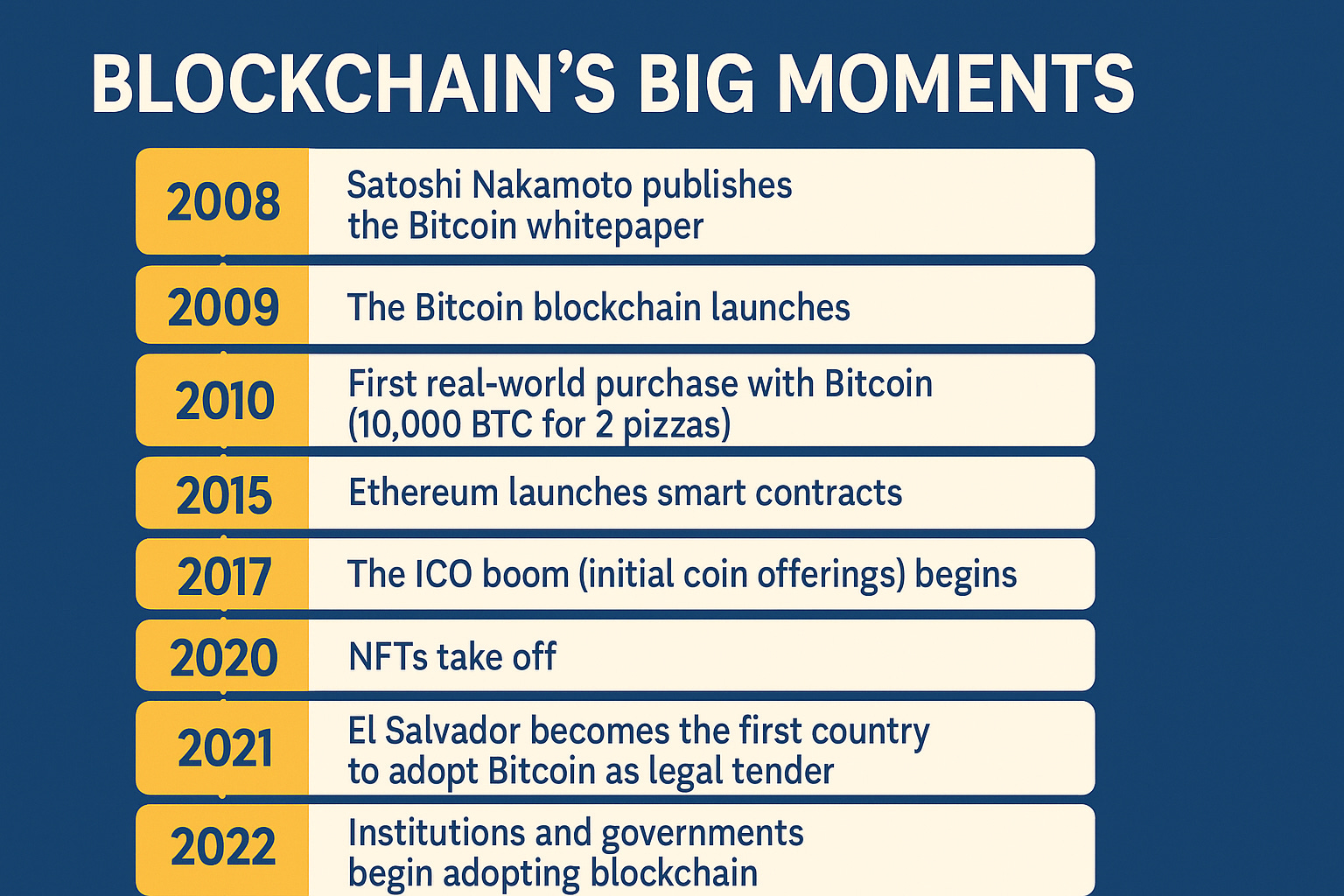
In October 2008, an anonymous figure (or group—who knows???) going by the name Satoshi Nakamoto released a whitepaper titled:
“Bitcoin: A Peer-to-Peer Electronic Cash System.” (rabbit hole warning—click that link only if you want to not come up for air for some time)
It described a new kind of money that didn’t need a central bank or government to verify transactions. The system relied on a network of people, working together through code and consensus, to keep a secure public ledger of transactions. Who is Satoshi Nakamoto? I have no idea, but this person/group has made a tremendous impact on how the internet works—He/they took an idea that was first published by researchers in 1991 and they made it a reality.
That public ledger? That’s the blockchain.
2009: The Genesis Block
On January 3, 2009, Satoshi launched the first-ever blockchain by “mining” the Genesis Block—the first block of the Bitcoin network.
Inside the code, they embedded a cryptic message:
“The Times 03/Jan/2009 Chancellor on brink of second bailout for banks.”
It was more than a timestamp—it was a statement. This wasn’t just about money. It was about creating an alternative to broken systems.
Satoshi stayed involved in the project for a couple of years, then disappeared entirely. To this day, no one knows who they are.
2015: Ethereum Brings Smart Contracts
While Bitcoin proved that blockchain could support decentralized money, developers soon asked: What else could it do?
The answer came in 2015 with the launch of Ethereum, a platform that introduced smart contracts—self-executing programs that live on the blockchain. Of all of the things the blockchain offers, this is truly the one that is the most interesting to me.
Instead of just recording transactions, Ethereum let people build apps directly on the blockchain. What could it do??? This makes it possible to create:
Lending platforms
NFT marketplaces
Community-run projects
Games with real-world value
This was the birth of Web3—a new internet where apps are owned and operated by users, not companies. This video provides a very simple explaination of Web3 in five minutes!
Quick Timeline: Blockchain’s Big Moments
Why Blockchain History Matters
What is fascinating about the history of blockchain is where it did NOT start. Blockchain didn’t start in a Silicon Valley boardroom—it started in response to a financial meltdown. It was built upon an idea of trust outside of the existing institutions. It is decentralized and It was an idea of ownership without the established middlemen.
Even though the tech is still evolving—and yes, there’s a lot of noise—this history tells us something important:
Blockchain isn’t just about digital money. It’s about building new kinds of systems.
Systems where:
No one can cook the books
Ownership is provable and portable
Value moves without borders or banks
Decentralization is king
Where is this going? I have no idea… but we will examine some possibilities in the other posts.
Coming Up Next: So… How Does It Work?
In the next post, I’ll break down how blockchain actually works—from blocks and chains to mining and consensus. No confusing terms (well, if I use confusing terms, I will explain them). I’m hoping that you learn while I learn. I have found that by explaining what I am learning, I am forced to actually learn more!